
News
‘Vulgar and Excessive’: The Real Reason Trump’s Building Monuments to Himself — Columnist
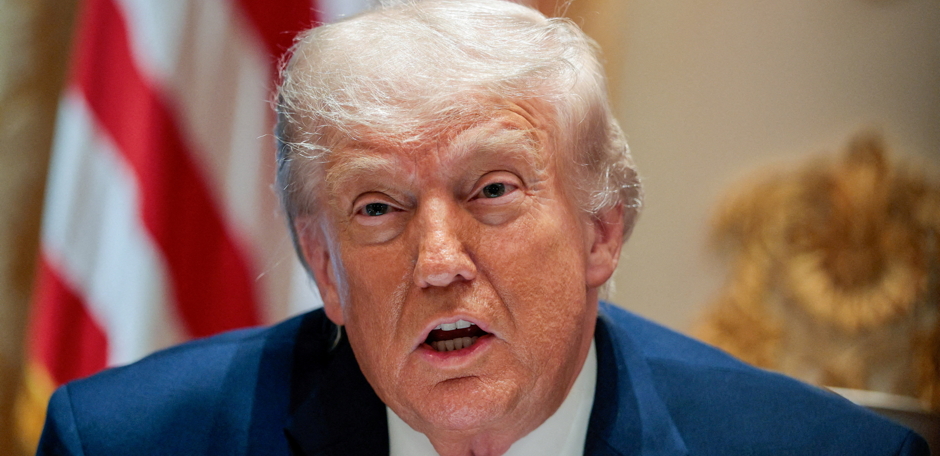
President Donald Trump’s mission to build monuments to himself is growing, and there’s a real reason behind why the nation’s 47th president is defying tradition and putting his name on so many things while he’s still in office — and still alive.
“Donald Trump’s two favorite things are himself and money,” writes Windsor Mann at The Daily Beast. “Now he has decided to combine the two. Indeed, for the first time in history, the sitting president is adding his signature to our paper currency. Trump’s name will be on your money, which is his way of saying that he owns you.”
Mann notes that the “John F. Kennedy Center for the Performing Arts is now, albeit unofficially, the Donald J. Trump and the John F. Kennedy Memorial Center for the Performing Arts.”
The U.S. Institute of Peace is now the Donald J. Trump Institute of Peace, and, “Trump reportedly floated the idea of renaming Penn Station after himself during negotiations over federal funds for a tunnel between New York and New Jersey.”
The president is not the only one naming things after himself.
READ MORE: Even MAGA Is Confused by Trump’s Birthday UFC Cage Match Project: Report
In 2024, House Republicans pushed legislation to rename Washington Dulles International Airport the “Donald J. Trump International Airport.”
“And last November,” Mann notes, “Florida State Rep. Meg Weinberger introduced a bill to rename the Palm Beach International Airport as another ‘Donald J. Trump International Airport.’ Sure, why not?”
Spending $300,000 on a two-story tall statue of Trump, a group of crypto investors installed it on Trump’s Doral, Florida golf course.
“It is, like the man it commemorates, vulgar and excessive,” says Mann. “But one thing it is not is unnecessary, at least not from the vantage point of these investors. The way to Trump’s heart is through his ego, and nothing satiates his ego as much as a graven image made in his image and at someone else’s expense.”
Pointing to the Washington Monument, the Lincoln Memorial, and the Jefferson Memorial — all built years after their namesakes’ passing — Mann notes that “we memorialize presidents once public opinion and historians have had time to reach a consensus as to whether their contributions merit commemoration.”
Which, perhaps, is why Trump is rushing to do so now.
“After all, what if we built a statue of someone who turned out to be in the Epstein files or who, after losing an election, tried to overthrow our democracy?” Mann asks. “It would be costly and tedious to dismantle a statue of such a person after these revelations surfaced. Perhaps Trump realizes this, which is why he’s building not one monument to himself but scores of them.”
READ MORE: White House Mocks CNN Anchors’ Health After Trump’s Third Checkup in 13 Months
Image via Reuters
Enjoy this piece?
… then let us make a small request. The New Civil Rights Movement depends on readers like you to meet our ongoing expenses and continue producing quality progressive journalism. Three Silicon Valley giants consume 70 percent of all online advertising dollars, so we need your help to continue doing what we do.
NCRM is independent. You won’t find mainstream media bias here. From unflinching coverage of religious extremism, to spotlighting efforts to roll back our rights, NCRM continues to speak truth to power. America needs independent voices like NCRM to be sure no one is forgotten.
Every reader contribution, whatever the amount, makes a tremendous difference. Help ensure NCRM remains independent long into the future. Support progressive journalism with a one-time contribution to NCRM, or click here to become a subscriber. Thank you. Click here to donate by check.
 |


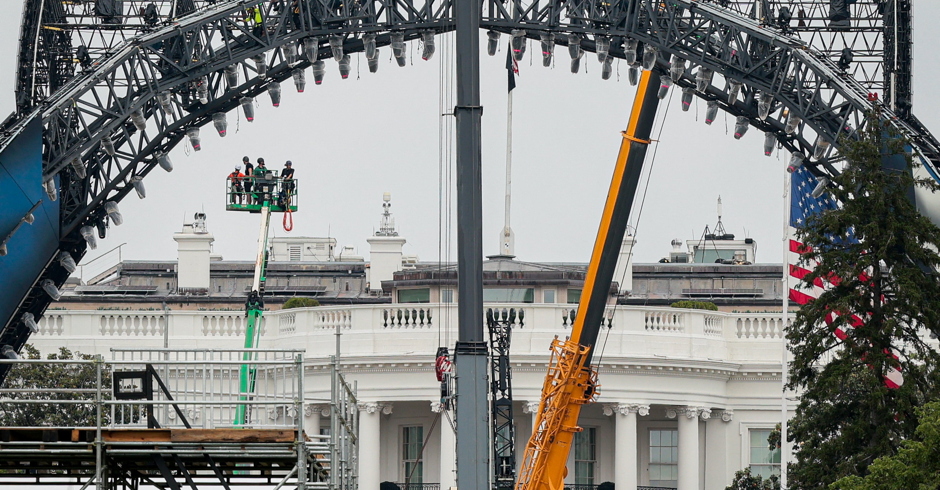
President Donald Trump’s birthday UFC cage match project is causing confusion.
“The ‘UFC Freedom 250’ fight, which just so happens to be scheduled for Trump’s 80th birthday, is a part of the MAGA-ified America 250 celebrations,” The Daily Beast reports. “The makeshift venue is expected to be able to hold 4,500 guests, far lower than Trump’s wish for it to hold 20,000 spectators.”
“I think it’s gonna be the biggest event we’ve ever had at the White House,” Trump said earlier this month. “I have never seen anybody want anything so much as people want those tickets.”
Event-related activities will take place around Washington, D.C.
“Weigh-ins for the fight will take place at the Lincoln Memorial,” The Daily Beast noted. “Trump has also said that the White House Ellipse grounds will be made available to host a ‘UFC Freedom 250 Fan Fest,’ where as many as 100,000 people could watch the fights on TV screens.”
UFC CEO Dana White acknowledged that the Fight Night event could harm the president, The Daily Beast also reported.
“I bet he probably wishes that this wasn’t happening, but it’s happening,” White told Rolling Stone on Tuesday.
But when Trump White House Deputy Chief of Staff Dan Scavino posted video of the construction of a temporary cage-match arena on the South Lawn of the White House, supporters appeared confused.
“Happening now, from the West Wing Colonnade—Looking out toward the South Lawn of The White House,” Scavino wrote, adding a #UFC hashtag.
“What is it?” one commenter asked.
“Thought it was a rollercoaster!” said another.
“Gosh, it looks like a big circle with seats on it. You could just plot people on the seats. Take them to the top and who knows if they’ll be hanging out up there 😂or what😂😂 wouldn’t this be a great idea if this were actually the military tribunal’s in front of the whole world,” another wrote.
“Hangings,” wrote yet another.
Others suggested it might be a circus, a portal, or a piece from a time-traveling device. Some mentioned the movies “Stargate” and “Contact.”
View this post on Instagram
Image via Reuters
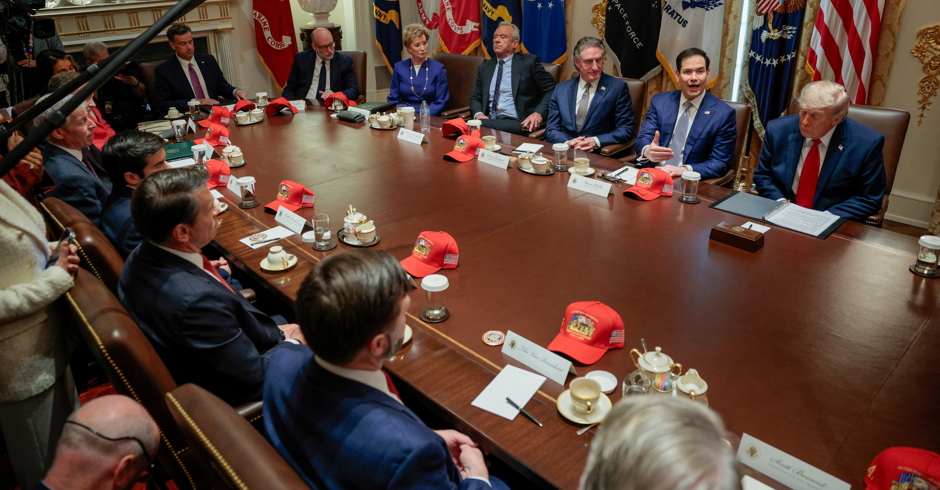
In some ways, President Donald Trump’s Wednesday Cabinet meeting was typical — officials took turns praising the president.
The New York Times reported that it had “reviewed over a dozen hours of cabinet meeting footage to analyze how his administration spoke to him. On average, at least one of every six sentences either flattered Mr. Trump, gave him credit or criticized his political opponents.”
But Wednesday’s meeting had one important difference: Trump promoted a new Trump hat that retails for $55 on the Trump Store. The hats were “displayed prominently in front of senior officials around the table as cameras rolled,” according to The Daily Beast.
“President Donald Trump has turned his latest Cabinet meeting into a merchandising opportunity to line his pockets,” The Daily Beast reported, noting that “new ‘USA 250 Anniversary’ hats were displayed prominently in front of senior officials around the table as cameras rolled.”
New York Post White House correspondent Emily Goodin on social media noted that there was “new merch” at the meeting. “Each cabinet member has one of these hats and a challenge coin.”
Fox Business White House correspondent Edward Lawrence reported that Trump had signed some of the hats.
CNN’s DJ Judd added that the “new USA 250 hat is for sale on the Trump org website and can be yours for $55 plus shipping.”
President Trump’s online store has added more than 600 new products since he returned to office in January 2025.
Government ethics watchdogs “who have long accused the president of leveraging public office for private gain,” are likely to criticize this latest effort to monetize his presidency, The Daily Beast added.
Pointing to the 622 new products being sold on the Trump Store, the “official retail website of The Trump Organization,” CREW, Citizens for Responsibility and Ethics in Washington, called it “an unprecedented level of monetization of the presidency, even by the standards of Trump’s own first term.”
Close-up of the red America 250 hats in the Trump Cabinet meeting …. pic.twitter.com/OBE0gDKF70
— Howard Mortman (@HowardMortman) May 27, 2026
Image via Reuters

President Donald Trump is going on offense against America’s partners in NATO.
The Commander in Chief, “stung by allies who haven’t been keen to fight another war in the Middle East,” as The Daily Beast reports, is pulling military assets vital to Europe’s protection — and vital to U.S. interests — out of Europe. Among them, a significant number of bombers, warships, fighter jets, refueling aircraft, submarines, destroyers, and roughly 5,000 troops.
The Daily Beast calls the moves “Snubbed Trump’s Petty Revenge Plot.”
While it would take an act of Congress to withdraw from NATO itself, withdrawing military assets is entirely up to the discretion of the Commander in Chief and the Secretary of Defense.
The president has become “incensed by European allies’ refusal to back his war in Iran, Der Spiegel reported,” The Daily Beast noted.
Trump, a strong critic of NATO for years, has, along with Secretary of State Marco Rubio, become “increasingly critical” of NATO, its refusal to assist U.S. efforts in the Iran war, and what he sees as NATO member countries’ refusal to spend sufficiently on their militaries and defense.
“Key members such as Spain and Italy incensed the president, 79, by closing their airspace and air bases to U.S. military aircraft taking part in the bombardment of Iran,” The Daily Beast noted. “That followed tension created by Trump’s repeated musings about seizing control of Greenland, which belongs to NATO member Denmark.”
Secretary Rubio told Fox News that the “problem with NATO, unfortunately—and I’ve been a supporter of NATO throughout my career in the Senate—and one of the reasons I supported NATO is it gave us basing rights.”
He explained that those rights gave the U.S. a “contingency” for when flying to areas like the Middle East. European bases can offer U.S. forces staging and refueling areas.
“And so, when you have NATO partners denying you the use of those bases, when the primary reason that NATO is good for America is now being denied to us by Spain, as an example, then what’s the purpose of the alliance?” Rubio asked.
Image via Reuters

Even MAGA Is Confused by Trump’s Birthday UFC Cage Match Project: Report

NATO Allies Refused to Back Trump’s Iran War — Now He’s Retaliating

Growing Group of GOP Exiles Are ‘Finally Speaking Up’ Against Trump: Columnist

How Trump Is Monetizing His Cabinet Meeting

‘Vulgar and Excessive’: The Real Reason Trump’s Building Monuments to Himself — Columnist
‘Vulgar and Excessive’: The Real Reason Trump’s Building Monuments to Himself — Columnist
Even MAGA Is Confused by Trump’s Birthday UFC Cage Match Project: Report
How Trump Is Monetizing His Cabinet Meeting
NATO Allies Refused to Back Trump’s Iran War — Now He’s Retaliating
Growing Group of GOP Exiles Are ‘Finally Speaking Up’ Against Trump: Columnist

 News2 days ago
White House Mocks CNN Anchors’ Health After Trump’s Third Checkup in 13 Months
 News2 days ago
GOP Senators Finally Admit the Truth About Trump’s War — Kristol Warns Damage Is Done

 News2 days ago
Nancy Mace Wants to Draw the Line on Which Americans Are American Enough to Hold Office
 News2 days ago
Trump’s Texas Endorsement Was Designed to Punish His Own Party: Report

 News2 days ago
Trump Melts Down Over Media Coverage of Iran War

 News2 days ago
How Trump Turns $1.776B Into ‘Tens of Billions’ in Promises for MAGA: Columnist
 News1 day ago
Trump’s Board of Peace Fund ‘Empty’ as Countries Fail to Pay Up: Reports
 News17 hours ago
Even MAGA Is Confused by Trump’s Birthday UFC Cage Match Project: Report