RIGHT WING EXTREMISM
DeSantis Downplays Insurrection, Denies Responsibility for First Amendment Restrictions on Protesting at Florida Capitol
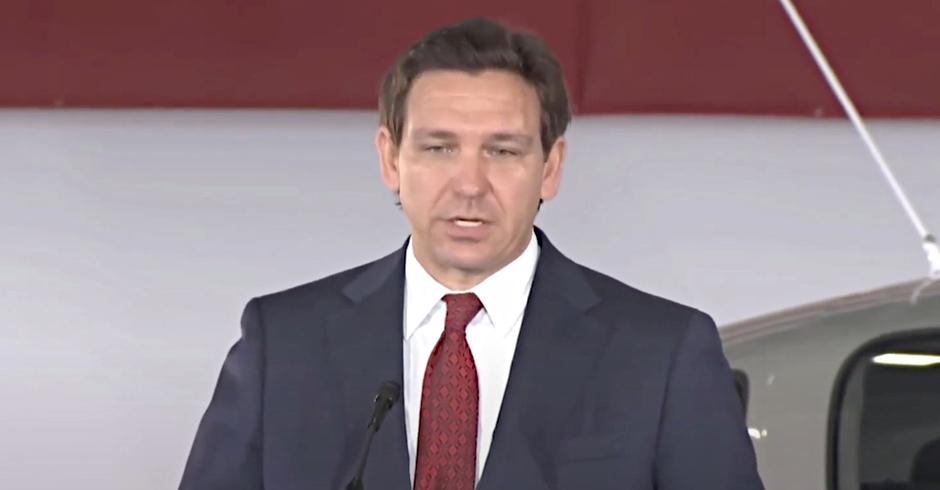
Governor Ron DeSantis is denying any responsibility for new Florida restrictions on the First Amendment that ban protests at the state Capitol unless groups requesting a permit are sponsored by a state official and their protest “aligns” with his administration’s mission. On Wednesday, DeSantis joked about the January 6, 2021 insurrection while downplaying it as he spoke about the new state policy effectively curtailing the right to protest the government.
“I saw a little report that actually was not something that I was involved with. It didn’t necessarily come down from me,” DeSantis told reporters as he stood in front of a small airplane at a podium with a sign that read “Biden’s Border Crisis.”
DeSantis was likely referring to a report in Politico that firmly puts the DeSantis administration behind the new policy that restricts freedoms guaranteed by the U.S. Constitution: “Congress shall make no law … abridging the freedom of speech, or of the press; or the right of the people peaceably to assemble, and to petition the Government for a redress of grievances.”
“The DeSantis administration now requires events held at the Florida state Capitol to ‘align’ with its mission, a recent change that is sparking concerns that the governor’s office is trying to censor events it doesn’t like,” Politico reported Tuesday evening.
“The Department of Management Services, the administration department that oversees state facilities, over the past few months has changed rules for groups or individuals who want to reserve space inside the Capitol. The changes require organizations seeking to reserve areas to make their requests through specific administration officials or legislative leaders and require they line up with the mission of the state.”
That effectively bans all protest against any legislation or policy the DeSantis administration supports. For example, it would have banned any protest at the Capitol against DeSantis’ “Don’t Say Gay” law.
Continuing his remarks to reporters, DeSantis, an attorney, said, “I think I would imagine that it’s just, you go there and you speak your mind. Great, but you’ll have some groups that will try to take over capitals like we’ve seen in other other state capitals, he said. Protesting at state capitols is a hallmark of the right to protest and the right to “peaceably to assemble, and to petition the Government for a redress of grievances.” It is as old as the Magna Carta.
” And you know, it’s interesting,” DeSantis added, “if, if, if they’re, if they’re doing that from the left and the media says, ‘that’s democracy in action.’ They don’t say it’s an insurrection if you take over you know, a capital because of that, but but I think that’s what it’s getting to and so, you know, we’ve been very supportive of people being able to speak their mind, it’s their right.”
Gov. Ron DeSantis (R-FL) defends an impending rule that would limit opposition protests at the state capitol:
“Some groups will try to take over capitols … If they’re doing that from the left, then the media says that’s democracy in action. They don’t say it’s an insurrection.” pic.twitter.com/GRYiZTpdeP
— The Recount (@therecount) February 23, 2023
Florida Politics, reporting on DeSantis “joking” about insurrection while denying responsibility for the restrictions on the right to protest at the state capitol, notes the “Governor had commented on Jan. 6 previously, including last spring when he said concern about the riots that delayed congressional certification of the 2020 Presidential Election was a ‘dead horse’ and a ‘loser’ with voters.”
READ MORE: Special Counsel Forced to Ask Judge to Compel Mike Pence to Obey Subpoena and Testify
On the one-year anniversary of Trump’s insurrection, Florida Politics also noted, DeSantis said: “This is their Christmas,” referring to the media and Democrats
The January 6, 2021 insurrection was an insurrection because its goal was to stop lawmakers from certifying a free and fair election in order to overturn election results. Insurrectionists and rioters were not peaceably assembling, nor were they protesting a policy or law.
DeSantis has repeatedly mocked concern over the insurrection while attempting to minimize its significance.
In May he called the leak of the Supreme Court’s draft opinion that overturned Roe v. Wade a “judicial insurrection.”
“You wanna talk about an insurrection, that’s a judicial insurrection.”
— Gov. Ron DeSantis (R-FL) on the leaked Supreme Court draft opinion to overturn Roe v. Wade pic.twitter.com/LhU69qLFg7
— The Recount (@therecount) May 3, 2022
One month later, as the actual decision in that case was about to be handed down, DeSantis likened pro-choice activists protesting at the Supreme Court to insurrectionists trying to shut down government to overturn the election.
Gov. Ron DeSantis (R-FL) says protests outside a Supreme Court justice’s house “would be considered an insurrection.” pic.twitter.com/uAhsDk25Tb
— The Recount (@therecount) June 13, 2022
Watch videos of DeSantis’ remarks above or at this link.
Enjoy this piece?
… then let us make a small request. The New Civil Rights Movement depends on readers like you to meet our ongoing expenses and continue producing quality progressive journalism. Three Silicon Valley giants consume 70 percent of all online advertising dollars, so we need your help to continue doing what we do.
NCRM is independent. You won’t find mainstream media bias here. From unflinching coverage of religious extremism, to spotlighting efforts to roll back our rights, NCRM continues to speak truth to power. America needs independent voices like NCRM to be sure no one is forgotten.
Every reader contribution, whatever the amount, makes a tremendous difference. Help ensure NCRM remains independent long into the future. Support progressive journalism with a one-time contribution to NCRM, or click here to become a subscriber. Thank you. Click here to donate by check.
 |





President Donald Trump and his allies have long accused critics of suffering from the imaginary ailment Trump Derangement Syndrome. Now, an Arizona state senator wants the local health department to conduct a study on the made-up disease.
State Sen. Janae Shamp introduced Senate Bill 1070 on Monday, asking Arizona’s Department of Health Services to “conduct or support research” on TDS, “including its origins, manifestations and long-term effects on individuals, communities and public discourse.” If the bill were passed into law, the department would have a year to submit a report on its findings.
READ MORE: ‘Monstrous’: Trump Blasted for Blaming Rob Reiner’s Death on ‘Trump Derangement Syndrome’
Shamp’s bill defines Trump Derangement Syndrome as “a behavioral or psychological phenomenon that is characterized by intense emotional or psychological reactions to Donald J. Trump, his actions or his public presence as observed in individuals or groups.” From there, the bill lays out its reasoning—mainly a laundry list of Trump’s accomplishments, including reducing the corporate tax rate by 14%, eliminating “22 regulations for every new one in 2017”, and “affirming biological truth in federal policy to protect family values.”
“Despite these contributions to America’s prosperity, security 26 and values, ‘Trump Derangement Syndrome’ (TDS) has emerged since his 2016 campaign,” Shamp wrote.
“TDS has led to significant social harm, with Americans who 33 support President Trump or his policies reporting discrimination, 34 intimidation or ostracism in professional, academic and social settings, 35 further eroding community cohesion,” she added.
The bill borrows heavily from a House bill proposed by Rep. Warren Davidson (R-OH), according to Tucson.com. It is unknown what chances Shamp’s bill has of passing the Arizona Senate; Davidson’s bill died in committee. But even should it pass, it is unlikely to be signed into law by Democratic Gov. Katie Hobbs.
When asked if Hobbs would sign the bill, her spokesperson laughed and told a KTVK-TV reporter “You can quote me on that.”
Image via Reuters
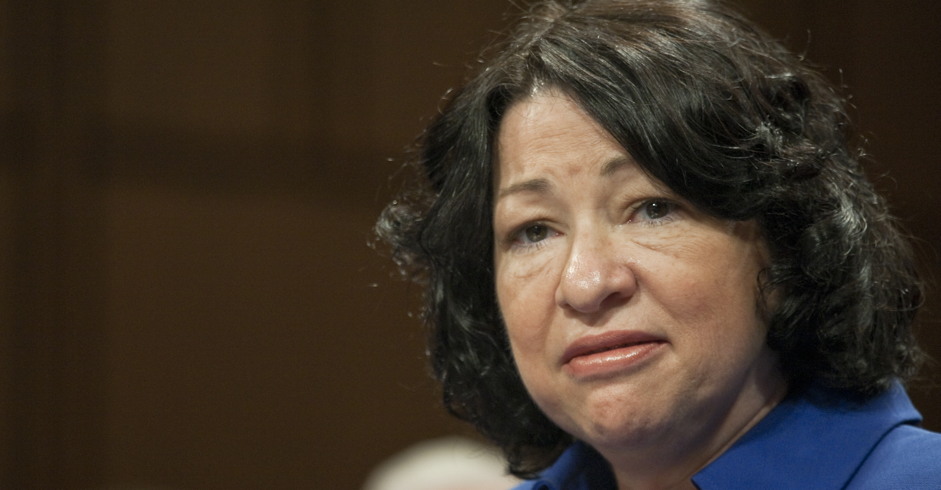
Justice Sonia Sotomayor had harsh words for the Supreme Court in her dissent in a ruling allowing Immigration and Customs Enforcement to continue to arrest people based on profiling Latinos working low-wage jobs.
Monday morning, the Supreme Court of the United States issued an emergency decision in Noem v. Vasquez Perdomo. The case concerns “Operation At Large,” which deployed ICE agents in the Los Angeles area to car washes, bus stops, farms and other locations believed to be frequented by Latino people who may or may not be undocumented immigrants. On July 11, the Central District Court of California ruled that ICE had to stop Operation At Large until appeals in the case could be heard.
The Court’s ruling contained no official explanation for the ruling, however Justice Brett Kavanaugh wrote a concurrence. In his concurrence, Kavanaugh said the law allowed ICE to “‘briefly detain’ an individual ‘for questioning’” if they have “a reasonable suspicion, based on specific articulable facts, that the person being questioned . . . is an alien illegally in the United States.”
READ MORE: Loyalty Litmus Test? Trump Allies Quietly Prep SCOTUS Short List
Operation At Large, he said, represented “reasonable suspicion” to detain someone on the following factors: “(i) presence at particular locations such as bus stops, car washes, day laborer pickup sites, agricultural sites, and the like; (ii) the type of work one does; (iii) speaking Spanish or speaking English with an accent; and (iv) apparent race or ethnicity.”
He added that “apparent ethnicity alone cannot furnish reasonable suspicion” but could be a “‘relevant factor,” and that if someone detained by ICE turned out to be a citizen, they would be “free to go after the brief encounter.”
Sotomayor disagreed that this is what was happening, citing what had happened to other citizens. Jason Gavidia worked at a Los Angeles tow yard that ICE stopped at. Agents repeatedly asked if he was a citizen. They then took his phone, pushed him against a metal fence, twisted his arm, and took away his identification, according to Sotomayor’s dissent.
“Other Operation At Large encounters have included even more force and even fewer questions. For example, agents pulled up in four unmarked cars to a bus stop in Pasadena; ‘the doors opened and men in masks with guns started running at’ three Latino men who were having their morning coffee, waiting to be picked up for work,” she wrote.
“In Glendale, nearly a dozen masked agents with guns ‘jumped out of . . . cars’ at a Home Depot, and began ‘chasing’ and ‘tackl[ing]’ Latino day laborers without ‘identify[ing] themselves as ICE or police, ask[ing] questions, or say[ing] anything else.’ In downtown Los Angeles, agents ‘jumped out of a van, rushed up to [a tamale vendor], surrounded him, and handled him violently,’ all ‘[w]ithout asking . . . any questions.'”
Sotomayor concluded that Operation At Large and the Court’s decision “all but declared that all Latinos, U. S. citizens or not, who work low wage jobs are fair game to be seized at any time, taken away from work, and held until they provide proof of their legal status to the agents’ satisfaction.”
She also condemned the court for not issuing an explanation beyond the concurrence. She alleged that the Court had been eager to “circumvent the ordinary appellate process” when it comes to President Donald Trump and his administration.
“Some situations simply cry out for an explanation, such as when the Government’s conduct flagrantly violates the law,” Sotomayor wrote, adding that Operation At Large and the Court’s ruling clearly violates the Bill of Rights.
“The Fourth Amendment protects every individual’s constitutional right to be ‘free from arbitrary interference by law officers.’ After today, that may no longer be true for those who happen to look a certain way, speak a certain way, and appear to work a certain type of legitimate job that pays very little. Because this is unconscionably irreconcilable with our Nation’s constitutional guarantees, I dissent,” she wrote.
Image via Shutterstock

The right-wing war on knowledge continues as an Arkansas state senator filed a bill Thursday to abolish the State Library as well as the library board.
Sen. Dan Sullivan (R-Jonesboro), along with State Rep. Wayne Long (R-Bradford), filed Senate Bill 536 on Thursday. The bill would not just remove all references to the State Library from existing laws, but also put the state’s other libraries under the control of the Arkansas Department of Education.
A previous version of the bill, SB184, would have also shuttered the Arkansas Educational Television Commission, which oversees the state’s PBS stations, according to the Arkansas Advocate.
READ MORE: Clean Up Alabama Wants State to Dump ‘Marxist’ American Library Association
The Arkansas State Library is not just a regular library. In addition to providing information to state agencies and lawmakers, it also distributes funding to the other libraries around the state. Under SB536, the Department of Education would take on all its responsibilities. The State Library is officially a part of the Department of Education already, but it operates as an independent organization.
While the proposal may sound like a shuffling-around of duties, the main thrust of the bill is to allow more direct control over the Arkansas library system by controlling the purse strings. The bill would keep libraries from distributing “age-inappropriate materials” to those under 17 years old and sex education materials from those under 12. Libraries would also have to set up a system where those in the community could request that certain items be banned for minors, according to KARK-TV. Those that don’t meet these restrictions will have state funding pulled.
Earlier legislation filed by Sullivan and passed into law includes Act 242, which ended the requirement for library directors to have a master’s degree in library science, the Advocate reported. Sullivan, however, was unsuccessful with a proposed amendment to another bill that would strip funding from libraries affiliated with the American Library Association—meaning most, if not all of them. That amendment was rejected this week over concerns the language in it was too broad, according to the Advocate.
The ALA has been a target of right-wing politicians and activists upset with its free speech stance and fights against censorship. Sullivan in particular has objected to a provision in the ALA’s Library Bill of Rights protecting library access for all ages, the Advocate reported. He also called for the state’s chapter of the ALA to be defunded—despite the fact that it receives no state funding.
Image via Shutterstock

Platner Scorched Over ‘Taking Time’ Video After New Accusation

Trump Sparks Fury Online After Posting Unblurred Video of Muslim Kindergartners in Hijabs

One Legal Maneuver Threatens to Undo Everything E. Jean Carroll Won

Inside the Group Helping MAGA Voters Walk Away — And What Finally Pushed Them