TESTIFY TESTIFY TESTIFY
Bolton Returns to Twitter, Says White House Tried to Silence Him, Gets Slammed: ‘Stop Trying to Sell Books and Testify’
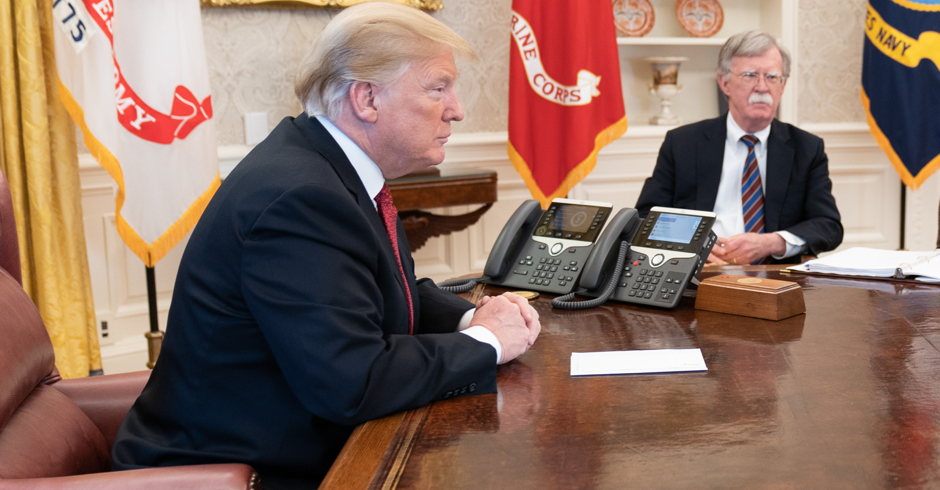
Former Trump National Security Advisor John Bolton, who resigned in early September, has been under attack for not testifying before the House Intelligence Committee’s impeachment inquiry. Bolton, however, does have a new $2 million book deal, leading some to criticize the career consultant and diplomat (and some say war hawk) for not revealing what he knows about the Trump administration unless he can sell it in a book.s impeachment inquiry
Friday morning “Fox & Friends,” during its non-stop 57 minute interview, asked President Trump about Bolton – and specifically if he had frozen his Twitter account, since the former Ambassador has not tweeted in months.
“No, of course not, I had a good relationship with John,” replied Trump, who claimed he had fired Bolton in September. Bolton furiously disagreed.
Friday morning, barely an hour after Trump’s “Fox & Friends” remarks, Bolton tweeted, “We have now liberated the Twitter account, previously suppressed unfairly in the aftermath of my resignation as National Security Advisor.
Hours later he announced the White House had “refused to return access to my personal Twitter account” after he left.
It’s unclear why the White House would have control over his personal Twitter account, but as some said, he could have wrested it the same way anyone else would have, by emailing a password change request.
Others were more blunt, criticizing Bolton for not going to the media or to Congress with all he knows. Remember, Bolton allegedly said he refused to be part of Trump and Mulvaney’s Ukraine “drug deal.”
Here’s how some are responding to Bolton now:
…stop trying to sell books and testify. https://t.co/r5To8MeqBE
— sohmer (@sohmer) November 22, 2019
Ambassador John Bolton took an oath of office to support and defend the US Constitution against all enemies, foreign and domestic
It’s time for him to fulfil his oath and testify before Congress https://t.co/959NYdJDl7
— Edward Hardy (@EdwardTHardy) November 22, 2019
The whole world knows you are writing a book for profit, asshole. https://t.co/1rxkLOKW6F
— J.R. McGrail 📎 (@JRMcGrail) November 22, 2019
Dude, seriously. Enough about your Twitter account. How about speaking to the pressing concerns of the nation—of which you apparently have unique knowledge? https://t.co/BCRICYGfO3
— Ted Genoways (@TedGenoways) November 22, 2019
Such a shame there’s no other prominent venue in which you could talk at length about what you know. https://t.co/U9rqzVbsh6
— Michael Plaxton (@MichaelPlaxton) November 22, 2019
You know it looks a rather shabby to stonewall congress, let your underlings testify in your stead, and save what you know for a lucrative book, right?
— Helen Kennedy (@HelenKennedy) November 22, 2019
I’d call it hiding when you refuse to testify. If you don’t fear WH then it is simply greed that keeps you quiet. https://t.co/Gu8l4rnyDA
— Joyce Frankel (@FrankelJoyce) November 22, 2019
This whole teasing routine is just sad. Testify under oath before House Intel in the impeachment inquiry and tell the country the truth about what you know, or you are no patriot… and damn you forever. #FridayMotivation #ImpeachmentHearing
— (((John M. Becker))) (@freedom2marry) November 22, 2019
Wanna join me in urging him to testify; to tell his own story?
John Bolton is back on Twitter the first time since resigning.
We dont have to agree on politics to agree he should do the right thing without getting paid for it. https://t.co/SBu6ABYWHs
— 💙 Koko: Here, right matters✊🏻✊🏽✊🏿💙 (@Kokomothegreat) November 22, 2019
Loving the drama and attention, Bolton toys with American people, Congress and the president. #KnockItOffAndTestify. https://t.co/0UNI5Ww2kg
— Casey Nikoloric (@CaseyNikoloric) November 22, 2019
Enjoy this piece?
… then let us make a small request. The New Civil Rights Movement depends on readers like you to meet our ongoing expenses and continue producing quality progressive journalism. Three Silicon Valley giants consume 70 percent of all online advertising dollars, so we need your help to continue doing what we do.
NCRM is independent. You won’t find mainstream media bias here. From unflinching coverage of religious extremism, to spotlighting efforts to roll back our rights, NCRM continues to speak truth to power. America needs independent voices like NCRM to be sure no one is forgotten.
Every reader contribution, whatever the amount, makes a tremendous difference. Help ensure NCRM remains independent long into the future. Support progressive journalism with a one-time contribution to NCRM, or click here to become a subscriber. Thank you. Click here to donate by check.
 |



'VERY COOL VERY NORMAL'
FTC Blocks Advertising Company From Boycotting Media Outlets Based on Political Views

The Federal Trade Commission announced a strange condition of the merger between two giant advertising companies. The FTC allowed the merger, but blocked the new company from being able to boycott media outlets based on political viewpoints.
The FTC announced Monday that Omnicom Group would be able to go ahead with its $13.5 billion purchase of The Interpublic Group of Companies. The merger faced antitrust concerns as the two companies are major players in the advertising industry. Currently, Omnicom is the third-largest ad agency in the United States, and IPG is fourth-largest.
Assuming the acquisition continues as planned, the enlarged Omnicom would be blocked from “engaging in collusion or coordination to direct advertising away from media publishers based on the publishers’ political or ideological viewpoints,” the FTC said.
READ MORE: Right Wing Lobbying Organization Pushing States to Shield Companies From Political Boycotts
“Websites and other publications that rely on advertising are critical to the flow of our nation’s commerce and communication,” Daniel Guarnera, Director of the FTC’s Bureau of Competition, said. “Coordination among advertising agencies to suppress advertising spending on publications with disfavored political or ideological viewpoints threatens to distort not only competition between ad agencies, but also public discussion and debate. The FTC’s action today prevents unlawful coordination that targets specific political or ideological viewpoints while preserving individual advertisers’ ability to choose where their ads are placed.”
The new rule comes after Elon Musk, the owner of the social media platform X, formerly Twitter, complained that advertisers were boycotting the platform. Last August, X filed an antitrust lawsuit against the Global Alliance for Responsible Media, a coalition of advertisers, for boycotting X following Musk’s purchase of the company. Founding members of GARM include both Omnicom and IPG.
GARM was originally formed in response to the mass shooting in a Christchurch, New Zealand mosque by a white supremacist. The shooting was livestreamed on Facebook, and as such, advertisements appeared on the platform alongside the livestream. GARM aimed to block members’ advertisements from appearing on platforms that didn’t have safeguards prohibiting what the organization called “illegal or harmful content, such as promoting terrorism or child pornography.”
Days after the X lawsuit, GARM disbanded.
“GARM has disbanded under a cloud of litigation and congressional investigation. The Commission has not been a party to those actions, and I take no position on any possible violation of the antitrust laws by GARM. The factual allegations, however, if true, paint a troubling picture of a history of coordination—that the group sought to marshal its members into collective boycotts to destroy publishers of content of which they disapproved,” FTC Chairman Andrew N. Ferguson said Monday.
“GARM was neither the beginning nor the end of harmful and potentially unlawful collusion in this industry. Numerous other industry groups and private organizations have publicly sought to use the chokepoint of the advertising industry to effect political or ideological goals. Clandestine pressure campaigns and private dealings among these parties are less well documented but pose the serious risk of harm and illegality,” he added.
The proviso to the Omnicom merger is not the FTC’s only foray into this issue. This May, the FTC opened an investigation to determine whether or not advertisers coming together in agreement to not buy ads on certain websites due to political content constituted an illegal boycott, according to the New York Times.

‘Did Not Rule Against Trump’s Tariffs’: Bessent Offers Alternative Interpretation

Bush-Era ‘Torture Memo’ Author Warns Trump to Stop Smearing SCOTUS Over Tariff Ruling

Epstein Files Scandal Is ‘Never Going to Go Away’: Carville

Donald Trump’s Very Bad Day

‘Major Blow’: Supreme Court Rejects Legal Basis for Trump’s Tariffs
 News3 days ago
‘One Way or Another’: Trump Vows to Pass SAVE America Voter ID Bill
 News4 days ago
‘You’re Kidding Right?’: WH Press Secretary Stunned Over ‘Falsely Called Racist’ Question
 News4 days ago
Trump’s Wild 24 Hour Truth Social Frenzy
 News3 days ago
Five of the Wildest Things Trump Said at His Black History Month Celebration

 News3 days ago
‘Can’t Play Cute With Me’: Trump Tries to Spin Big-Power Snub of Peace Board
 News2 days ago
‘Can You Imagine?’: Trump Slams SCOTUS Over Tariffs Case

 News4 days ago
‘Gaslight America’: Marjorie Taylor Greene Blasts Trump Ahead of His Trip to Georgia

 News3 days ago
‘It’s Not Us, It’s You’: New Report Says Canadians Now See Trump’s US as Top Peace Threat