RIGHT WING EXTREMISM
School District’s Book Ban Created a Hostile Environment and May Have Violated Civil Rights Says Biden Education Dept.
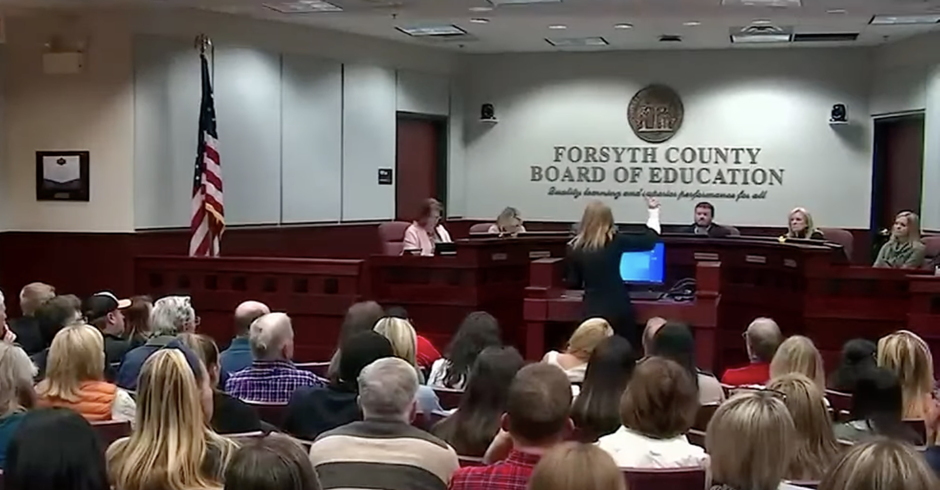
A U.S. Dept. of Education investigation into how a Georgia school district chose to remove almost a dozen books, mostly with Black and LGBTQ characters, finds it created a hostile environment for students and may have violated their civil rights. The DOE’s Office of Civil Rights says the effects of the book removals were so “harsh” they led at least several students to be afraid to go to school.
The Washington Post calls the investigation’s conclusion “a move that could affect how schools handle book challenges.” The Forsyth County, Georgia school district has “agreed to offer ‘supportive measures’ to students affected by the book removals and to administer a school climate survey,” according to a letter from the Dept. of Education’s Office for Civil Rights (OCR).
The extensive and detailed letter notes that the district weighed multiple methods to handle parents’ complaints about several books, and took steps, albeit insufficient, to attempt fairness. But it also makes clear extremist parents’ demands played a role in its decision to remove certain books. The letter also includes comments from students.
READ MORE: Moms for Liberty Leader Says Biden Behind High-Level, Coordinated Effort to Make Kids LGBTQ (Video)
In March of 2022, a local CBS affiliate in Georgia ran a news report detailing the remarks of some parents. That report largely focused on parents who were demanding books be banned. It did not include any students. It also alleged the books were inappropriate: “A slew of inappropriate books in Forsyth County school libraries is causing outrage amongst some parents,” the video’s written statement on YouTube reads.
“During a February 15 District school board meeting, which the District’s Superintendent attended, multiple parents and students spoke about the District’s removal of books,” the Office of Civil Rights’ letter reads, referring to an earlier meeting. “Many parents called for the removal of additional books, with most of their comments focused on sexually explicit content; however, some comments focused on removing books for reasons related to gender identity or sexual orientation. Also, some parents made negative comments about diversity and inclusion or critical race theory.”
“The students’ comments at the board meeting focused on the gender identity, sexual orientation, and race or color of authors or characters in the books. Some students also raised concern about the impact of removing the books. One student stated that the book ban immediately made the environment more harsh for students; people like him who are not in the closet are watching their safe spaces disappear, and he is sick of being fearful at school,” OCR states. “A student who identified herself as Asian said it is hard for her to find books with main characters who are of her race; she knows that people of other minority backgrounds have the same struggle and banning books written with diversity silences mainly minority voices. A third student — who characterized the District’s actions as singling out books by authors who are gay, supporters of the LGBTQI+ community, women and people of color — expressed the belief that the District does not care about diversity.”
In its letter, the Office of Civil Rights sys it “has a concern the District received notice that its media center book screening process may have created a hostile environment for students, yet the District’s responsive steps related to the book screening process were not designed to, and were insufficient to, ameliorate any resultant racially and sexually hostile environment.”
It also “recognizes the District Media Committee rejected suggestions to handle challenged books in ways that it believed would target certain groups of students and that the District posted a statement on media centers’ websites that they ‘provide resources that reflect all students within each school community’ and that ‘If you come across a book that does not match your family’s values and/or beliefs, and you would prefer that your child does not check that book out, please discuss it with your child.’ OCR also recognizes the District limited its book screening process to sexually explicit material.”
But OCR makes clear the district’s attempts were insufficient, noting that “communications at [school] board meetings conveyed the impression that books were being screened to exclude diverse authors and characters, including people who are LGBTQI+ and authors who are not white, leading to increased fears and possibly harassment.”
“District witnesses reported to OCR that the District has not taken steps to address with students the impact of the book removals. In light of these communications and actions, OCR is concerned a hostile environment may have arisen that the District needed to ameliorate.”
Watch the video above or at this link.
Enjoy this piece?
… then let us make a small request. The New Civil Rights Movement depends on readers like you to meet our ongoing expenses and continue producing quality progressive journalism. Three Silicon Valley giants consume 70 percent of all online advertising dollars, so we need your help to continue doing what we do.
NCRM is independent. You won’t find mainstream media bias here. From unflinching coverage of religious extremism, to spotlighting efforts to roll back our rights, NCRM continues to speak truth to power. America needs independent voices like NCRM to be sure no one is forgotten.
Every reader contribution, whatever the amount, makes a tremendous difference. Help ensure NCRM remains independent long into the future. Support progressive journalism with a one-time contribution to NCRM, or click here to become a subscriber. Thank you. Click here to donate by check.
 |





President Donald Trump and his allies have long accused critics of suffering from the imaginary ailment Trump Derangement Syndrome. Now, an Arizona state senator wants the local health department to conduct a study on the made-up disease.
State Sen. Janae Shamp introduced Senate Bill 1070 on Monday, asking Arizona’s Department of Health Services to “conduct or support research” on TDS, “including its origins, manifestations and long-term effects on individuals, communities and public discourse.” If the bill were passed into law, the department would have a year to submit a report on its findings.
READ MORE: ‘Monstrous’: Trump Blasted for Blaming Rob Reiner’s Death on ‘Trump Derangement Syndrome’
Shamp’s bill defines Trump Derangement Syndrome as “a behavioral or psychological phenomenon that is characterized by intense emotional or psychological reactions to Donald J. Trump, his actions or his public presence as observed in individuals or groups.” From there, the bill lays out its reasoning—mainly a laundry list of Trump’s accomplishments, including reducing the corporate tax rate by 14%, eliminating “22 regulations for every new one in 2017”, and “affirming biological truth in federal policy to protect family values.”
“Despite these contributions to America’s prosperity, security 26 and values, ‘Trump Derangement Syndrome’ (TDS) has emerged since his 2016 campaign,” Shamp wrote.
“TDS has led to significant social harm, with Americans who 33 support President Trump or his policies reporting discrimination, 34 intimidation or ostracism in professional, academic and social settings, 35 further eroding community cohesion,” she added.
The bill borrows heavily from a House bill proposed by Rep. Warren Davidson (R-OH), according to Tucson.com. It is unknown what chances Shamp’s bill has of passing the Arizona Senate; Davidson’s bill died in committee. But even should it pass, it is unlikely to be signed into law by Democratic Gov. Katie Hobbs.
When asked if Hobbs would sign the bill, her spokesperson laughed and told a KTVK-TV reporter “You can quote me on that.”
Image via Reuters
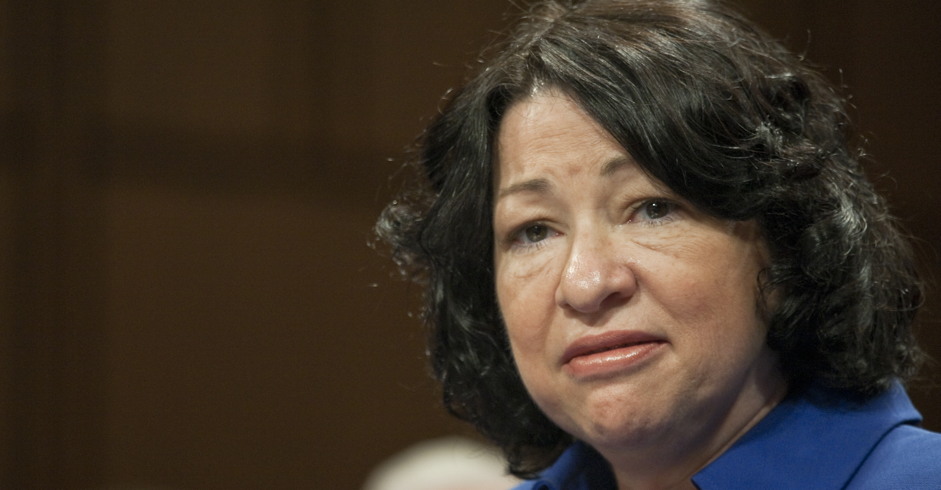
Justice Sonia Sotomayor had harsh words for the Supreme Court in her dissent in a ruling allowing Immigration and Customs Enforcement to continue to arrest people based on profiling Latinos working low-wage jobs.
Monday morning, the Supreme Court of the United States issued an emergency decision in Noem v. Vasquez Perdomo. The case concerns “Operation At Large,” which deployed ICE agents in the Los Angeles area to car washes, bus stops, farms and other locations believed to be frequented by Latino people who may or may not be undocumented immigrants. On July 11, the Central District Court of California ruled that ICE had to stop Operation At Large until appeals in the case could be heard.
The Court’s ruling contained no official explanation for the ruling, however Justice Brett Kavanaugh wrote a concurrence. In his concurrence, Kavanaugh said the law allowed ICE to “‘briefly detain’ an individual ‘for questioning’” if they have “a reasonable suspicion, based on specific articulable facts, that the person being questioned . . . is an alien illegally in the United States.”
READ MORE: Loyalty Litmus Test? Trump Allies Quietly Prep SCOTUS Short List
Operation At Large, he said, represented “reasonable suspicion” to detain someone on the following factors: “(i) presence at particular locations such as bus stops, car washes, day laborer pickup sites, agricultural sites, and the like; (ii) the type of work one does; (iii) speaking Spanish or speaking English with an accent; and (iv) apparent race or ethnicity.”
He added that “apparent ethnicity alone cannot furnish reasonable suspicion” but could be a “‘relevant factor,” and that if someone detained by ICE turned out to be a citizen, they would be “free to go after the brief encounter.”
Sotomayor disagreed that this is what was happening, citing what had happened to other citizens. Jason Gavidia worked at a Los Angeles tow yard that ICE stopped at. Agents repeatedly asked if he was a citizen. They then took his phone, pushed him against a metal fence, twisted his arm, and took away his identification, according to Sotomayor’s dissent.
“Other Operation At Large encounters have included even more force and even fewer questions. For example, agents pulled up in four unmarked cars to a bus stop in Pasadena; ‘the doors opened and men in masks with guns started running at’ three Latino men who were having their morning coffee, waiting to be picked up for work,” she wrote.
“In Glendale, nearly a dozen masked agents with guns ‘jumped out of . . . cars’ at a Home Depot, and began ‘chasing’ and ‘tackl[ing]’ Latino day laborers without ‘identify[ing] themselves as ICE or police, ask[ing] questions, or say[ing] anything else.’ In downtown Los Angeles, agents ‘jumped out of a van, rushed up to [a tamale vendor], surrounded him, and handled him violently,’ all ‘[w]ithout asking . . . any questions.'”
Sotomayor concluded that Operation At Large and the Court’s decision “all but declared that all Latinos, U. S. citizens or not, who work low wage jobs are fair game to be seized at any time, taken away from work, and held until they provide proof of their legal status to the agents’ satisfaction.”
She also condemned the court for not issuing an explanation beyond the concurrence. She alleged that the Court had been eager to “circumvent the ordinary appellate process” when it comes to President Donald Trump and his administration.
“Some situations simply cry out for an explanation, such as when the Government’s conduct flagrantly violates the law,” Sotomayor wrote, adding that Operation At Large and the Court’s ruling clearly violates the Bill of Rights.
“The Fourth Amendment protects every individual’s constitutional right to be ‘free from arbitrary interference by law officers.’ After today, that may no longer be true for those who happen to look a certain way, speak a certain way, and appear to work a certain type of legitimate job that pays very little. Because this is unconscionably irreconcilable with our Nation’s constitutional guarantees, I dissent,” she wrote.
Image via Shutterstock

The right-wing war on knowledge continues as an Arkansas state senator filed a bill Thursday to abolish the State Library as well as the library board.
Sen. Dan Sullivan (R-Jonesboro), along with State Rep. Wayne Long (R-Bradford), filed Senate Bill 536 on Thursday. The bill would not just remove all references to the State Library from existing laws, but also put the state’s other libraries under the control of the Arkansas Department of Education.
A previous version of the bill, SB184, would have also shuttered the Arkansas Educational Television Commission, which oversees the state’s PBS stations, according to the Arkansas Advocate.
READ MORE: Clean Up Alabama Wants State to Dump ‘Marxist’ American Library Association
The Arkansas State Library is not just a regular library. In addition to providing information to state agencies and lawmakers, it also distributes funding to the other libraries around the state. Under SB536, the Department of Education would take on all its responsibilities. The State Library is officially a part of the Department of Education already, but it operates as an independent organization.
While the proposal may sound like a shuffling-around of duties, the main thrust of the bill is to allow more direct control over the Arkansas library system by controlling the purse strings. The bill would keep libraries from distributing “age-inappropriate materials” to those under 17 years old and sex education materials from those under 12. Libraries would also have to set up a system where those in the community could request that certain items be banned for minors, according to KARK-TV. Those that don’t meet these restrictions will have state funding pulled.
Earlier legislation filed by Sullivan and passed into law includes Act 242, which ended the requirement for library directors to have a master’s degree in library science, the Advocate reported. Sullivan, however, was unsuccessful with a proposed amendment to another bill that would strip funding from libraries affiliated with the American Library Association—meaning most, if not all of them. That amendment was rejected this week over concerns the language in it was too broad, according to the Advocate.
The ALA has been a target of right-wing politicians and activists upset with its free speech stance and fights against censorship. Sullivan in particular has objected to a provision in the ALA’s Library Bill of Rights protecting library access for all ages, the Advocate reported. He also called for the state’s chapter of the ALA to be defunded—despite the fact that it receives no state funding.
Image via Shutterstock

Platner Scorched Over ‘Taking Time’ Video After New Accusation

Trump Sparks Fury Online After Posting Unblurred Video of Muslim Kindergartners in Hijabs

One Legal Maneuver Threatens to Undo Everything E. Jean Carroll Won

Inside the Group Helping MAGA Voters Walk Away — And What Finally Pushed Them