
News
‘Exhausted,’ ‘Weary’ and ‘Decomposing’ Trump Keeps Canceling Interviews: Reports

Over the past week Donald Trump canceled a major interview with CBS News’ “60 Minutes,” canceled an interview with a pro-Trump host at CNBC, and canceled an interview with NBC News, with just weeks before Election Day as voters are rushing to the polls in some early voting states.
Trump also cut short the Q&A portion of a Pennsylvania town hall after two attendees reportedly fainted — instead, just playing music while standing (and occasionally swaying) on stage. And he was short and combative with the editor-in-chief of Bloomberg News in a sit-down interview on economic policy at the Chicago Economic Club, leading one critic to call the ex-president a “petulant toddler.”
The ex-president who still faces charges in his election interference case in Georgia even canceled delivering the keynote speech at an NRA “Defend the Second Amendment” event in that must-win state. And at a Univision town hall for undecided Latino voters, Trump disparaged immigrants and dodged strong questions from audience members, leading one to say he made up his mind that night and will not be voting for Trump.
RELATED: ‘Aghast’: Trump Dodges and Dismisses Latino Voters’ Concerns at Univision Town Hall
And despite debating Vice President Kamala Harris, his Democratic presidential opponent, nearly six weeks ago on the condition she agree to two additional debates, Trump has now refused to participate in any more. CNN Thursday night reported Trump has previously said presidential candidates who won’t debate lack “courage.”
On Tuesday in Atlanta, the 78-year old Republican presidential nominee complained to supporters he’s been campaigning “for 42 days straight without a rest,” The New York Times reports, and complained, “If we don’t win, it’s like, it was all for not very much.”
The Times called Trump, “weary,” and his remark, “an uncharacteristically vulnerable display.”
Trump reportedly is canceling interviews due to—as one media outlet who couldn’t get him to commit to an interview date—”exhaustion.”
“The Trump campaign had spent weeks in conversations with The Shade Room, a site that draws a largely young and Black audience — a demographic where Trump has been making inroads. It hosted an interview with Kamala Harris just last week,” Politico reported Friday. “As Shade Room staff began feeling that feet were being dragged inside Trump’s campaign, they pressed earlier this week to set a date for a sit-down.”
“In response, a Trump adviser told Shade Room producers that Trump was ‘exhausted and refusing [some] interviews but that could change’ at any time, according to two people familiar with the conversations.”
READ MORE: ‘Almost Loved Me to Death’: Officer Who Defended Capitol Slams Trump Over J6 ‘Day of Love’
Politico adds: “While Trump’s team notes that their candidate has constantly done interviews, they have been mainly with friendly hosts or on friendly networks of late.”
Others have a different take on why Trump is “cancelling events.”
Barbara Comstock is a dyed-in-the wool Republican, a former U.S. Congresswoman from Virginia. She served as a consultant to Mitt Romney’s presidential campaign, and as an attorney she assisted in the defense of both Vice President Dick Cheney’s former chief of staff, Scooter Libby and former Republican House Majority Leader Tom DeLay.
Friday morning Comstock, who has endorsed Vice President Harris, pointed to Donald Trump’s appearance Thursday night at the annual Al Smith Dinner, which during presidential years hosts the candidates for what is supposed to be a biting but respectful and self-deprecating roast.
“At a Catholic Charities event last night,” Comstock wrote atop a video (below), “a slurring confused Trump was swearing in front of the priests, doing his mean girls revenge list and showing his brain is circling the drain and decomposing by the hour…..which is why his staff is cancelling events.”
At a Catholic Charities event last night, a slurring confused Trump was swearing in front of the priests, doing his mean girls revenge list and showing his brain is circling the drain and decomposing by the hour…..which is why his staff is cancelling events https://t.co/VMhkM9UEys
— Barbara Comstock (@BarbaraComstock) October 18, 2024
Trump’s alleged behavior Thursday night is far from a one-off.
“Donald Trump had ‘no sense of who he was in front of or who he was talking to’ when he made a shocking slur about his Democratic rival Kamala Harris during a recent dinner for billionaire donors in New York, according to New York Times journalist Maggie Haberman,” The Independent reported Wednesday.
“Some of them are huge pro-Israel backers,” Haberman said. “And he starts trashing Jews who don’t back him. He uses a slur to describe Kamala Harris’s mental state. It goes on and on and on like this, and he seemed to have… It was as if he had no sense of who he was in front of or who he was or he’s talking to.”
“It’s like he’s devoid of context,” she added.
Watch the video above or at this link.
READ MORE: ‘Is He OK?’: Trump’s Dark of Night Rage Posting Backfires
Enjoy this piece?
… then let us make a small request. The New Civil Rights Movement depends on readers like you to meet our ongoing expenses and continue producing quality progressive journalism. Three Silicon Valley giants consume 70 percent of all online advertising dollars, so we need your help to continue doing what we do.
NCRM is independent. You won’t find mainstream media bias here. From unflinching coverage of religious extremism, to spotlighting efforts to roll back our rights, NCRM continues to speak truth to power. America needs independent voices like NCRM to be sure no one is forgotten.
Every reader contribution, whatever the amount, makes a tremendous difference. Help ensure NCRM remains independent long into the future. Support progressive journalism with a one-time contribution to NCRM, or click here to become a subscriber. Thank you. Click here to donate by check.
 |



The Dispatch‘s national correspondent, Kevin D. Williamson, wants to ask Republicans a question.
He points to the $270 it takes to fill up the tank of a Ford Super Duty truck in his neighborhood — 48 gallons at $5.60 a gallon for diesel — and asks, “Do you feel smart?”
Citing a column by The New York Times’ Bret Stephens, Williamson weighs the pros and cons of voters electing candidates to achieve results over voters choosing “paragons of moral rectitude.”
“There is something to be said for that approach,” writes Williamson. “One of the problems with our politics is that politicians—especially presidents—are treated as embodiments of the nation, the people, and our values, to such an extent that members of a party feel alienated and humiliated when the other party’s leader occupies the White House.”
He concludes that for partisans, “inconvenient facts necessitate a kind of rhetorical two-step.”
“There are proud Trump cultists and there are embarrassed Trump cultists, and, if you press one of the latter on Trump’s viciousness—his dishonesty, his infidelity, his venality, his susceptibility to flattery, his inconstancy—he often will retreat into comfortable pragmatism,” Williamson writes.
They will say they like Trump’s “policies,” which, Williamson charges, “mainly indicates the economic conditions coincident with Trump’s first term in office, pre-COVID, which were only to a very minor degree the result of any Trump policy.”
But press the embarrassed Trump cultist further — like on the $270 tank fill-up — and they will “retreat into moralism, albeit a negative kind of moralism based in the perceived deficiencies of the Democrats rather than in any of Trump’s particular moral virtues, which, it is plain, simply do not exist.”
When Republicans insist Americans “think of the policies,” Williamson says he wonders “what those beneficial policies are.”
“The illegally initiated and incompetently executed war in Iran that is the proximate cause of that $270 diesel bill? The obviously criminal massacres of civilians on the high seas? The gross self-dealing and corruption? The elevation of wildly unqualified yes-men such as Bill Pulte to high office? The deepening debt? The rising inflation?”
Williamson says that they like the policies, “Except for the inflation, and the trade chaos, and the war, and the corruption, and the enshrinement of utter incompetence.”
He says that you “can two-step around reality any way you like, but the fact is that right now Republicans are offering both Ken Paxton and $5.60 diesel. And so I repeat the question to my Republican friends: ‘Do you feel smart?'”
Image via Shutterstock
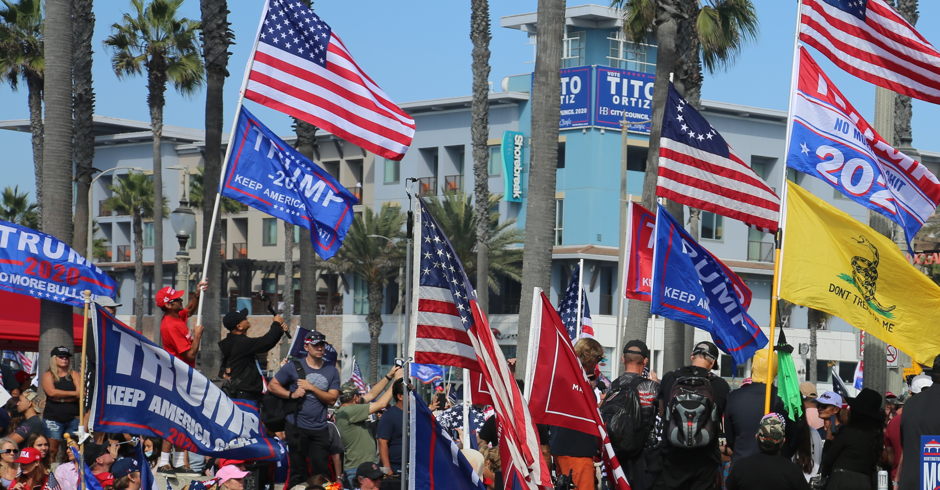
Port Charlotte, Florida, is part of Charlotte County — which voted for President Donald Trump by a solid two-to-one margin in 2024. It was named one of the top ten places to retire in 2012.
Still seen as a deeply red state, Democrats are making inroads into the Sunshine State. Ahead of the August primary, in the race for governor, Republican Byron Donalds often polls ahead of Democrat David Jolly but only by single digits, according to data from The New York Times. Donald Trump won the state by 13 points in 2024.
A letter to the editor highly critical of President Donald Trump and his MAGA base in a Port Charlotte news outlet could be seen as surprising.
“MAGA crowd, Trump are all about winning,” reads the headline.
“Donald Trump and the MAGA movement have turned American politics into a fan-based team sport,” writes its author, Gayle Yarnall.
“Governing has become an us versus them rivalry regardless of the consequences. It is all about winning,” she laments.
“The 2024 election is long over. Yet, there are Trump signs, banners, and flags still posted around. It is akin to displaying the flag of your favorite teams like the Patriots or the Buckeyes. What is the purpose except to express that, ‘I’m on a winning team’?” Yarnall asks.
“No one will be persuaded to vote for Trump. The election is done and he won. Is there any memory of Reagan, Biden, Bush, Obama, or Clinton flags or signs posted months or years after the election? Of course not.”
Yarnall calls the still-flying banners and flags “visual reminders” for “those with low self-esteem, feeling left out and unheard.”
“They scream, ‘look at me, we won, I’m on a winning team,'” she says.
“Even when gas prices spike, the cost of tariffs are passed on, a war continues, inflation is rising in all sectors it matters not because my team won.”
In a last-ditch plea, Yarnall asks her neighbors, “Please remember to vote!”
Image via Shutterstock

Right-wing journalist Ben Domenech isn’t aligned with GOP wisdom that the Republican Party should do well in the November midterm elections. In a lengthy written conversation with The New York Times, Domenech says he is “skeptical.”
“Republicans still seem to think that, thanks to redistricting and their advantages in fund-raising, they could buck historical trends and hold on, perhaps even in the House,” Domenech told the Times’ John Guida. “They’re just scared about gas prices. Personally, I’m skeptical.”
Looking specifically at Maine, which Republicans see as the “linchpin” to holding the Senate majority, according to Guida, Domenech also sends a warning. The race will be between U.S. Senator Susan Collins (R-ME) and Democratic insurgent newcomer Graham Platner, who has already faced numerous scandals.
“The interesting thing about this whole focus on Maine is that if you talk to Senate Republican staff and consultants, they’re actually less worried about it than other states,” says Domenech. “This is partially because of Platner’s shall we say unique collection of scandals and challenges, but it’s also because of enormous faith in Collins as a survivor.”
Collins, 73, is running for her sixth term after being first elected in 1996.
Guida points to a Politico report on a memo that states: “the political fundamentals in Maine remain challenging, and it is a fatal mistake to assume Platner is too damaged to win.”
“I think that’s correct,” says Domenech, “and top Republicans should actually be more concerned.”
“Platner clearly has energy behind him. He speaks to a desire on the left for a strong message, and he’s shown no signs of bowing to pressure to get out for a more centrist-coded candidate,” he adds. “Collins is absolutely capable of winning, but national assumptions are taking over based on her last election, in 2020, when she came back from what seemed like a deep hole by keeping her campaign hyperlocal.”
Domenech says that Republicans do have some concerns, specifically about three states Donald Trump won by double digits in 2024: Alaska, Iowa and Ohio.
In Ohio, former U.S. Senator Sherrod Brown is seeking to return to the Senate, and is running against “an appointee who has never won a Senate election, Jon Husted.”
In Alaska, Democrat Mary Peltola is running against Dan Sullivan, the Republican incumbent who “has the advantage there, but again, we’re talking about a unique state, and Peltola is an Alaska Native,” says Domenech. That race is now considered a “toss up” by The Center for Politics’ “Crystal Ball,” which also now rates the Ohio race as a “toss up.”
Iowa could become a difficult race for Republicans as well. Domenech warns it “could turn out to be a real test for Trump’s tariff policies, which have been a decidedly mixed bag in many of the states that backed him. The president will probably have to take that argument to the people of Iowa himself.”
Overall, says Domenech, Republicans’ confidence “comes from a belief that Democratic radicalism, particularly the various examples of what they view as a renewed cultural leftism in opposition to Trump during his first term, will play in their favor.”
Image via Shutterstock

Conservative Columnist Torches Trump ‘Cultists’ Over Their ‘Two-Step Around Reality’

Letter From Deep Red Florida Torches ‘Low Self-Esteem’ MAGA Voters

Conservative Insider Throws Cold Water on GOP’s Midterm Confidence

Conservative Talk Radio Host’s Brutal New Label for Trump: ‘Clown’

What Democratic Voters Actually Want

 News2 days ago
Helicopter Circles as Gloved Officers Test Grass Over Apparent ?86 47? Mall Message

 News3 days ago
Johnson Scrambles to Defend Trump’s ‘I Love the Inflation’ Remark — Critics Don’t Buy It
 News4 days ago
GOP Leader Skips Trump’s Bill Signing—Then Pins Three-Year High Inflation on His Iran War

 News4 days ago
‘Hated and Alone’: Steve Schmidt Scorches Trump Ahead of His 80th Birthday

 News3 days ago
Historian Warns Trump’s Military May Be Committing War Crimes

 News3 days ago
Steve Schmidt Slams ‘Decrepit’ Trump as a ‘Human Malignancy’ on America

 News4 days ago
Trump ‘Destroyed’ NATO Without Firing a Shot Warns Ex-Trump Official

 News3 days ago
CNN Fact-Checker: Trump Using ‘Time-Tested Conspiracist Tactic’