News
Trump Moves to Return to Twitter and Facebook After Being Banned Over Risk of ‘Incitement of Violence’ and to Public Safety
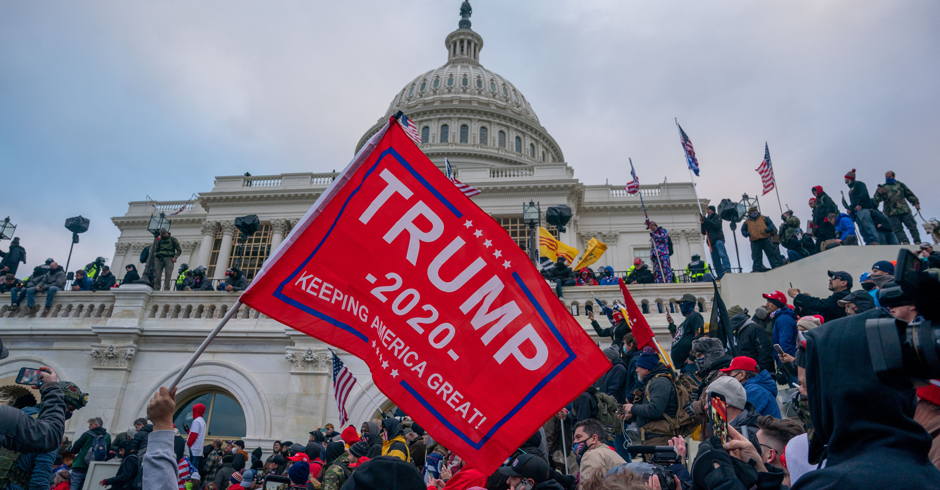
At 8:36 PM on January 6, 2021, Facebook publicly announced it was imposing a 24-hour block on then-President Donald Trump, following the deadly riot and insurrection on Capitol Hill. The following day Facebook CEO Mark Zuckerberg, citing the “use of our platform to incite violent insurrection against a democratically elected government,” announced the social media giant had banned Trump “indefinitely and for at least the next two weeks until the peaceful transition of power is complete.”
On January 8, 2021, Twitter announced its permanent suspension of Donald Trump’s account, “due to the risk of further incitement of violence,” after the January 6 insurrection. Citing two tweets earlier that day, Twitter “determined that they were highly likely to encourage and inspire people to replicate the criminal acts that took place at the U.S. Capitol on January 6, 2021.”
The company found the tweets “are in violation of the Glorification of Violence Policy and the user @realDonaldTrump should be immediately permanently suspended from the service.”
READ MORE: ‘Next Chapter?’ Manhattan DA Signals Trump Himself Might Finally Land Under Indictment
Two years later Donald Trump is preparing to return to both social media platforms, according to NBC News.
Several factors are responsible.
Over at Facebook, its Oversight Board decided in June of 2021 Trump’s suspension would be in place for just two years, starting in January of 2021, but also appeared to make clear the suspension would be lifted after that time, although its stated it would “look to experts to assess whether the risk to public safety has receded.”
“When the suspension is eventually lifted,” Facebook’s Oversight Board said at the time, making clear the suspension would be lifted “when,” and not “if,” “there will be a strict set of rapidly escalating sanctions that will be triggered if Mr. Trump commits further violations in future, up to and including permanent removal of his pages and accounts.”
The company has not yet made any decision public, but is expected to do so soon.
And at Twitter, Elon Musk purchased the company and reinstated numerous far right wing accounts, including Trump’s.
Trump has repeatedly stated he would not return to Twitter after starting his own social media platform. Truth Social pales in comparison to both Twitter and Facebook.
“With access to his Twitter account back,” NBC News reports, “Trump’s campaign is formally petitioning Facebook’s parent company to unblock his account there after it was locked in response to the U.S. Capitol riot two years ago.”
The Trump campaign is urging Meta, Facebook’s parent company, to allow him to return.
“’We believe that the ban on President Trump’s account on Facebook has dramatically distorted and inhibited the public discourse,’ Trump’s campaign wrote in its letter to Meta on Tuesday, according to a copy reviewed by NBC News.”
Tech Policy Press editor Justin Hendrix notes the letter to Meta comes on the “Same day a J6 Committee draft report detailed how he used social media to incite an insurrection.”
Meta says it “will announce a decision in the coming weeks in line with the process we laid out.”
NBC News, citing two anonymous Trump confidantes, reports, “Trump has sought input for weeks about hopping back on Twitter and that his campaign advisers have also workshopped ideas for his first tweet.”
Another, a Trump advisor, warned if the Facebook ban on Trump is extended, House Republicans will pressure Meta. NBC’s reporting suggests they would use hearings on how federal law treats social media platforms as “leverage.”
Meanwhile, Rep. Adam Schiff (D-CA), Sen. Sheldon Whitehouse (D-RI), and two other colleagues sent Meta a letter urging the ban be extended.
“Trump has continued to post harmful election content on Truth Social that would likely violate Facebook’s policies, and we have every reason to believe he would bring similar conspiratorial rhetoric back to Facebook, if given the chance,” they wrote.
AFP’s White House correspondent Sebastian Smith suggests it is, “Worth remembering Trump was thrown off FBook and Twitter because those platforms were his principle avenues for deluding an enormous part of the country into believing that the 2020 election was ‘stolen’.”
Noah Bookbinder, the president of the government watchdog Citizens for Responsibility and Ethics in Washington (CREW), posted this warning: “Donald Trump tried to overturn a free and fair election that he lost and incited a violent insurrection to try to keep himself in power. That he would be given back the megaphone of Twitter, and now maybe Facebook, is beyond irresponsible.”
Image via Shuttterstock
Enjoy this piece?
… then let us make a small request. The New Civil Rights Movement depends on readers like you to meet our ongoing expenses and continue producing quality progressive journalism. Three Silicon Valley giants consume 70 percent of all online advertising dollars, so we need your help to continue doing what we do.
NCRM is independent. You won’t find mainstream media bias here. From unflinching coverage of religious extremism, to spotlighting efforts to roll back our rights, NCRM continues to speak truth to power. America needs independent voices like NCRM to be sure no one is forgotten.
Every reader contribution, whatever the amount, makes a tremendous difference. Help ensure NCRM remains independent long into the future. Support progressive journalism with a one-time contribution to NCRM, or click here to become a subscriber. Thank you. Click here to donate by check.
 |


Six grand jury subpoenas were quashed by a federal judge Wednesday, when it was decided that the subpoenas were filed to retaliate against Democratic Minnesota Gov. Tim Walz’s administration and the city governments of Minneapolis and St. Paul.
Chief Judge Patrick J. Schiltz of the District of Minnesota made his ruling public on Monday, granting the motion requested by the Minnesota officials to quash grand jury subpoenas related to Minnesota declaring itself to be a “sanctuary” state.
Last December, the Department of Homeland Security deployed over 3,000 agents to Minnesota as part of the largest immigration-related operation in the department’s history, Operation Metro Surge. After the killings of Renee Good and Alex Pretti by DHS agents, the state of Minnesota as well as the twin cities challenged Operation Metro Surge in court, prompting President Donald Trump to rail against the local officials on social media.
READ MORE: Trump Dangles Another Insurrection Act Threat for Minnesota
Days after Minnesota, Minneapolis and St. Paul filed suit, news reports revealed that the Department of Justice had begun to investigate Walz and Minnesota Mayor Jacob Frey. Trump administration officials said that by not supporting the actions of DHS, Walz and Frey were breaking the law.
The Minnesotan officials argued that the subpoenas were “issued as part of an unconstitutional effort to coerce” them into working with DHS and ICE.
Judge Schiltz found that though grand juries traditionally “have broad investigatory powers,” the subpoenas had exceeded those powers. Schiltz agreed that the subpoenas were in violation of the Tenth Amendment, allowing states some degree of autonomy from the federal government.
Schiltz wrote that he had “no doubt” the subpoenas were issued for the “forbidden purposes” of attempting to “harass” or “coerce” Walz and Frey “into taking official action…. a blatantly unlawful and unethical use the grand-jury process.”
“On the one hand, the evidence that the challenged subpoenas were issued for unlawful reasons is overwhelming. On the other hand, the Department has struggled-without success-to identify a single plausible investigatory justification for the subpoenas,” Schiltz wrote, pointing out that the “public record… is replete with direct evidence of the Trump administration—including the highest-ranking officials of the Department—threatening and attempting to punish states and localities that have adopted ‘sanctuary’ policies.”
“To be clear, the Court agrees with the Department that a grand-jury subpoena need not be supported by probable cause. At the same time, a grand-jury subpoena cannot be issued for an improper purpose. The fact that connections between the information sought in the subpoenas and any possible criminal violation range from extremely weak to nonexistent only adds to the overwhelming evidence that these subpoenas were not issued to investigate, but to harass, coerce, and retaliate,” Schiltz added.
Image via Shutterstock

Rep. James Comer (R-KY) appeared on Fox Business to demand that former President Joe Biden’s pardons made on the final day of his term be nullified.
Comer appeared on Mornings With Maria Monday, demanding that Biden’s last-day pardons be undone, particularly one granted to former head of the National Institute of Allergy and Infectious Diseases (NIAID) and Biden’s chief medical advisor, Dr. Anthony Fauci.
“There were never any meetings that Joe Biden had with his staff on these pardons,” Comer said, according to a clip surfaced by journalist Aaron Rupar, dismissing host Maria Bartiromo’s statement that it was merely that the pardons wouldn’t count because they were signed with an autopen rather than by hand.
READ MORE: Trump Is Promising Mass White House Pardons: Report
“The defense is: There were never any scheduled meetings on his calendar… There was not a single person involved in the pardon process, in the decision making on who authorized the auto-pen, that ever met with Joe Biden and discussed the individual pardon. So, there’s no evidence Joe Biden had any decision making in the pardon process. So, I think that alone is more than enough evidence to declare all the pardons issued by Joe Biden in the last day of his presidency null and void.”
Comer calls on all of Biden's pardons issued on the last day of his presidency (especially the one for Fauci) to be "declared null and void" pic.twitter.com/N5TB0YUng3
— Aaron Rupar (@atrupar) June 22, 2026
Comer’s comments came after outgoing Director of National Intelligence Tulsi Gabbard declassified documents related to the COVID-19 pandemic. Gabbard said the documents show a connection between the United States and the Wuhan Institute of Virology, reigniting debunked claims that COVID-19 was the result of a lab leak.
The autopen, a device that stores the motions of a person’s signature and can automatically recreate it, has been at the center of a number of right wing conspiracy theories. Though it is a fact that Biden often used an autopen to automate the document-signing process, he is far from the first president to use it, according to NPR. Moreover, there is no evidence that Biden did in fact use an autopen for these particular pardons.
But even if he did, it would not matter. Nothing in the legal code requires a pardon to have a hand-signed signature. The president is granted the power to issue pardons or grant clemency in Article II, Section 2 of the Constitution. There is no mechanism through which Congress or another president can revoke a completed pardon. A president can revoke a pardon before it has been accepted by the pardonee—as happened in 1869 and again in 2008 under President George W. Bush—but once the pardon has been completed, it is forever. The only person who can go against a presidential pardon is the pardonee themselves if they refuse to accept it.
Not to mention that while the Department of Justice or other officials can make recommendations on whether or not to grant a person clemency, there is no requirement that the president must meet with anyone to discuss a pardon. The president has full discretion on whom to pardon. A pardonee does not have to be convicted or even indicted—for example, President Gerald Ford preemptively pardoned his predecessor, Richard Nixon, from being tried for any of the actions that led to his resignation.
Though he’s called for Biden’s pardons to be revoked in the past, President Donald Trump has also made a number of controversial pardons. Most famously, one of his first acts upon taking office for the second time was to pardon anyone involved with the January 6th, 2021 insurrection at the Capitol. If Biden’s pardons could be revoked, it stands to reason that a future president could revoke many of Trump’s pardons.
Image via Reuters
BAD PRESIDENT
Large Majority of Americans Say Iran Conflict Should End, Hasn’t Met Any of Trump’s Goals

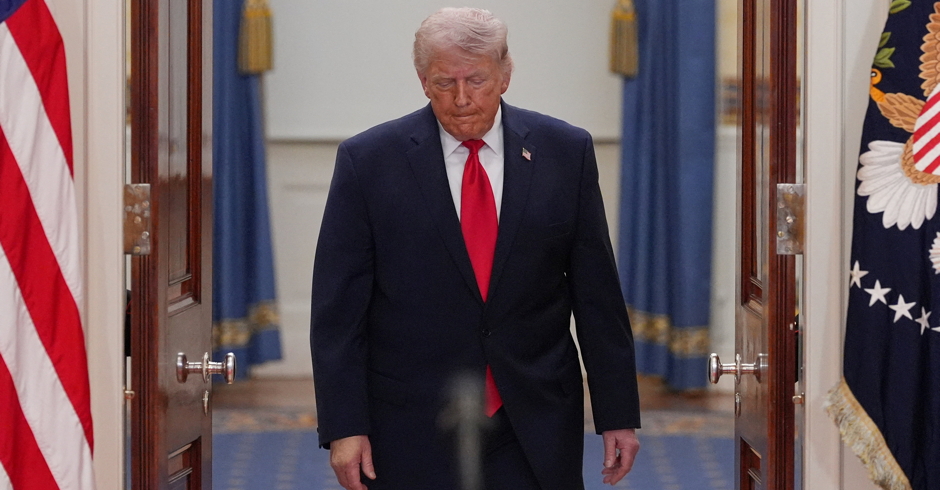
A large majority of Americans say that not only should the Iran conflict end immediately, but that President Donald Trump has not reached any of his stated goals for starting the conflict in the first place.
Over three-quarters of Americans, 78%, said in a new CBS News/YouGov poll the conflict in Iran should end “now.” Only 22% said it would be better to keep fighting until Iran agrees to “give up more” concessions to the United States.
Americans also felt that Trump’s stated goals for starting the conflict had not been met. When asked if Iran had been stopped from threatening other countries, only 32% said it had. A similar proportion, 31%, think that the conflict “permanently stopped” nuclear programs in the country. Even fewer think that the conflict has led to pro-U.S. leaders taking charge—only 21%—and slightly more, 26%, think that the U.S. has brought safety and freedom to the Iranian people. Overall, 69% say the Iran conflict was “not worth the cost.”
READ MORE: MAGA Revolt Erupts as Trump’s Own Hawks Turn Against His Iran Deal
The results remained relatively steady across demographics, with the exception of Americans who identified as conservative. But even then, the conservative responses were not as much in Trump’s favor as one might expect. When asked if the Iran conflict should end now, while liberals and moderates strongly agreed, at 95% and 80% respectively, a majority of conservatives, 61%, also agreed.
A slight majority of conservatives, 53%, thought Iran’s nuclear programs had been permanently stopped. They were split on the question of whether Iran would threaten other countries—48% of conservatives said Iran would stop, while 52% said they wouldn’t. When it came to replacing Iran’s leaders with pro-U.S. ones or bringing freedom to Iranian citizens, a majority of conservatives agreed that hadn’t happened.
The survey was conducted between June 17-19, and surveyed 2,519 adults. It has a 2.4% margin of error.
While the Iranian conflict has caused new leaders to take control of the country—former Supreme Leader Ali Khamenei was killed in airstrikes in February—he was replaced by his son, Mojtaba Khamenei. The younger Khamenei is widely described as being more conservative than his father, and the Atlantic Council think tank said he has ties to clerics it described as the “most ideologically extremist,” according to Axios.
Though Trump has claimed Iran’s military is “totally destroyed,” he’s also warned that the country could have a nuclear bomb “within six months.” However, the first report from the International Atomic Energy Agency since the Iran conflict started says that there has been no major change to the country’s nuclear program, according to Reuters.
Image via Reuters

Large Majority of Americans Say Iran Conflict Should End, Hasn’t Met Any of Trump’s Goals

GOP Rep Demands Biden’s Pardons to Be ‘Declared Null and Void’

Federal Judge Quashes ‘Retaliatory’ Subpoenas Against Minnesota Gov. Tim Walz
Federal Judge Quashes ‘Retaliatory’ Subpoenas Against Minnesota Gov. Tim Walz
GOP Rep Demands Biden’s Pardons to Be ‘Declared Null and Void’
Large Majority of Americans Say Iran Conflict Should End, Hasn’t Met Any of Trump’s Goals

Trump White House Turns on ‘Moron’ MAGA Loyalist ‘Begging for an Additional Brain Cell’

Veteran Journalist War-Games Trump’s ‘Rolling Coup’ — and How It Fails
 News3 days ago
Trump White House Turns on ‘Moron’ MAGA Loyalist ‘Begging for an Additional Brain Cell’
 News4 days ago
Administration Orders Federal Workers to Wear Pins From Trump’s Freedom 250 Group: Report

 News3 days ago
Trump Is a ‘Mountain of Degeneracy’ Driving America’s ‘Dignity Crisis’: Steve Schmidt

 News3 days ago
Trump Used Vulgar Epithet to Attack His Own Commerce Secretary: Report

 News3 days ago
‘Be Very Afraid’: Carville Warns Trump ‘Everybody Is Out for You’
 News4 days ago
National Trust Delivers Brutal Response to Trump Claim Foiled UFC Plot Proves Ballroom Urgency
 News3 days ago
Veteran Journalist War-Games Trump’s ‘Rolling Coup’ — and How It Fails
 BAD PRESIDENT4 hours ago
Large Majority of Americans Say Iran Conflict Should End, Hasn’t Met Any of Trump’s Goals