Intel Explains Boy Scout Funding Policy
Activist’s focus shifts to UPS
Intel has revealed new details about its plan to exclude organizations that discriminate on the basis of sexual orientation from its corporate giving, a move that could cost some Boy Scout troops thousands of dollars in donations.
Meanwhile, the activist whose campaign helped pressure Intel into announcing the plan has turned his attention to UPS, another of the Scouts’ corporate backers.
In an interview last week with The American Independent, Intel’s foundation explained that it will require all recipients — including individual Boy Scout troops and councils — to sign a letter agreeing to comply with the company’s non-discrimination policy, which bars funding for any group that discriminates based sexual orientation.
In September, a TAI report showed that the company had given $700,000 to various Boy Scout groups in 2010 through its “Intel Involved†volunteer matching grant program — despite the Scouts’ policy excluding gays and lesbians.
Zach Wahls of Scouts for Equality subsequently launched a petition drive calling on Intel to halt donations until the Boy Scouts reversed their exclusionary policy. That petition drive spurred Intel to issue a statement indicating that its foundation had already decided to apply “new rigor†to its grant-making process to ensure that all recipients complained with its non-discrimination policy.
On Wednesday, Wahls launched a similar campaign against UPS, which donated $167,000 to the Boy Scout in 2010 and about $85,000 in 2011. As of Monday, Wahls’ petition had nearly 14,000 signatures.
In an earlier interview, a UPS spokesperson told TAI that the Boy Scouts’ reaffirmation of its discriminatory policy “has not and will not impact The UPS Foundation’s decision to provide funding to BSA although we evaluate each funding request on an individual basis.â€
In Intel’s case, the company’s donations to various Boy Scout entities appeared to clash with its own policies regarding its volunteer matching program, which donates funds to charities based on employees’ volunteer hours. According to its website, the foundation disqualifies “organizations that discriminate on the basis of race, color, creed, sex, national origin, sexual orientation, veteran, or disability statuses†from the grant program.
TAI’s original report included several comments from Intel Foundation executive director Wendy Ramage-Hawkins:
When asked about the Intel’s funding policies, Intel Foundation executive director Wendy Ramage-Hawkins told TAI via email: “All organizations seeking financial support from the Intel Foundation are required to affirm their compliance with Intel’s non-discrimination corporate donation policy. Organizations that cannot affirm their compliance will not receive funding from the Intel Foundation.â€
Intel wouldn’t say whether or not it would continue to fund the Boy Scouts.
“We will know if and when they affirm our non-discrimination policy and request our support,†Ramage-Hawkins said.
She later clarified that the Intel Foundation will be asking for a statement of agreement with their nondiscrimination policy in the next grant cycle but had not done so in the past.
“We have not previously asked for affirmation, so this will be the first time the question is raised,†she said.
Shortly after Wahls launched the petition drive to urge Intel to end donations the Boy Scouts until they ended their exclusionary policy, Intel sent a statement to Think Progress.
“In an effort to recognize our employees commitment to the communities we call home, Intel expanded its volunteer matching grants program in 2009,†Intel’s Chief Diversity Officer, Rosalind Hudnell said. “Through it, Intel matches the amount of time employees’ volunteer with non-profits with dollars from the Intel Foundation. Due to significant growth in the number of organizations funded, earlier this year we revisited our policies associated with the program, and applied new rigor that requires any organization to confirm that it adheres to Intel’s anti-discrimination policy in order to receive funding.â€
TAI asked Intel Spokesman Chuck Mulloy what that “new rigor†looks like.
Mulloy said that individual Boy Scout troops that participate in the volunteer matching program will be contacted to ensure that they follow Intel’s non-discrimination policy.
“We want them to acknowledge that they have read and will comply with the non-discrimination policy,†he said. “For example, let’s say Troop 222 is going to get funded. They will get a letter that says, ‘You understand — and your organization will comply with — the non-discrimination policy.’â€
If the troop does not sign that letter, it will not get funded, said Mulloy.
He said that the new scrutiny being applied to the matching grant program came about last spring when Intel noticed that it hadn’t been checking whether organizations receiving funds were following Intel’s non-discrimination policy.
“We needed to be in compliance with our non-discrimination policy,†he said.
“When we set up the ‘Intel Involved†matching grant program, we said, ‘That’s a great idea,’†explained Mulloy. But as the program saw tremendous growth, the company realized it hadn’t properly vetted the organizations. “We looked at it and said, ‘Wait a minute, we forgot to check this.’â€
Mulloy said that the new rules in the program will apply to every organization slated to receive funds, not just the Boy Scouts, and scout troops that sign the non-discrimination statement will still receive funding.
TAI contacted Boy Scout entities that received money from Intel in the past, including the Golden Empire Council in Calif., the Knox Trail Council in Mass., and the Cascade Pacific Council in Ore. But they said they hadn’t yet heard from Intel and wouldn’t say whether they had plans to sign a non-discrimination statement.
Still, at least one Boy Scout council has prepared a document that it hopes will start the conversation with Intel.
Chris Shelby, the executive scout with the Great Southwest Council in New Mexico — which got about $4800 from Intel in 2010 — told TAI via email, “We will work with Intel to develop a better understanding of how GSWC will deal with the issue.â€
He sent TAI what he called the council’s membership standards, which appears to mirror the national Boy Scouts policy and does not appear to explicitly prohibit discrimination.
The document states, in part:
Great Southwest Council does not teach any program dealing with human sexuality, other than to encourage members to be sexually responsible to themselves and others. Programmatically, it places other issues of human sexuality, including heterosexual and homosexual sexuality, outside of its program;
Great Southwest Council does not initiate inquiry into the sexual orientation of existing or prospective members;
Great Southwest Council believes that issues or questions of human sexuality arising among its members are the province of that member’s family, religious leaders, doctors or other qualified advisors;
Great Southwest Council asks its members or those who seek to become members to subscribe to its programs, policies, principles and standards in support of Scouting’s mission. Among other reasons, Great Southwest Council reserves the right to exclude a member if his or her sexuality or behavior becomes publicly inappropriate;
Inappropriate sexual behavior is inconsistent with the Scout program and may hinder, distract or prevent Great Southwest Council from attaining its long sought and well established goals to foster the development of youth;
Great Southwest Council does not permit its organization to be used as a vehicle to promote any personal, political, social or other agenda that is inconsistent with Scouting’s mission or attaining its goals;
Great Southwest Council follows applicable laws and regulations dealing with employees’ rights and the fair treatment of people generally.
The Boy Scouts national policy, which the organization reaffirmed in July, is very similar.
In June, the BSA released the following statement:
The BSA policy is: “While the BSA does not proactively inquire about the sexual orientation of employees, volunteers, or members, we do not grant membership to individuals who are open or avowed homosexuals or who engage in behavior that would become a distraction to the mission of the BSA.â€
Scouting believes same-sex attraction should be introduced and discussed outside of its program with parents, caregivers, or spiritual advisers, at the appropriate time and in the right setting. The vast majority of parents we serve value this right and do not sign their children up for Scouting for it to introduce or discuss, in any way, these topics.
The BSA is a voluntary, private organization that sets policies that are best for the organization. The BSA welcomes all who share its beliefs but does not criticize or condemn those who wish to follow a different path.
This article originally appeared at The American Independent and is republished here by permission.
Related:
Boy Scouts Lose Largest Donor Over Anti-Gay Policies
Hundreds Of Boy Scouts’ Child Sex Abuse Cases Covered Up For Decades
Boy Scouts Determined To Continue Ban On Gays After Secret Study
Enjoy this piece?
… then let us make a small request. The New Civil Rights Movement depends on readers like you to meet our ongoing expenses and continue producing quality progressive journalism. Three Silicon Valley giants consume 70 percent of all online advertising dollars, so we need your help to continue doing what we do.
NCRM is independent. You won’t find mainstream media bias here. From unflinching coverage of religious extremism, to spotlighting efforts to roll back our rights, NCRM continues to speak truth to power. America needs independent voices like NCRM to be sure no one is forgotten.
Every reader contribution, whatever the amount, makes a tremendous difference. Help ensure NCRM remains independent long into the future. Support progressive journalism with a one-time contribution to NCRM, or click here to become a subscriber. Thank you. Click here to donate by check.
 |


President Donald Trump thrilled his supporters in New York on Friday as he shared how he came up with his latest nickname for Democrats — his explanation included a spelling lesson.
“Blue means Dumocrat,” the president said. “That’s a new name I came up with.”
“I was, I was thinking about this character we have in the House. His name is Hakeem Jeffries,” Trump said to boos from the audience.
“And he’s a low IQ person, very low IQ.”
“And I watched what he was saying, and what the horrible things he was saying, and I said, ‘He’s a dumb guy.’ I said, Wait a minute, he’s a Dumocrat. That’s how I got the name,” Trump excitedly said.
“You take the ‘e’ out, you don’t use the ‘b’. A lot of people don’t know ‘dumb’ has a ‘b’ in it, actually. You don’t need it. You discard the ‘b.’
“But you take the ‘e’ out, and you replace it with a ‘u.'”
“They are Dumocrats. You know why? ‘Cause their policies are dumb. Their policies are very dumb. All of their policies.”
Critics mocked the president.
“His uncle taught at MIT, but Trump just recently learned there is a b in dumb,” wrote political strategist Jeff Timmer.
“Dumbo @realDonaldTrump here is the only one who doesn’t know there’s a b in DUMB,” said former GOP Congresswoman Barbara Comstock.
“It’s impossible to overstate how f— — stupid Trump looks on the world stage,” wrote another online commenter.
Image via Reuters

President Donald Trump’s controversial Director of National Intelligence, Tulsi Gabbard, is resigning.
“Unfortunately, I must submit my resignation, effective June 30, 2026,” DNI Gabbard wrote to President Trump, Fox News reports. “My husband, Abraham, has recently been diagnosed with an extremely rare form of bone cancer.”
“During pivotal moments,” NBC News reports, “as Trump deliberated over possible military action or watched live video feeds of operations in Iran or Venezuela, Gabbard was often not in the room, underscoring her outsider status.”
“Gabbard has had a tough tenure being sidelined on Venezuela and Iran. Last month, Trump floated replacing her with Pam Bondi, but some advisers saved her,” reported WIRED’s Hugo Lowell.
President Trump wrote that Gabbard had done an “incredible job,” and “we will miss her,” while Reuters reports that the White House ”forced” Gabbard “to resign from her post, a person familiar with the matter said on Friday.”
The Wall Street Journal’s Dave Brown called Gabbard’s tenure “tumultuous.”
Critics were quick to respond.
“Good riddance. The Iran war has been the biggest display of intelligence incompetence in decades,” wrote U.S. Rep. Shri Thanedar (D-MI).
“Tulsi Gabbard leaves this administration in disgrace after helping Trump drag the country into yet another forever war in the Middle East,” wrote political strategist Mike Nellis. “She built her entire image on opposing these wars, then abandoned that principle the second it became politically inconvenient. That’s her legacy: a complete fraud, completely full of s— — about the one thing people thought she genuinely believed in. Good f— — riddance.”
“Also, is anybody in Congress or the media going to get to the bottom of the whistleblower’s story about Tulsi Gabbard withholding classified intercepted intel for political reasons?” Nellis continued. “What the hell happened there, or are we just going to pretend that didn’t happen?”
“Are we ever going to found out if Tulsi Gabbard broke how many different national security laws by allegedly refusing to hand over investigative documents, or is that just going away now?” asked writer Charlotte Clymer.
Professor and policy analyst Adam Cochran called Gabbard’s resignation “shocking,” and added: “Can’t imagine what they would ask to do that is too out of line for her…”
Associate Professor of Political Science Christopher Clary said Gabbard “will go down as perhaps the most ineffective and incompetent DNI in the short history of that position.”
Image via Reuters
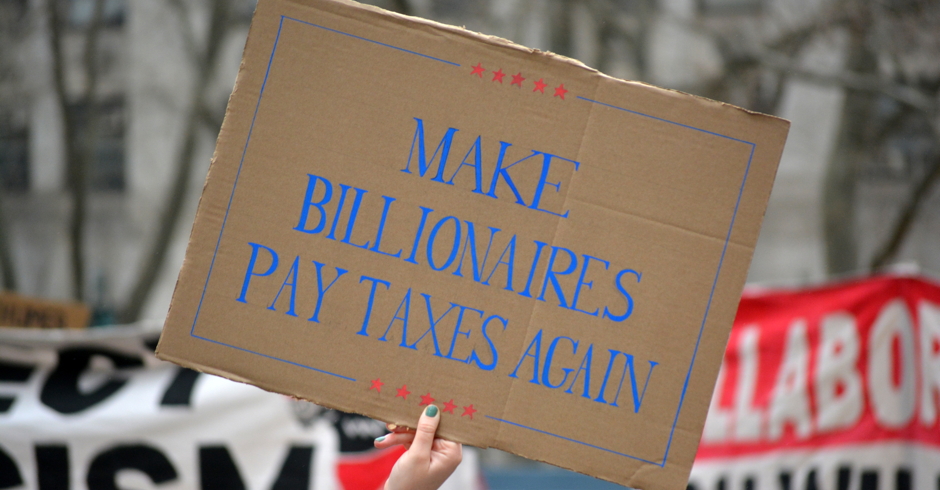
President Donald Trump managed to effectively raise taxes on the majority of Americans through his tax policies, while handing the richest five percent a tax cut. Now, many Americans want to see the rich pay their fair share — and that could mean increasing their taxes.
The former chief economist of the White House Office of Management and Budget, Professor Zachary Liscow, argues there’s a “slow, boring” yet “easy” way to do so.
“The United States is seeing an increasing concentration of wealth at the very top and a worsening national debt,” Liscow writes in an op-ed at The New York Times. “For many Americans, taxing the rich more is an obvious move.”
He details some of the “novel proposals to curb the many intricate ways the rich make and hide their money,” including a wealth tax, a tax on unrealized gains, and a tax on “loans that billionaires take against their stock.”
But, Liscow warns, while novel, these methods would not raise the substantial amount of money the U.S. needs.
“The boring truth is that Congress can accomplish a lot simply by raising the rates of the taxes already on the books,” Liscow explains.
He examines U.S. Senator Elizabeth Warren’s (D-MA) proposal to tax “fortunes above $50 million,” and says there are “serious constitutional and policy arguments for this idea, but the Supreme Court’s current members would probably strike it down.”
There is a billionaire’s tax proposal by U.S. Senator Ron Wyden (D-OR) that would tax unrealized capital gains, “the appreciation in the paper value of assets such as stocks.” That would likely find a Supreme Court challenge.
There are other tax vehicles, like fixing the “buy, borrow, die” loophole, which would tax loans taken against stock portfolios, but that would likely not raise sufficient funds: “It’s just not where the money is.”
He finds that “the most powerful lever is also the simplest one,” and concludes that “Congress has a simpler, tried-and-true tax policy to choose from: raising the rates.”
Liscow is advocating to restore the “top marginal ordinary income tax rate to its pre-2017 level of 39.6 percent” — where it was before Trump’s first term in office.
“In addition, raising the corporate tax rate from 21 percent toward the 35 percent it had been set at historically would add hundreds of billions in revenue for the government,” he says.
“Raising the rates,” Liscow concludes, “the simple, boring answer — is where the real money lies.”
Image: Christopher Penler / Shutterstock.com

Trump Explains ‘Dumb’ Has a ‘B’

‘Good Riddance’: Critics Cheer Tulsi Gabbard’s ‘Shocking’ Resignation

The ‘Slow, Boring’ and ‘Easy’ Way to Tax the Rich: Expert

Trump’s Latest ‘Executive Time’ Grievance Session Reveals What He’s Really Worried About

‘Political Survival’ Fears Driving Senate GOP to ‘Breaking Point’ With Trump: Report
 News2 days ago
Trump Explains ‘Dumb’ Has a ‘B’

 News3 days ago
‘Galactic Blunder’: Republicans Furious Over Timing of Trump’s $1.8 Billion Fund

 News3 days ago
‘Incredibly Hostile’: Blanche’s Capitol Hill Visit With Senate GOP ‘Did Not Go Well’
 News4 days ago
Rove Warns Trump Is ‘Helping Democrats’ Take Back the House

 News3 days ago
Trump: ‘I Don’t Know’ If I’m Losing Control of Senate Republicans
 News3 days ago
Trump’s Latest ‘Executive Time’ Grievance Session Reveals What He’s Really Worried About

 News3 days ago
‘Go Home USA’: Greenlanders Protest New American Consulate as PM Snubs Opening
 News2 days ago
‘Good Riddance’: Critics Cheer Tulsi Gabbard’s ‘Shocking’ Resignation