
FIRST AMENDMENT? WHAT FIRST AMENDMENT?
Watch: Trump Threatens to ‘Put Down Very Quickly’ Democrats Who Take to the Streets in Protest if He Wins Re-Election
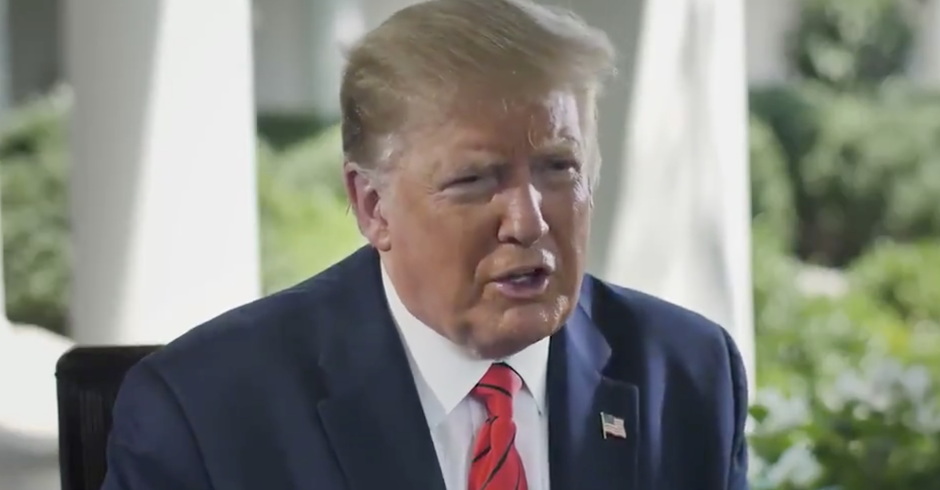
President Donald Trump promises to “put down” Democrats who choose to exercise their First Amendment rights to protest in the streets if he wins re-election.
“We’ll put them down very quickly if they do that. We have the right to do that. We have the power to do that, if we want,” Trump told Fox News host Jeanine Pirro in a taped interview that will air Saturday, as Politico reports.
“Look, it’s called insurrection,” the president added. “We just send in, and we do it very easy. I mean, it’s very easy. I’d rather not do that because there’s no reason for it, but if we had to, we’d do that and put it down within minutes.”
For months Trump has been deploying into American cities paramilitary SWAT teams of federal secret police with no insignias or name badges, armed with assault weapons, who have been tear gassing U.S. citizens protesting police killings of unarmed Black people.
Included among these highly-armed elite tactical agents are members of the U.S. Border Patrol’s BORTAC unit who receive “enhanced Special Forces-type training, including sniper certification,” The New York Times has reported. These “officers typically conduct high-risk operations targeting individuals who are known to be violent, many of them with extensive criminal records.”
Watch the president:
Fox & Friends teases Jeanine Pirro's Trump interview on Saturday with a bit where Pirro says hypothetically, "they're gonna threaten riots" on election night. Trump suggests using the Insurrection Act to "put them down very quickly. … Just send in and we do it very easy." pic.twitter.com/deIMpOJcCw
— Bobby Lewis (@revrrlewis) September 11, 2020
Enjoy this piece?
… then let us make a small request. The New Civil Rights Movement depends on readers like you to meet our ongoing expenses and continue producing quality progressive journalism. Three Silicon Valley giants consume 70 percent of all online advertising dollars, so we need your help to continue doing what we do.
NCRM is independent. You won’t find mainstream media bias here. From unflinching coverage of religious extremism, to spotlighting efforts to roll back our rights, NCRM continues to speak truth to power. America needs independent voices like NCRM to be sure no one is forgotten.
Every reader contribution, whatever the amount, makes a tremendous difference. Help ensure NCRM remains independent long into the future. Support progressive journalism with a one-time contribution to NCRM, or click here to become a subscriber. Thank you. Click here to donate by check.
 |


FIRST AMENDMENT? WHAT FIRST AMENDMENT?
Kagan Calls SCOTUS Porn Ruling ‘Confused’: ‘At War With Itself’

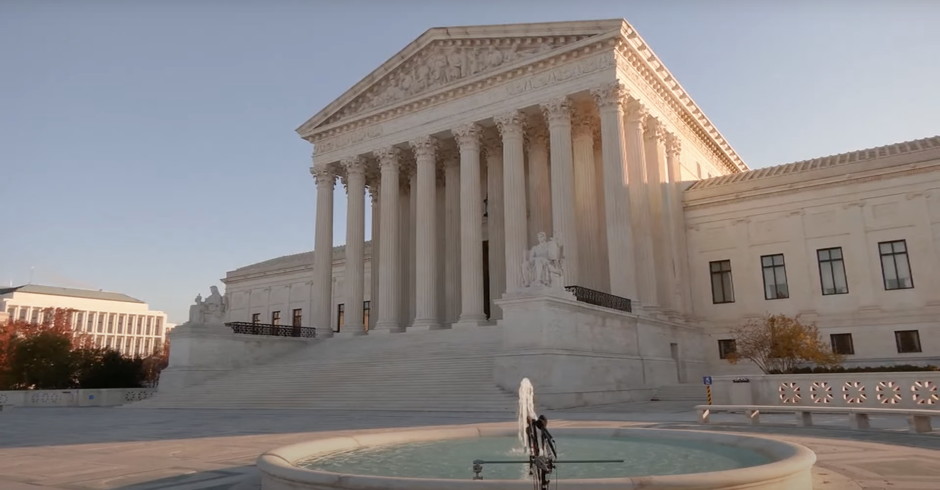
Justice Elena Kagan called Friday morning’s Supreme Court porn ruling “confused,” saying it flies in the face of established First Amendment case law.
In Free Speech Coalition, Inc. v. Paxton, the Supreme Court upheld a Texas state law that requires adults to provide official identification in order to view websites where at least one-third of the content on it is “harmful to minors.” The case was decided 6-3 on ideological lines, with Justice Clarence Thomas writing the majority opinion, and Justice Kagan writing the dissent.
The Court found that the 2023 Texas law did not run afoul of the First Amendment, in part because the state has an interest in protecting minors from harmful material. That part of the ruling was widely agreed upon. Where the issue lies is whether the specific law was well-tailored enough to not infringe on protected speech.
READ MORE: Louisiana Adults Must Now Show Drivers’ Licenses to Access Porn Online
Kagan and the other liberal justices disagreed on this point. She argued that while the state clearly has the right to declare certain speech obscene for minors and legally prohibit them from engaging with it, adults must still be allowed access. Kagan said that Friday’s ruling runs counter to cases brought before the Court “on no fewer than four prior occasions,” where the Court has “given the same answer, consistent with general free speech principles, each and every time.”
Kagan argued that the concept of “strict scrutiny” should have been applied to the Texas law, which requires the “least restrictive means of achieving a compelling state interest.” The ruling however, said that the ID requirement only hit the level of “intermediate scrutiny,” which does not require the state to answer the “least restrictive means” question.
“The majority’s opinion concluding to the contrary is, to be frank, confused. The opinion, to start with, is at war with itself. Parts suggest that the First Amendment plays no role here—that because Texas’s law works through age verification mandates, the First Amendment is beside the point. But even the majority eventually gives up that ghost. As, really, it must,” Kagan wrote.
She argued that the law would cause some people not to access these objectionable-to-minors websites, saying that people may not want to “identify themselves to a website (and maybe, from there, to the world)” as someone who enjoys pornography. The reference to “the world” refers to concerns raised by the Free Speech Coalition that the Texas law could leave citizens open to hackers if sites do not properly protect the identification information.
“But still, the majority proposes, that burden demands only intermediate scrutiny because it arises from an ‘incidental’ restriction, given that Texas’s statute uses age verification to prevent minors from viewing the speech. Except that is wrong—nothing like what we have ever understood as an incidental restraint for First Amendment purposes. Texas’s law defines speech by content and tells people entitled to view that speech that they must incur a cost to do so. That is, under our First Amendment law, a direct (not incidental) regulation of speech based on its content—which demands strict scrutiny,” Kagan wrote.
After the law passed, some pundits warned that if it were upheld, it could lead to other laws against content deemed objectionable. The Free Speech Coalition argued that porn can be the “canary in the coal mine of free speech,” and Harvard Law Professor Rebecca Tushnet agreed.
“If the Court is open to revisiting the First Amendment framework that structured the last 70 years or so of constitutional history, then many things will be up for grabs, including defamation law, political speech regulations, and compelled speech. Speech about abortion and LGBTQ issues would be the obvious next targets,” she said.
Image via Shutterstock
FIRST AMENDMENT? WHAT FIRST AMENDMENT?
Justice Clarence Thomas Believes Media Criticism of Decisions ‘Jeopardizes Any Faith’ in the Supreme Court

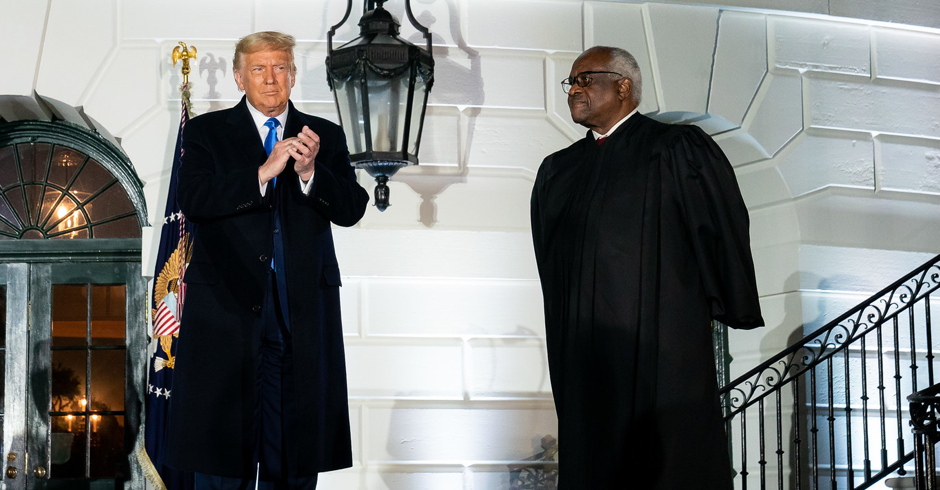
Justice Clarence Thomas complained about the harsh criticism the Supreme Court has received since allowing a controversial anti-abortion law to go into effect in Texas.
Thomas delivered the 2021 Tocqueville Lecture at the University of Notre Dame on Thursday, where he complained about media criticism, The Washington Post reported.
“I think the media makes it sound as though you are just always going right to your personal preference. So if they think you are anti-abortion or something personally, they think that’s the way you always will come out. They think you’re for this or for that. They think you become like a politician,” Thomas said.
“That’s a problem. You’re going to jeopardize any faith in the legal institutions,” he said.
A second Post report on the speech noted Thomas’ remarks on the ongoing mistrust of the court.
“The court was thought to be the least dangerous branch and we may have become the most dangerous,” Thomas said. “And I think that’s problematic.”
The newspaper noted the lecture was interrupted by protesters who yelled, “I still believe Anita Hill.”
FIRST AMENDMENT? WHAT FIRST AMENDMENT?
Four Cops ‘Drag’ Man From McCarthy Press Conference for Asking Question About Jan. 6 Committee

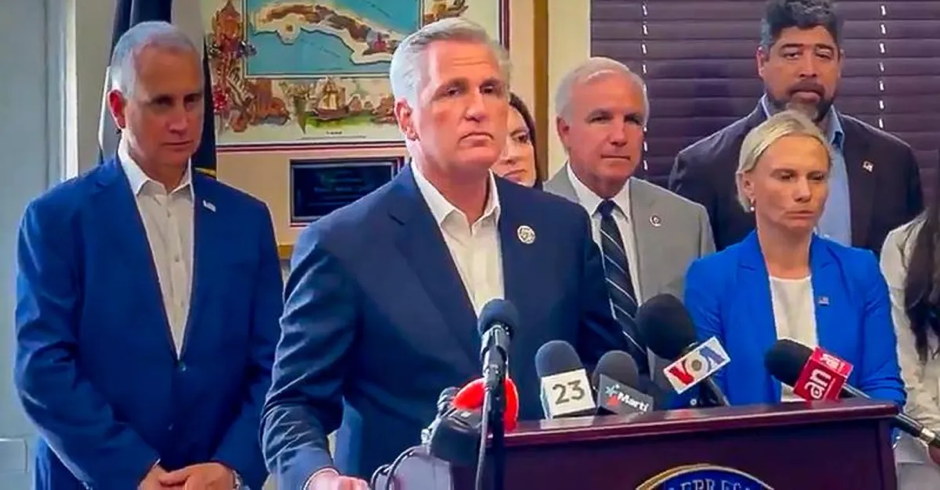
Four law enforcement officers reportedly removed a man from House Minority Leader Kevin McCarthy’s (R-CA) press conference on Thursday when he tried to ask a question about the Jan. 6 committee.
“I tried to ask @GOPLeader McCarthy a question after he decried Cuban police pickup up people in the streets,” Grant Stern explained in a tweet. “Why does he oppose the bipartisan #January6thCommission?”
“A Congressional staffer had four cops pick me up and drag me from the room,” he explained.
Stern’s bio indicates that he is an editor for the OccupyDemocrats organization.
Watch the video below
I tried to ask @GOPLeader McCarthy a question after he decried Cuban police pickup up people in the streets.
Why does he oppose the bipartisan #January6thCommission?
A Congressional staffer had four cops pick me up and drag me from the room.
I still asked the question. pic.twitter.com/HDqrhvARaC
— Grant Stern is fully vaccinated (@grantstern) August 5, 2021

Activist Minister Slams Regal Movie Theaters for Running War ‘Propaganda’ Before Films

Susan Collins Doesn’t Regret Kavanaugh Vote After Roe Repeal: ‘Didn’t Impact Maine’

Josh Hawley Slams Baseball League for Punishing Players Over Anti-Pride Night Demonstration

White House Retweets McDonald’s Advertisement, Appears to Take Credit for Bringing Back Apple Pie

Anti-Black Hate Crimes Per Capita Highest in Pacific Northwest Than Rest of U.S.
Susan Collins Doesn’t Regret Kavanaugh Vote After Roe Repeal: ‘Didn’t Impact Maine’
Josh Hawley Slams Baseball League for Punishing Players Over Anti-Pride Night Demonstration
White House Retweets McDonald’s Advertisement, Appears to Take Credit for Bringing Back Apple Pie
Anti-Black Hate Crimes Per Capita Highest in Pacific Northwest Than Rest of U.S.
Activist Minister Slams Regal Movie Theaters for Running War ‘Propaganda’ Before Films

 News2 days ago
A Letter From Florida Has a Blunt Verdict on the MAGA Movement: It’s ‘Dying’

 News2 days ago
‘I Feel So Bad for Him’: George Conway Trolls Trump Amid White House Attack

 News2 days ago
Red State Democrats Sound 2026 Warning Over ‘Trump Derangement Syndrome’

 News2 days ago
Can America Stage a ‘Remarkable Comeback’ After Trump’s ‘Bread and Circuses’: Kristol
 News2 days ago
GOP Lawmakers Turn on Trump: ‘Trying to Undermine Our Institutions’
 News23 hours ago
Activist Minister Slams Regal Movie Theaters for Running War ‘Propaganda’ Before Films
 News18 hours ago
Susan Collins Doesn’t Regret Kavanaugh Vote After Roe Repeal: ‘Didn’t Impact Maine’
 News19 hours ago
Josh Hawley Slams Baseball League for Punishing Players Over Anti-Pride Night Demonstration