
News
LISTEN: Trump Judge Asks House Why They Can’t Send Sergeant at Arms Into the DOJ With a Gun for Documents
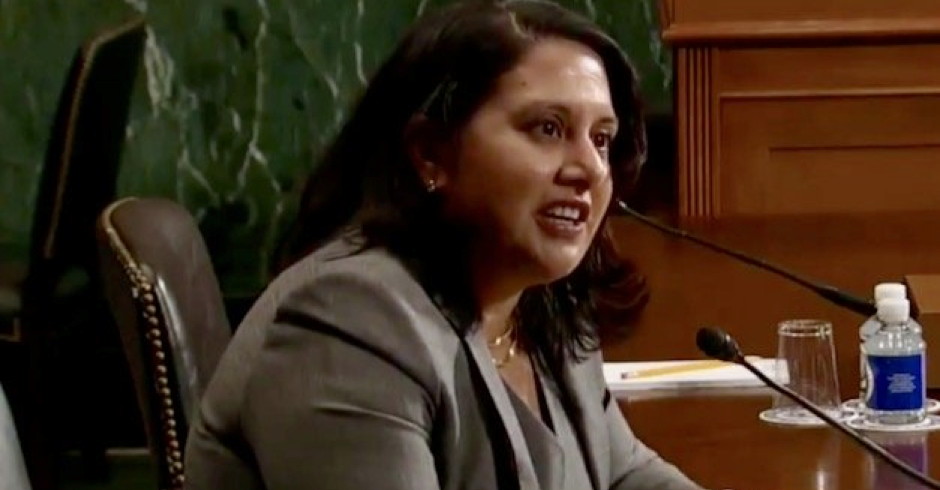
A strange exchange erupted between the U.S. House counsel and a federal judge appointed by Donald Trump Friday over the subpoenaed documents from special counsel Robert Mueller’s investigation and the convened grand jury.
Trump has demanded none of his staff or appointees comply with Congressional subpoenas on impeachment and refuse to give documents requested by the committees. Understandably, the House took the case to court, appearing before Trump appointee Judge Neomi Rao.
Republicans have complained that Democrats are not following the procedure by holding an impeachment vote before the case can move through the courts to subpoena first-hand witnesses that Trump has blocked. Yet, Trump’s judge asked Congress why they were coming to the Judicial branch when they had other avenues of getting Trump to comply with the subpoenas.
The last available option to Congress, House General Counsel Doug Letter said, would be to dispatch the Sergeant at Arms to march into the Justice Department with guns blazing.
Letter: “That’s stunning. That’s just stunning. If this court rules that the House is entitled to this material, the Attorney General is going to say — no?”
Judge Rao: “I’m asking a hypothetical.”
Letter: “I guess what we would do is we would use the main remedy that the House has had from the beginning. We’ll send the Sergeant at Arms over to the Justice Department. I cannot imagine that anybody at the Justice Department is going to interfere with him doing his duty as an officer to the House. And he will pick up the grand jury materials, and he will bring them to the House.”
Judge Rao: “So you do have some methods of self-help that don’t require this court to intervein?”
Letter: “Absolutely. We can send the Sergeant at Arms, and he can go have a gun battle with –”
Judge Rao: “Why not avail yourself of that remedy?”
Letter: “The reason is obvious.”
Judge Rao: “Why is it obvious?”
“When was the last time that was done?” another voice can be heard asking but isn’t identified.
Letter: “That’s why — again, this was discussed in the first case — that’s why we don’t do that anymore. We don’t have the Sergeant at Arms go out and arrest people and have a gun battle with Mr. Barr’s FBI security detail. Instead, we go to court.”
Former federal prosecutor Glenn Kirschner was in the courtroom for the exchange and explained that it isn’t often that discussion of two branches of government facing off in a gun battle is considered “light-hearted.”
“I don’t think it was intended to be serious, and it was really down in the weeds of a legal issue,” he explained. “If the court decided that these grand jury materials from the Mueller case can be sort of unsealed and available, that’s different from the court ordering the Department of Justice to turn them over. They seem like a difference without a distinction, but they are different things. So, I do think that Mr. Letter was surprised by the question because you have to believe if a federal appellate court orders that, ‘Yes, the House is entitled to these Mueller materials,’ then naturally the Department of Justice headed up by Bill Barr will simply turn them over.”
Kirschner said that given what Barr has done in the past, he’s not sure “it wasn’t actually a question with some consequences.”
Listen to the audio of the court discussion and the analysis by MSNBC in the video below:
Enjoy this piece?
… then let us make a small request. The New Civil Rights Movement depends on readers like you to meet our ongoing expenses and continue producing quality progressive journalism. Three Silicon Valley giants consume 70 percent of all online advertising dollars, so we need your help to continue doing what we do.
NCRM is independent. You won’t find mainstream media bias here. From unflinching coverage of religious extremism, to spotlighting efforts to roll back our rights, NCRM continues to speak truth to power. America needs independent voices like NCRM to be sure no one is forgotten.
Every reader contribution, whatever the amount, makes a tremendous difference. Help ensure NCRM remains independent long into the future. Support progressive journalism with a one-time contribution to NCRM, or click here to become a subscriber. Thank you. Click here to donate by check.
 |
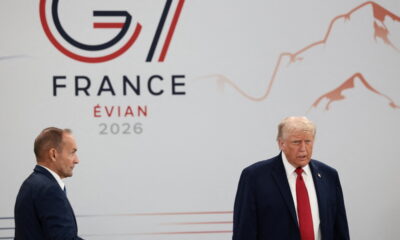


President Donald Trump spent years praising the trade deal he signed into law in 2020, the USMCA — United States–Mexico–Canada Agreement — which was his replacement for NAFTA — the North American Free Trade Agreement.
“America’s great USMCA Trade Bill is looking good,” Trump wrote in 2019. “It will be the best and most important trade deal ever made by the USA.” Declaring it would be good for everybody, he cheered, “we will finally end our Country’s worst Trade Deal, NAFTA!”
One year earlier, Trump said that his USMCA would serve as a means for Mexico to pay for his border wall:
“Mexico is paying for the wall through the many billions of dollars a year that the U.S.A. is saving through the new Trade Deal, the USMCA, that will replace the horrendous NAFTA Trade Deal, which has so badly hurt our Country. Mexico & Canada will also thrive – good for all!”
On Wednesday in Paris, the president gave reporters a different take on his deal, suggesting he would prefer to have no trade deal with America’s top trading partners, Canada and Mexico.
“I think it’s better without it,” Trump said. “I mean, to be honest with you. I’m not a big fan of it.”
He said the reason he had “liked it” was it helped get the U.S. out of NAFTA.
“That is the thing I liked about it the most,” Trump insisted. “We do better without an agreement.”
The president then offered two different scenarios. He said he would rather leave any USMCA extension “unsigned,” but then declared, “I’d rather have it terminated.”
When a reporter explained that those are “different things,” Trump replied, “I would rather not have the agreement, but I may sign it.”
“I would rather not have the USMCA,” he said. “I would prefer not having an agreement, but I’m open to doing it. We’ll see what happens.”
“It’ll be terminated,” he continued, as opposed to it expiring and not being renewed.
“I view it as possibly expiring immediately,” the president said.
The USMCA is up for renewal on July 1, but the U.S. has ruled that date out, Bloomberg News reported. “The US is negotiating on a bilateral basis. Talks with Mexico are ongoing, including sessions this week, while formal talks with Canada have not been launched.”
Last week, Trump said: “We don’t need anything that Canada has, we don’t need anything that Mexico has, but they need everything that we have, and they have to treat us better.”
.@POTUS: “I would rather not have the USMCA. The primary reason I wanted it was because there was no way out of NAFTA, which was the worst trade agreement ever made — like, ever — and they had no termination… I would prefer not having an agreement, but I’m open to doing it.” pic.twitter.com/aMM7MpAF9e
— Rapid Response 47 (@RapidResponse47) June 17, 2026
Image via Reuters
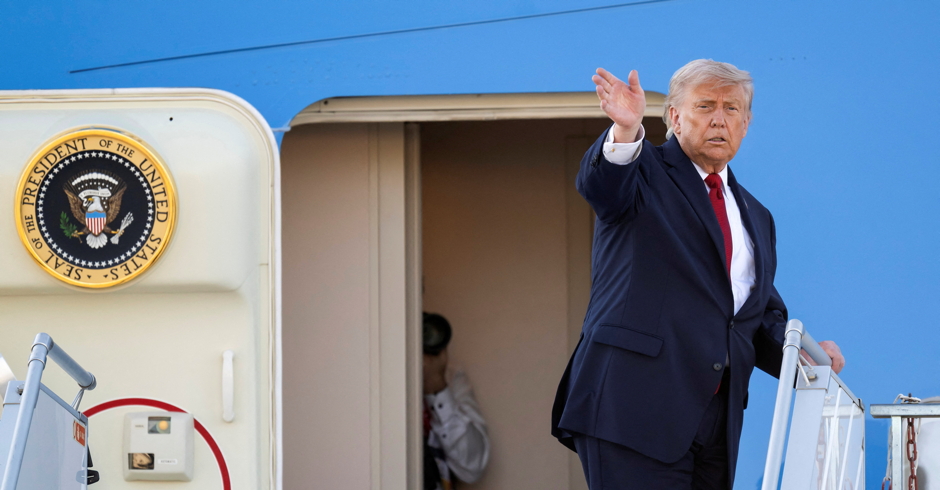
President Donald Trump will not serve out his full second term in office, argues political strategist James Carville, but rather, he will resign and “walk away.”
Carville points to two major reasons looming over Trump as to why he believes the 47th president will exit the office.
“I want to be very clear on something,” says Carville. “I’m not doing this as a crazy a—— prediction. I’m doing it because I genuinely think that he will resign next spring.”
“He’s going to walk away because the pain that is coming for him, both the emotional pain and the physical deterioration, you watch it right in front of your eyes,” said Carville. “I don’t have to be a doctor to see this guy can’t move. He can’t get out of a chair. I know what it’s like to be in the 80s. And unlike a lot of people, I know what that job is like, and it’s not compatible. You know, maybe there’s some people 80 who could do that. He’s not one.”
Acknowledging that he is not a medical doctor, Carville does note that he is close to Trump’s age: the president is 80, Carville is approaching 82.
He highlights Trump’s “rate of decline from Election Day to now,” and warns that “it’s not linear. You don’t lose a quarter of a percent a month. When it goes down, it goes quickly, and you can look at him and see how just fat and unhealthy he is.”
The other reason Carville believes Trump will exit the White House next spring: he suggests a tremendous loss in the November midterms for Trump, and explains how devastating that will be.
“I know what it’s like to lose a massive off-year election,” says Carville. “We did in 1994. It’s so monumental. It’s so massive. It hurts so deep. You just can’t imagine it. The entire world around him is going to change after November of this year.”
“People don’t pay attention to you,” says Carville. “They’re making jokes. Everybody knows you’re on a short leash. You got two years left to go. You don’t have any power. Everybody around you is being subpoenaed for everything that you can imagine. Your life is miserable.”
Carville went on to declare, “I’m doubling down on this prediction. He is just going to walk away.”
Trump, Carville predicts, will tell Vice President JD Vance — who would become president should Trump resign — that as president Vance can likely pardon himself. And while there is “some uncertainty as to whether you can do that,” there is “no uncertainty” as to whether a President Vance can pardon Trump and his family.
“So, I’m sticking with my prediction,” says Carville. “I think the son of a b—— is just going to walk away.”
Image via Reuters
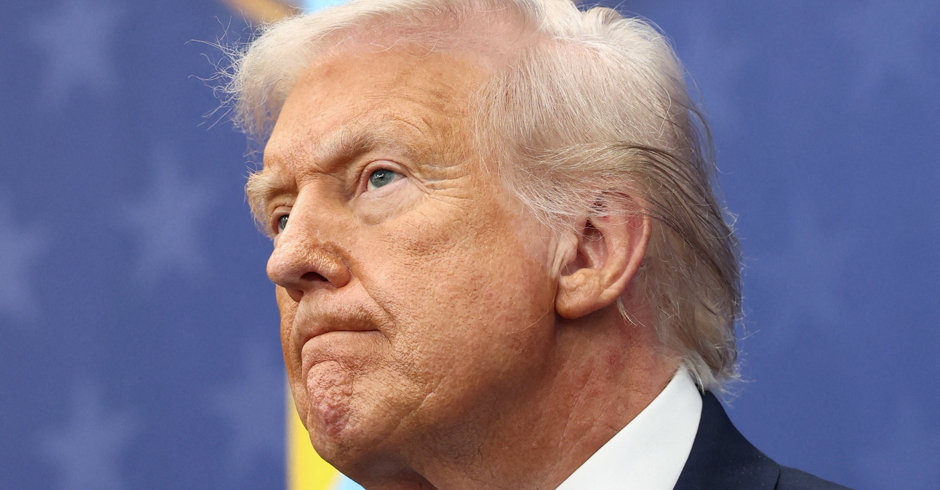
Republican National Committee leadership is staring at a “five-alarm fire bell,” conservative analyst Henry Olsen warns, as President Donald Trump’s sinking poll numbers put the GOP’s Senate majority at risk in November.
“The Republicans’ Senate fortunes,” Olsen writes at The Washington Post, “are tied to the man in the Oval Office. If the president can recover his standing even a few points, the GOP will probably retain Senate control. But all bets are off if he remains as unpopular as he is now.”
Olsen, a longtime Republican strategist and a senior fellow at the Ethics and Public Policy Center, explains that at the start of the year the road map for Democrats looked daunting. They had to gain four Senate seats to win the majority, while holding three open seats — Minnesota, New Hampshire and Michigan — that were seen as “far from safe.”
At best, the “most politically favorable remaining states” on the Senate map — Ohio, Iowa and Alaska — “were all carried by Trump by over 10 points. Democrats have not won a Senate seat in a state that red since 2018, when Jon Tester prevailed in Montana and Joe Manchin carried West Virginia.”
The tables have turned, and now it is Republicans who are facing an uphill battle.
Democrats are “leading or statistically tied in all of the seats they need to retain,” and “also lead or are statistically tied in six GOP-held states: Alaska, Iowa, Maine, North Carolina, Ohio and Texas.”
Plus, retired Army Lt. Col. Alexander Vindman, the expected Democratic nominee for Senate in Florida, is ahead of Republican U.S. Senator Ashley Moody, according to one recent poll.
Of course, as Olsen suggests, the campaigns have yet to get into full swing, there is still time, and the Democrats’ Maine nominee, Graham Platner, could be seen as a wild card.
“Perhaps Platner’s troubles will allow Collins to equal or slightly surpass her earlier result, but even then, the vast majority of her support will come from Trump approvers,” says Olsen. “If that total is under 40 percent, as it surely is right now, Collins probably won’t win.”
“But surely no one in the Republican high command thought they would be trailing or tied in 10 critical Senate races at this stage,” writes Olsen. “That sound you hear is a five-alarm fire bell at GOP HQ.”
In today’s polarized era, Olsen notes, many voters back their party rather than the candidate — and a party whose leader is underwater on most key issues weighs on every candidate on the ticket.
Image via Reuters

Carville Predicts When Trump Will Resign — and Why

MAGA Revolt Erupts as Trump’s Own Hawks Turn Against His Iran Deal

World Leaders Laugh as Trump Arrives Late to G7 With Odd Excuse: ‘I’m the Boss’

‘Better Without It’: Trump Now Trashes the Deal He Once Called the Best Ever

‘Five-Alarm Fire Bell at GOP HQ’: Conservative Warns of Brutal November for Republicans
‘Better Without It’: Trump Now Trashes the Deal He Once Called the Best Ever
Carville Predicts When Trump Will Resign — and Why
‘Five-Alarm Fire Bell at GOP HQ’: Conservative Warns of Brutal November for Republicans
World Leaders Laugh as Trump Arrives Late to G7 With Odd Excuse: ‘I’m the Boss’
MAGA Revolt Erupts as Trump’s Own Hawks Turn Against His Iran Deal

 News3 days ago
A Letter From Florida Has a Blunt Verdict on the MAGA Movement: It’s ‘Dying’

 News3 days ago
‘I Feel So Bad for Him’: George Conway Trolls Trump Amid White House Attack

 News3 days ago
Can America Stage a ‘Remarkable Comeback’ After Trump’s ‘Bread and Circuses’: Kristol

 News3 days ago
Red State Democrats Sound 2026 Warning Over ‘Trump Derangement Syndrome’

 News2 days ago
Activist Minister Slams Regal Movie Theaters for Running War ‘Propaganda’ Before Films
 News3 days ago
GOP Lawmakers Turn on Trump: ‘Trying to Undermine Our Institutions’
 News2 days ago
Susan Collins Doesn’t Regret Kavanaugh Vote After Roe Repeal: ‘Didn’t Impact Maine’

 News2 days ago
Josh Hawley Slams Baseball League for Punishing Players Over Anti-Pride Night Demonstration