FIRST AMENDMENT? WHAT FIRST AMENDMENT?
President Announces Executive Order ‘Very Soon’ on Conservatives on College Campuses
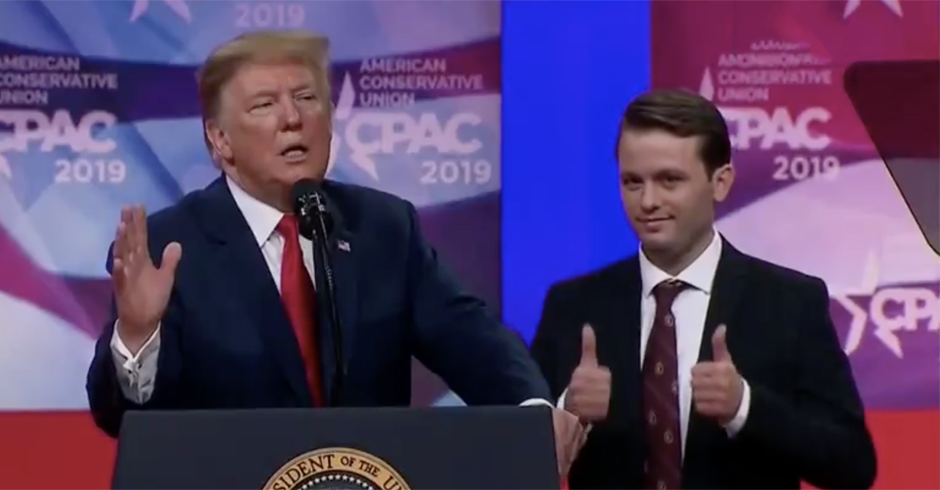
President Trump, during his bizarre, often rambling speech in front of the 2019 Conservative Political Action Conference (CPAC), lauded a young conservative activist assaulted on the University of California at Berkeley campus last month, vowing to sign an executive order in support of far-right speakers.
Trump urged the man, Hayden Williams, to “sue the college, the university. And maybe sue the state” over the assault, which was spurred on by signage at the Turning Point USA booth Williams was stationed at on the Berkeley Campus.
“He’s going to be a very wealthy young man,” said Trump. “Go get ’em, Hayden.”
Williams is not a student of the university, but was asked to be at the booth that day by members of the UC Berkeley chapter of Turning Point USA to attend. His suspected attacker, Zachary Greenberg, is also not a UC Berkeley student.
According to Williams, a pair of men had initially been angered by a sign referencing Jussie Smollett, and began cursing at the group. One of them, allegedly Greenberg, became physically aggressive.
Cell phone video of the assault shows Williams recording his attacker up close, before the assailant shoved Williams away, then punches Williams.
The school’s Chancellor, Carol Christ, spoke out about the attack in a message sent to the university.
“Let there be no mistake, we strongly condemn violence and harassment of any sort, for any reason,” read the message from Christ and the Vice Chancellor for student affairs Stephen C. Sutton. “That sort of behavior is intolerable and has no place here. Our commitment to freedom of expression and belief is unwavering.”
The president also announced that he will “very soon” sign an executive order requiring schools to “support free speech” as a requirement to receive research money from the government.
“If they want our dollars, and we give it to them by the billions, they’ve got to allow people like Hayden to speak,” said Trump.
It is unclear how such a statement would enhance already existing protections under the United States Constitution, nor if such an executive order would be limited to conservative speakers.
View the exchange below:
Trump calls Hayden Williams on stage. Williams was punched on UC Berkeley campus. Trump encourages him to “sue the college, the university. And maybe sue the state.” pic.twitter.com/mQqBQmnQgs
— Aaron Rupar (@atrupar) March 2, 2019
TRUMP: “Today I’m proud to announce that I will be soon signing an executive order requiring colleges and universities to support free speech if they want federal dollars.” pic.twitter.com/xDF5KLcrSu
— Aaron Rupar (@atrupar) March 2, 2019
Image via screen capture from video source.
Enjoy this piece?
… then let us make a small request. The New Civil Rights Movement depends on readers like you to meet our ongoing expenses and continue producing quality progressive journalism. Three Silicon Valley giants consume 70 percent of all online advertising dollars, so we need your help to continue doing what we do.
NCRM is independent. You won’t find mainstream media bias here. From unflinching coverage of religious extremism, to spotlighting efforts to roll back our rights, NCRM continues to speak truth to power. America needs independent voices like NCRM to be sure no one is forgotten.
Every reader contribution, whatever the amount, makes a tremendous difference. Help ensure NCRM remains independent long into the future. Support progressive journalism with a one-time contribution to NCRM, or click here to become a subscriber. Thank you. Click here to donate by check.
 |






FIRST AMENDMENT? WHAT FIRST AMENDMENT?
Kagan Calls SCOTUS Porn Ruling ‘Confused’: ‘At War With Itself’

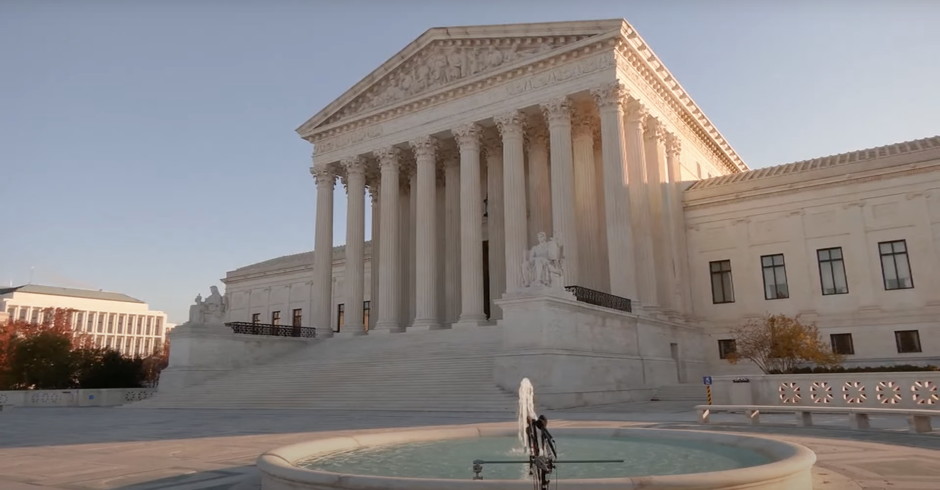
Justice Elena Kagan called Friday morning’s Supreme Court porn ruling “confused,” saying it flies in the face of established First Amendment case law.
In Free Speech Coalition, Inc. v. Paxton, the Supreme Court upheld a Texas state law that requires adults to provide official identification in order to view websites where at least one-third of the content on it is “harmful to minors.” The case was decided 6-3 on ideological lines, with Justice Clarence Thomas writing the majority opinion, and Justice Kagan writing the dissent.
The Court found that the 2023 Texas law did not run afoul of the First Amendment, in part because the state has an interest in protecting minors from harmful material. That part of the ruling was widely agreed upon. Where the issue lies is whether the specific law was well-tailored enough to not infringe on protected speech.
READ MORE: Louisiana Adults Must Now Show Drivers’ Licenses to Access Porn Online
Kagan and the other liberal justices disagreed on this point. She argued that while the state clearly has the right to declare certain speech obscene for minors and legally prohibit them from engaging with it, adults must still be allowed access. Kagan said that Friday’s ruling runs counter to cases brought before the Court “on no fewer than four prior occasions,” where the Court has “given the same answer, consistent with general free speech principles, each and every time.”
Kagan argued that the concept of “strict scrutiny” should have been applied to the Texas law, which requires the “least restrictive means of achieving a compelling state interest.” The ruling however, said that the ID requirement only hit the level of “intermediate scrutiny,” which does not require the state to answer the “least restrictive means” question.
“The majority’s opinion concluding to the contrary is, to be frank, confused. The opinion, to start with, is at war with itself. Parts suggest that the First Amendment plays no role here—that because Texas’s law works through age verification mandates, the First Amendment is beside the point. But even the majority eventually gives up that ghost. As, really, it must,” Kagan wrote.
She argued that the law would cause some people not to access these objectionable-to-minors websites, saying that people may not want to “identify themselves to a website (and maybe, from there, to the world)” as someone who enjoys pornography. The reference to “the world” refers to concerns raised by the Free Speech Coalition that the Texas law could leave citizens open to hackers if sites do not properly protect the identification information.
“But still, the majority proposes, that burden demands only intermediate scrutiny because it arises from an ‘incidental’ restriction, given that Texas’s statute uses age verification to prevent minors from viewing the speech. Except that is wrong—nothing like what we have ever understood as an incidental restraint for First Amendment purposes. Texas’s law defines speech by content and tells people entitled to view that speech that they must incur a cost to do so. That is, under our First Amendment law, a direct (not incidental) regulation of speech based on its content—which demands strict scrutiny,” Kagan wrote.
After the law passed, some pundits warned that if it were upheld, it could lead to other laws against content deemed objectionable. The Free Speech Coalition argued that porn can be the “canary in the coal mine of free speech,” and Harvard Law Professor Rebecca Tushnet agreed.
“If the Court is open to revisiting the First Amendment framework that structured the last 70 years or so of constitutional history, then many things will be up for grabs, including defamation law, political speech regulations, and compelled speech. Speech about abortion and LGBTQ issues would be the obvious next targets,” she said.
Image via Shutterstock
FIRST AMENDMENT? WHAT FIRST AMENDMENT?
Justice Clarence Thomas Believes Media Criticism of Decisions ‘Jeopardizes Any Faith’ in the Supreme Court

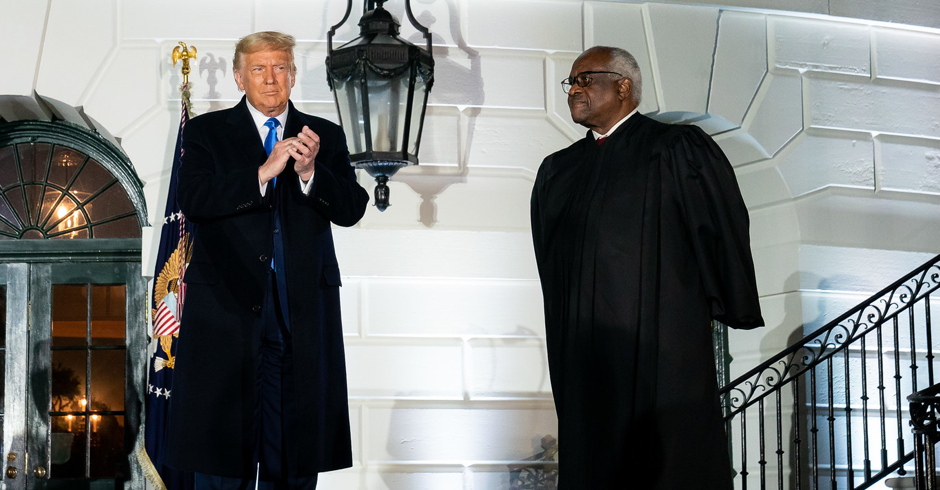
Justice Clarence Thomas complained about the harsh criticism the Supreme Court has received since allowing a controversial anti-abortion law to go into effect in Texas.
Thomas delivered the 2021 Tocqueville Lecture at the University of Notre Dame on Thursday, where he complained about media criticism, The Washington Post reported.
“I think the media makes it sound as though you are just always going right to your personal preference. So if they think you are anti-abortion or something personally, they think that’s the way you always will come out. They think you’re for this or for that. They think you become like a politician,” Thomas said.
“That’s a problem. You’re going to jeopardize any faith in the legal institutions,” he said.
A second Post report on the speech noted Thomas’ remarks on the ongoing mistrust of the court.
“The court was thought to be the least dangerous branch and we may have become the most dangerous,” Thomas said. “And I think that’s problematic.”
The newspaper noted the lecture was interrupted by protesters who yelled, “I still believe Anita Hill.”
FIRST AMENDMENT? WHAT FIRST AMENDMENT?
Four Cops ‘Drag’ Man From McCarthy Press Conference for Asking Question About Jan. 6 Committee

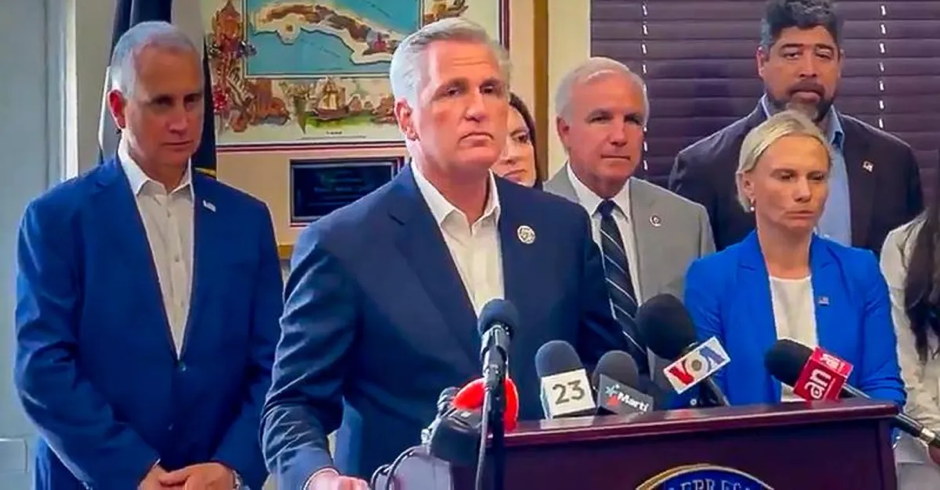
Four law enforcement officers reportedly removed a man from House Minority Leader Kevin McCarthy’s (R-CA) press conference on Thursday when he tried to ask a question about the Jan. 6 committee.
“I tried to ask @GOPLeader McCarthy a question after he decried Cuban police pickup up people in the streets,” Grant Stern explained in a tweet. “Why does he oppose the bipartisan #January6thCommission?”
“A Congressional staffer had four cops pick me up and drag me from the room,” he explained.
Stern’s bio indicates that he is an editor for the OccupyDemocrats organization.
Watch the video below
I tried to ask @GOPLeader McCarthy a question after he decried Cuban police pickup up people in the streets.
Why does he oppose the bipartisan #January6thCommission?
A Congressional staffer had four cops pick me up and drag me from the room.
I still asked the question. pic.twitter.com/HDqrhvARaC
— Grant Stern is fully vaccinated (@grantstern) August 5, 2021

Platner Scorched Over ‘Taking Time’ Video After New Accusation

Trump Sparks Fury Online After Posting Unblurred Video of Muslim Kindergartners in Hijabs

One Legal Maneuver Threatens to Undo Everything E. Jean Carroll Won

Inside the Group Helping MAGA Voters Walk Away — And What Finally Pushed Them