Trump: I Was Going to Fire FBI Director Comey ‘Regardless’
Contradicts Repeated White House Claims
President Donald Trump today contradicted repeated claims by his own White House, saying he was going to fire FBI Director James Comey regardless of the recommendation written by Deputy Attorney General Rod Rosenstein.Â
“I was going to fire Comey,” President Trump told NBC News anchor Lester Holt in an exclusive interview airing tonight. “Oh, I was going to fire regardless of recommendation” from Rosenstein.
Trump repeated the statement: “Regardless of recommendation I was going to fire Comey.”
BREAKING: I was going to fire Comey anyway, Pres. Trump tells @LesterHoltNBC in exclusive interview at White House https://t.co/MAmo1PE1RL
— NBC Nightly News (@NBCNightlyNews) May 11, 2017
The President, asked about the claim he made in Comey’s termination letter that says he is not under FBI investigation, insisted the now-former Director “told me that.”
Trump says Comey told him he was not under investigation once at dinner, and twice in telephone calls.
NBC News’ Justice Correspondent Pete Williams says it is not illegal for Trump to have asked or for Comey to have responded.
UPDATE: 1:17 PM EDT –
CNN White House producer:
.@VP said 7 times yesterday during presser on the hill that @POTUS fired Comey b/c of “recommendation of deputy attorney general.”
— Elizabeth Landers (@ElizLanders) May 11, 2017
EARLIER – RELATED:
To comment on this article and other NCRM content, visit our Facebook page.Â

Enjoy this piece?
… then let us make a small request. The New Civil Rights Movement depends on readers like you to meet our ongoing expenses and continue producing quality progressive journalism. Three Silicon Valley giants consume 70 percent of all online advertising dollars, so we need your help to continue doing what we do.
NCRM is independent. You won’t find mainstream media bias here. From unflinching coverage of religious extremism, to spotlighting efforts to roll back our rights, NCRM continues to speak truth to power. America needs independent voices like NCRM to be sure no one is forgotten.
Every reader contribution, whatever the amount, makes a tremendous difference. Help ensure NCRM remains independent long into the future. Support progressive journalism with a one-time contribution to NCRM, or click here to become a subscriber. Thank you. Click here to donate by check.
 |


President Donald Trump, who has insisted on federalizing voting and who issued an executive order last March to pressure states to require proof of citizenship to register voters, is reportedly now being urged to declare an emergency over voting.
“Pro-Trump activists who say they are in coordination with the White House are circulating a 17-page draft executive order that claims China interfered in the 2020 election as a basis to declare a national emergency that would unlock extraordinary presidential power over voting,” The Washington Post reported in an exclusive.
“President Donald Trump has repeatedly previewed a plan to mandate voter ID and ban mail ballots in November’s midterm elections, and the activists expect their draft will figure into Trump’s promised executive order on the issue.”
According to Florida lawyer Peter Ticktin, who is advocating for a presidential order on voting, “we have a situation where the president is aware that there are foreign interests that are interfering in our election processes.”
“That causes a national emergency where the president has to be able to deal with it,” Ticktin told the Post.
Claiming there is an emergency would allow the president to ban voting by mail and voting machines “as the vectors of foreign interference, Ticktin argued.”
Trump has repeatedly urged Republicans to pass the SAVE Act, which critics say could disenfranchise millions of American citizens who do not currently have a passport or access to their birth certificates. It could also disenfranchise people who have married and changed their names but did not do so on all their legal documents.
“Trump has said that if the bill fails, he will act unilaterally to impose the changes for the midterms,” the Post reported.
Image via Reuters
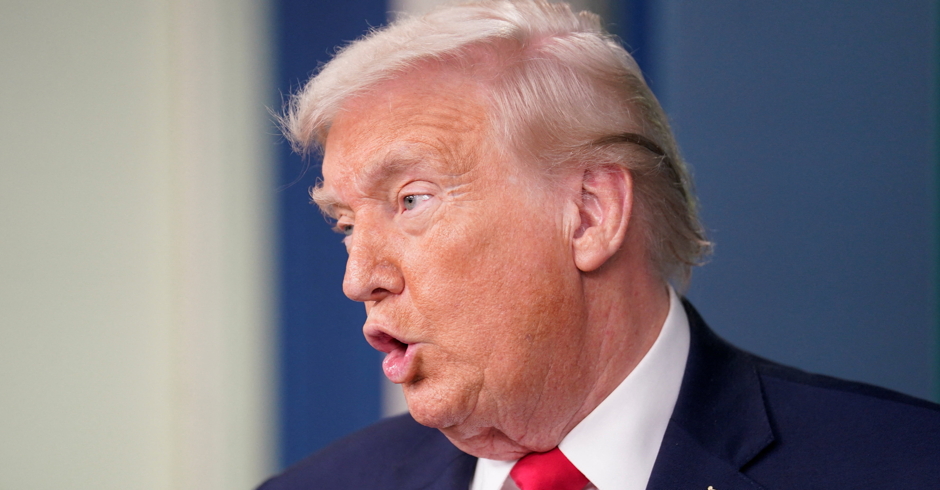
Despite the U.S. Supreme Court ruling that President Donald Trump‘s sweeping global tariffs were unlawful, administration officials are strategizing ways to keep at least some of the $133 billion already collected — even after the Trump Justice Department told the courts the funds would be paid back, plus interest, if he lost the case.
“Early ideas include policies to discourage companies from claiming their refunds, prevent the government from paying the money back or otherwise preserve at least some of the tariff revenue, according to five people familiar with the conversations, granted anonymity to discuss them,” according to Politico.
Another idea would be to claim that the funds are now lawfully held, after the administration announced its would use alternate legal vehicles to support collecting the tariffs going forward.
Yet another possible plan would be to allow companies that agree to forfeit a portion of the funds to obtain faster refunds.
READ MORE: Florida Bill Spurs Political Persecution and Surveillance Fears — Sponsor Says ‘Trust Me’
“Trump is trying to paint a blurry picture that the courts haven’t decided what to do with the money,” one of the people familiar with the strategies told Politico. They added that the normal refund process takes about two-and-a-half years, which would give the Trump administration “two years before there’s real question marks that they’re being insincere in returning that money.”
Should the Trump administration attempt to slow-walk refunds, Politico reports, its attempts would be challenged in the courts — and challenged by Democrats who see the refunds as a winning issue in a consequential political year.
“Trade lawyers and customs experts are skeptical that any mechanism the administration devises would hold up in court,” Politico noted. Judges at the Court of International Trade “are likely to scrutinize any effort that appears designed to sidestep repayment.”
“Obviously courts will not like it if the government not only doesn’t honor its word, but then makes everybody file a lawsuit to get the refund,” said Jeffrey Schwab, a lawyer for one of the companies that sued the Trump administration over the tariffs.
“What is fair in this case is the people that were harmed get the money back because that money was illegal,” Schwab told Yahoo Finance. “That money that they were charged was illegal.”
READ MORE: Trump Slammed for ‘Bragging’ He Kicked Millions Off Food Stamps
Image via Reuters

Controversial Florida legislation is raising alarms over issues including free speech, political persecution, surveillance, and viewpoint discrimination. But the bill’s sponsor says opponents should trust him to alter what critics charge is broad language that could be used to target alleged subversives based on their opinions.
The bill, which advanced in committee on Tuesday, “would allow secretive government surveillance and arrests of Floridians based on views, opinions or actions,” according to the Florida Trident.
The “primary mission” of what would be a new Florida Department of Law Enforcement (FDLE) unit “would include the detection, identification, and neutralization of ‘adversary intelligence entities,’ which include a ‘person whose demonstrated actions, views, or opinions are a threat of are inimical to the interests of the this state and the United States of America.'”
The bill’s sponsor, Republican state Rep. Danny Alvarez, “told the committee Tuesday that an amendment was in the works addressing concerns that he said had arisen in recent days over dangers the bill posed to free speech and risks of political persecution.”
READ MORE: Trump Vows Retirement Boost for Millions — Expert Questions His Fiscal Authority
Rep. Alvarez says he is “very aware” of the concerns surrounding First Amendment rights. “But just understand, this is going after terrorists, nation state bad actors, not political speech.” He defended the need for the new legislation, citing the terrorist attacks on September 11, 2001.
“People are looking for boogeymen here,” Alvarez said of the bill’s critics, according to The Intercept.
“There’s no boogeyman. I’m going to strip everything that makes you question it. You just have to trust me to get to the next committee,” he said. “But while you look for boogeymen, I need to be looking for terrorists. I need to prevent the next bomb.”
Alvarez disputed critics’ concerns, telling The Intercept that his bill “does not authorize investigations based solely on speech.”
“Any action must be tied to demonstrable conduct and constitutional standards. The First Amendment remains fully intact, and the unit operates under strong statutory safeguards and oversight.”
But critics see a “civil liberties nightmare in the making that could be used to target Muslims and alleged subversives based solely on their views or opinions, much like the FBI’s notorious COINTELPRO program,” The Intercept noted.
Adversary Intelligence Entities
“According to the bill,” The Intercept reports, “adversary intelligence entities” are entities that “include but are not limited to ‘any national, foreign, multinational, friendly, competitor, opponent, adversary, or recognized enemy government or nongovernmental organization, company, business, corporation, consortium, group, agency, cell, terrorist, insurgent, guerrilla entity, or person whose demonstrated actions, views, or opinions are a threat or are inimical to the interests of this state and the United States of America.”
Bobby Block, the executive director of the Florida First Amendment Foundation, “said the bill’s sweeping language leaves open the possibility that the new unit could target people simply based on their views, citing the language about actors who hold views deemed ‘inimical’ to Florida,” meaning harmful or hostile.
“What does that mean? If I’m not a white Christian nationalist, does that mean my views are inimical to the values? It begs a lot of questions,” Block said.
READ MORE: Trump Slammed for ‘Bragging’ He Kicked Millions Off Food Stamps
Image: Official Florida House photo

Trump Vows Retirement Boost for Millions — Expert Questions His Fiscal Authority

Media Mogul Who Urged Prayer for Trump’s Win Met With Top White House Aide: Report

‘Bloodshot Eyes of Crazy People’: Trump Lashes Out at Two ‘Deranged’ Dems in New Wild Rant

Trump’s First Stop to Sell His New Message — Deep Red Texas

Florida Bill Spurs Political Persecution and Surveillance Fears — Sponsor Says ‘Trust Me’

‘Extraordinary Presidential Power’: Trump Is Urged to Declare Emergency Over Voting

Trump Wants to Keep Billions in Tariffs Unlawfully Collected — Here’s His Playbook
Florida Bill Spurs Political Persecution and Surveillance Fears — Sponsor Says ‘Trust Me’
Trump Vows Retirement Boost for Millions — Expert Questions His Fiscal Authority
Media Mogul Who Urged Prayer for Trump’s Win Met With Top White House Aide: Report

 News3 days ago
‘Orwellian Gaslighting’: Trump CIA Slammed for Retractions of ‘Biased’ Reports
 News3 days ago
Judge Cannon Permanently Blocks Release of Jack Smith Classified Docs Report

 News2 days ago
Trump Slammed for ‘Bragging’ He Kicked Millions Off Food Stamps
 News3 days ago
Trump Previews State of the Union Address in Wild and Rambling White House Remarks
 News3 days ago
MAGA Existed Before Trump — It Isn’t Going Away When He Leaves Says Op-Ed
 News2 days ago
‘This Is Wrong’: Attorney Who Argued Tariff Case Tells Trump ‘Time to Pay Up’
 News2 days ago
Trump Confronted With Sign Saying ‘Black People Aren’t Apes’ at State of the Union

 News2 days ago
Top Dems Sound Alarm After Intel Briefing: Middle East Wars ‘Don’t Go Well for Presidents’