Utah To 10th Circuit Judges: Hey, That Regnerus Study We Cited, Just Fuhgeddaboudit
The State of Utah has conducted their defense of traditional marriage in such an appalling manner one almost might feel sorry for them. On December 20, when a federal judge ruled that their ban on same-sex marriage was unconstitutional, state attorneys were entirely unprepared and seemingly didn’t know how to respond. It took them over a week to convince, finally, the Supreme Court to stay the ruling.
That was just the start.
The New Civil Rights Movement’s Eric Ethington wrote at the end of last month:
In the latest round of submitted briefs to the 10th Circuit Court, Utah was forced to submit a clarification brief, asking the court to let them correct more than ninety misspelling, grammar, and incorrect citation errors. As if that wasn’t embarrassing enough, it turns out that the clarification brief had errors of its own, and Utah had to submit another brief to fix the new errors.
(By the way, Ethington reports that in a separate brief filed last night, Utah Republican Attorney General Sean Reyes “quietly filed a Petition For Emergency Extraordinary Relief with the Utah Supreme Court to allow the state to halt adoptions by LGBT parents already in motion.”)
Add to this the news that last night the State of Utah submitted a letter asking the 10th Circuit Court judges to totally disregard any arguments they previously made regarding the work of wholly discredited researcher Mark Regnerus.
Regnerus, you’ll remember, was funded by the religious and anti-gay right, and claimed that his study proved that adult children raised by same-sex parents do profoundly worse in dozens of areas that their peers raised by different-sex parents. That claim has been debunked repeatedly, including many times on these pages.
Zack Ford at Think Progress pulls the relevant quote from yesterday’s letter to the Court:
First, we wish to emphasize the very limited relevance to this case of the comparison addressed by Professor Regnerus. As the State’s briefing makes clear, the State’s principal concern is the potential long-term impact of a redefinition of marriage on the children of heterosexual parents. The debate over man-woman versus same-sex parenting has little if any bearing on that issue, given that being raised in a same-sex household would normally not be one of the alternatives available to children of heterosexual parents.
Second, on the limited issue addressed by the Regnerus study, the State wishes to be clear about what that study (in the State’s view) does and does not establish. The Regnerus study did not examine as its sole focus the outcomes of children raised in same-sex households but, because of sample limitations inherent in the field of study at this point, examined primarily children who acknowledged having a parent who had engaged in a same-sex relationship. Thus, the Regnerus study cannot be viewed as conclusively establishing that raising a child in a same-sex household produces outcomes that are inferior to those produced by man-woman parenting arrangements.
You’ll remember, too, that the judge in last month’s Michigan marriage trial added to the disgrace heaped upon Regnerus and his work:
The Court finds Regnerus’s testimony entirely unbelievable and not worthy of serious consideration. The evidence adduced at trial demonstrated that his 2012 ‘study’ was hastily concocted at the behest of a third-party funder, which found it ‘essential that the necessary data be gathered to settle the question in the forum of public debate about what kinds of family arrangement are best for society’ and which ‘was confident that the traditional understanding of marriage will be vindicated by this study.’ … While Regnerus maintained that the funding source did not affect his impartiality as a researcher, the Court finds this testimony unbelievable. The funder clearly wanted a certain result, and Regnerus obliged.
[Bolding ours]
With absolutely no scientific or non-religion-based arguments left to discriminate against same-sex couples, how long will it take for marriage equality to reach all 50 states?
Stay tuned today to The New Civil Rights Movement for updates on today’s 10th Circuit hearing.
Image: Screenshot of Utah letter, via Equality Case Files on Scribd

Enjoy this piece?
… then let us make a small request. The New Civil Rights Movement depends on readers like you to meet our ongoing expenses and continue producing quality progressive journalism. Three Silicon Valley giants consume 70 percent of all online advertising dollars, so we need your help to continue doing what we do.
NCRM is independent. You won’t find mainstream media bias here. From unflinching coverage of religious extremism, to spotlighting efforts to roll back our rights, NCRM continues to speak truth to power. America needs independent voices like NCRM to be sure no one is forgotten.
Every reader contribution, whatever the amount, makes a tremendous difference. Help ensure NCRM remains independent long into the future. Support progressive journalism with a one-time contribution to NCRM, or click here to become a subscriber. Thank you. Click here to donate by check.
 |

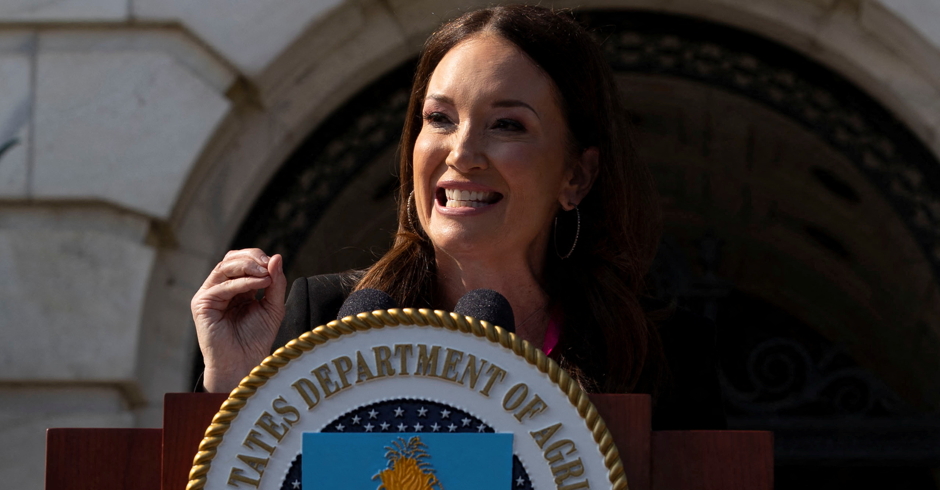
U.S. Secretary of Agriculture Brooke Rollins claimed Medicaid is “bankrupting” the states, while suggesting that “healthy” foods could serve to help reduce health care costs. Yet both Medicaid and nutrition programs like SNAP were slashed under President Donald Trump and Republicans’ so-called One Big Beautiful Bill Act, which was signed into law just ten days ago.
“Medicaid is bankrupting almost every state,” Secretary Rollins claimed in remarks on Monday (video below).
With the Republicans gutting over $1 trillion in federal Medicaid funds, and approximately $200 billion in SNAP funds, states face either picking up that massive shortfall or cutting some programs, benefits, or users.
Medicaid is “taking between 30, 40, 45, 50 percent of the state budgets, and has for a really long time, for those of us who come from state policy, we know this very, very well,” Rollins continued. State funds for Medicaid (not including federal matching funds) account for less than 20 percent of state budgets, overall, according to the Pew Research Center.
READ MORE: At Faith-Based Event Trump Courts Religious CEOs, Uses Expletive, Calls Dems ‘Evil’
Secretary Rollins previously served as a policy director for Texas Governor Rick Perry and led the right-wing Texas Public Policy Foundation. More recently, she headed the America First Policy Institute, a conservative think tank dedicated to advancing President Trump’s first post-presidency agenda.
Rollins decried what she says is the number one purchase using SNAP funds: “sugary drinks and junk food.”
“Frankly, we have to make a change,” she insisted.
“So there is a lot of wholesale across the government that we can do, but there’s also a recognition that a lot of these communities that are part of the Medicaid program, they don’t always have access to healthy food,” Rollins continued, not mentioning the billions the BBB Act gutted from both.
Rollins insisted the federal government has to do “a better job through our nutrition programs, through our partnerships, et cetera, of ensuring that those communities have access to healthy foods.”
“So on the back end, we have programs that are not bankrupting our government.”
Watch the video below or at this link.
Brooke Rollins: “Medicaid is bankrupting almost every state … we have to do a better job through our nutrition programs of ensuring that those communities have access to health foods, so on the backend we have programs that are not bankrupting our government.” pic.twitter.com/WyaQp3C9Hy
— Aaron Rupar (@atrupar) July 14, 2025
READ MORE: ‘Dumb-Dumb’: Fox News Host Declares Rising Democrat a ‘Mental Deficient’ Amid Senate Buzz
Image via Reuters
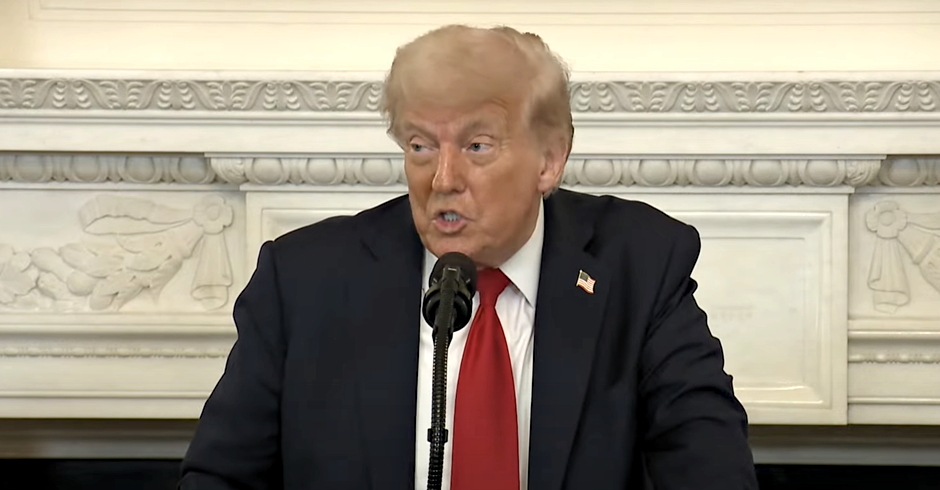
During a White House Faith Office event focused on renewing America “spiritually and financially,” President Donald Trump lashed out at “evil” Democrats and used an expletive while venting about his indictments and impeachments.
The meeting was attended by about 60 CEOs and business leaders who have donated to faith-based causes, in an attempt to persuade them to invest in the White House Faith Office, according to Fox News.
“White House Faith Office senior advisor Pastor Paula White, Faith Director Jenny Korn, National Economic Council Director Kevin Hassett, Treasury Secretary Scott Bessent, Commerce Secretary Howard Lutnick and Small Business Administrator Kelly Loeffler will attend the event and also deliver remarks,” Fox News also reported.
READ MORE: ‘Dumb-Dumb’: Fox News Host Declares Rising Democrat a ‘Mental Deficient’ Amid Senate Buzz
Trump was “expected to explain why the White House Faith Office is so important to his agenda,” and “encourage business leaders to help the Trump administration, specifically on programs concerning foster care and adoption, fatherhood initiatives, poverty alleviation, substance abuse and prisoner reentry.”
But the President also explained (video below) “one thing” about Democrats: “they have bad policy, they’re evil people in many ways, but they stick together,” he claimed.
Trump warned that if Republicans don’t stand together “and make the economy strong…you’re gonna literally have perhaps a depression, where you people so rich, so beautiful, so nice to look at, will be totally busted. And let’s see how long your wife stays with you, your beautiful — she’ll stay with you for about three weeks and she’ll say, ‘Darling, I can’t take you anymore. I can’t take it anymore, darling, I’m leaving you’.”
The President also denounced his indictments and impeachments.
“Indicted five times, impeached two times, all b——-, right?” he told the group. “Oh, terrible stuff, and I got impeached for making a perfect phone call.”
READ MORE: ‘Like Taking a Knife to a Gunfight’: Trump’s Russia Tariffs of ‘About 100%’ Mocked
Trump also claimed that he is “getting rid of” the Johnson Amendment, a 1954 provision in the tax code that bans certain non-profits, including groups like churches, from endorsing political candidates. It has never been fully enforced, and no church has ever lost its tax-exempt status solely for violations of that law.
The Freedom From Religion Foundation denounced the meeting’s agenda.
“Trump is again blurring the line between church and state,” FFRF wrote. “A president shouldn’t be rewarding CEOs for promoting religion or using public office to advance a ‘faith-centered’ agenda. Government must serve all Americans — not just the religious.”
Watch the video below or at this link.
Trump on Democrats during his speech to a faith group: “They’re evil people in many ways.” pic.twitter.com/qhxgccA7Mj
— Aaron Rupar (@atrupar) July 14, 2025
READ MORE: ‘Absolute Cringe’: DHS Ridiculed After Attacking CNN Report—by Confirming It

For the past few days, President Donald Trump and his allies have been teasing what was billed as a major announcement about Russia. On Monday, the President issued a warning to President Vladimir Putin: sign a cease-fire agreement within 50 days with Ukraine or face tariffs of “about 100%” on Russian goods imported into the United States.
“I am very disappointed with President Putin,” Trump said on Sunday. “I thought he was somebody that meant what he said. And he’ll talk so beautifully and then he’ll bomb people at night. We don’t like that.”
“I’m disappointed in President Putin because I thought we would have had a deal two months ago,” Trump declared on Monday from the Oval Office, continuing what has been a rare distancing from the Russian dictator. But in announcing his secondary tariffs of about 100%, Trump added, “I hope we don’t have to do it.”
Trump called the tariffs “major” and “very severe,” while telling reporters that he speaks to Putin “a lot.”
READ MORE: ‘Dumb-Dumb’: Fox News Host Declares Rising Democrat a ‘Mental Deficient’ Amid Senate Buzz
He also defended giving Russia 50 days notice by saying, “I think it’s a very short period of time,” and, “I’ve just really been involved in this not very long. It wasn’t an initial focus. This is a Biden war. This is a Democrat war.”
Critics disagree.
Some observers are noting that Trump ran for re-election last year on the promise he would end Russia’s war against Ukraine in one day. Some also note that 50 days gives Putin a lot of time to inflict further damage on Ukraine, although Trump also announced he is authorizing Patriot missiles to go to Ukraine.
Technologist, historian, and researcher Dave Troy, who has written extensively on Russia, noted: “Trump’s announcement on Russia/Ukraine is not significant. 1) we’re not paying for weapons, we are selling them to NATO, 2) secondary 100% tariffs isolate the US from Russia sphere of influence, a strategic goal for Putin, 3) 50 day window provides pretext for attack escalation.”
Former Obama National Security Council official Tommy Vietor wrote: “I’m glad that Trump finally figured out that Putin is a liar who can’t be trusted & has chosen to support Ukraine, but: 1) he ran on ending this war in 24 hours and failed, 2) he said sending weapons to Ukraine would lead to World War 3, but now is doing exactly what Biden did.”
Last year, the U.S. imported only $3 billion from Russia, according to the Office of the United States Trade Representative.
READ MORE: GOP Senator Denounces Anti-ICE Democrats as ‘Pawns’ of an ‘Anarchist Agenda’
“Congress has been waiting on Trump’s green light for a bipartisan bill that would slap 500% tariffs on any country doing business with Russia,” reported Fox News senior White House correspondent Jacqui Heinrich. Later, she added that Trump appears supportive of the legislation, although he said, “I’m not sure we need it, but it’s certainly good that they’re doing it.”
“Trump’s big reveal on Russia,” observed journalist Marcy Wheeler, “is to give Putin more time than he is giving America’s nominal allies to do what he demands, 50 days instead of 20.”
Daily Beast columnist and creator of the Russian Media Monitor, Julia Davis, wrote: “Seems like this ‘major announcement’ was teased ad nauseam solely to distract from the Epstein fallout. We already knew about selling Patriots to Europe. Trump is giving Putin 50 more days to bomb Ukrainians before he considers doing anything about it.”
Rina Shah, a Senior Fellow at the Rainey Center for Public Policy, wrote: “Threatening tariffs on Russia to try to settle its 3+ year war on Ukraine? This is like taking a knife to a gunfight.”
Watch the video below or at this link.
Trump’s “big announcement” on Ukraine is that he’s going to put 100 percent tariffs on Russia if there isn’t a Russia-Ukraine deal soon pic.twitter.com/d1bw1t0DWv
— Aaron Rupar (@atrupar) July 14, 2025
READ MORE: ‘Absolute Cringe’: DHS Ridiculed After Attacking CNN Report—by Confirming It
This article was updated to include the quote from Julia Davis

Trump Official: Never Mind Rising Costs, President’s ‘Leadership’ Is Making Prices Drop

‘Like Taking a Knife to a Gunfight’: Trump’s Russia Tariffs of ‘About 100%’ Mocked

At Faith-Based Event Trump Courts Religious CEOs, Uses Expletive, Calls Dems ‘Evil’

Rollins Slams Medicaid, Touts Healthy Food to Cut Health Care Costs—GOP Cut Both Programs
Rollins Slams Medicaid, Touts Healthy Food to Cut Health Care Costs—GOP Cut Both Programs
At Faith-Based Event Trump Courts Religious CEOs, Uses Expletive, Calls Dems ‘Evil’
‘Like Taking a Knife to a Gunfight’: Trump’s Russia Tariffs of ‘About 100%’ Mocked
Trump Official: Never Mind Rising Costs, President’s ‘Leadership’ Is Making Prices Drop

Stephen Miller’s Latest Rant Prompts Priest to Cite Goebbels Propaganda
 News3 days ago
Stephen Miller’s Latest Rant Prompts Priest to Cite Goebbels Propaganda

 News3 days ago
‘Racial Profiling’: Border Czar Blasted for Claim ICE Can Detain for ‘Personal Appearance’

 News3 days ago
Luxury Air Force One, Rose Garden Reno? ‘Priorities’ Says Trump Budget Chief

 News3 days ago
Record Majority of Americans Support Immigration in Massive Blow to Trump Agenda
 News9 hours ago
Trump Official: Never Mind Rising Costs, President’s ‘Leadership’ Is Making Prices Drop
 News7 hours ago
‘Like Taking a Knife to a Gunfight’: Trump’s Russia Tariffs of ‘About 100%’ Mocked
 News5 hours ago
At Faith-Based Event Trump Courts Religious CEOs, Uses Expletive, Calls Dems ‘Evil’
 News2 hours ago
Rollins Slams Medicaid, Touts Healthy Food to Cut Health Care Costs—GOP Cut Both Programs