Out October: “Truth Is, I Was Contemplating Suicide.”
Today’s Out October Project story comes from Phil Reese, writer and contributor for The Bilerico Project and writer for Ameriqueer, who explains that sometimes it isn’t an actual physical bully pushing you over the edge. Sometimes it is you and your own thoughts that torture and torment.
Missed our other coming out stories? Catch up here!
I was never, exactly, an angst-ridden teen growing up. It might be more dramatic to claim I was some brooding introvert before I made good with myself and turned into this sloshing bucket of sunshine that ‘stands’ before you today. However, truth-be-told, I’ve always been the picture next to “Happy-Go-Lucky” in Webster’s New American. Nature over nurture.
When I was growing up someone was really awful, mean and cruel to me, used to torture me, fill me with a sense of doom and shame. It wasn’t mom. Mom could be shrill sometimes, and we fought almost constantly, but it was only because she wanted the best for me, and she could be abrasive and tactless, so when the two clashed with my short Mediterranean temper that I inherited from her (that seemed to ONLY be set off with her, for some reason), it was like throwing an ice cube in a deep-fryer. Things bubbled over quick, and it got very loud.
It wasn’t dad. Dad’s where I got happy-go-lucky from. I always just sort of imagined the inside of my dad’s head must have been a lot like The Yellow Submarine 24/7; only interrupted by my mom and I bickering.
Not my little sister. She worshiped me (still sorta does).
The jerk who secretly made my life a living hell was me. I was a popular kid–Student Government, Homecoming Court, football, baseball (not to mention fencing)–I had a great family, and I had few conflicts with people. However, for a lot of LGBT kids, the bully may not be external. I was one of those.
When I was only in Junior High, I saw a 20/20 special about a doctor in New York who claimed to be able to change queer people to being straight. They showed this guy with a wife and kids who claimed he’d be full-on gaygaygay just a few years before. I wanted that. When my parents were at work one day, I called information and got the Doctor’s phone number. I called his office, hoping he could tell me what I could do, but when his receptionist answered, I freaked out and hung up. I saved his number and planned to try again someday. I’m glad I didn’t.
October of my Junior year, my guidance counselor called my parents to tell them I was on suicide watch. Happy-go-lucky Phil–Sunshine, as some teachers called me–had been writing some really dark stuff, and some friends found it in his locker, and promptly took it to the office out of fear.
Truth is, I was contemplating suicide. I’d been thinking about it for years, and no one knew. I came out my Sophomore year of High School in Catholic School to the biggest “So What” in history. Though my friends had all accepted me, I still hadn’t.
See, I was out, but I didn’t really know any other out gay people. When I’d come out, the only friends that did reject me were those ones who had been in the closet with me. When I threw open those closet doors, they feared being implicated by association. I got shunned. So though everyone loved me, I felt sort of like an island, much like Kurt on Glee. Being the ‘Token,’ is sort of a burden iself.
That year, though, I began staying after school and just chatting with the only openly gay teacher in our school, Mr. Z. Mr. Z told me about coming out and leaving his monestary, being viciously attacked when hired on as Religion teacher at Father Gabriel Richard High School, and staying above the fray and being true to yourself. He helped me reconcile my Catholic upbringing with my realization that despite years and years of frantic tearful prayer, I wasn’t going to be able to change myself. I began to see the light at the end of the tunnel.
That summer, I met my next gay mentor–my gay ‘big brother,’ Christopher. Christopher gave me my first literature on being a gay youth–the original 1 in 10 Teenagers, and some other books about famous gays in history, how to have safe sex, what to do when your family finds out, and where to go to find more people like you.
I also found the internet that year. AOL chat became a huge escape and relief for me. I was even able to do research on the gay-friendliness of my potential colleges, and the existence of any LGBT programming there.
I choose to go to college at Central Michigan University. I got a job in the hall I lived in, I joined the community council, I wrote for the newspaper, and I got involved in the LGBT community. By October I had a huge group of accepting and affirming friends–straight and gay–that helped me dismantle those demons, one by one. By the time I left, I’d made a name for myself nationally for my local LGBT leadership, had become a well-known leader of the local LGBT community, and helped guide hundreds of LGBT youngsters to a stronger, healthier sense of self.
Now, October means a lot to me. It’s not just a celebration of LGBT history, its a celebration of my own history, and coming out of the pain and suffering of self-inflicted violence and hatred to an awesome place of love and affirmation. Use this October to start building your October love this year. Embrace all those awesome things about yourself, all your awesome talents and qualities, and fall in love with yourself and your journey.
Remember, there are always options.
The Trevor Project: a 24-hour hotline for gay and questioning youth: 866-4-U-TREVOR (488-7386)
National Suicide Prevention Lifeline: 800-273-TALK (8255)
 Subscribe to
The New Civil Rights Movement
<!–
google_ad_client = “pub-6759057198693805”;
/* 468×60, created 10/21/10 */
google_ad_slot = “8507588931”;
google_ad_width = 468;
google_ad_height = 60;
//–>

Enjoy this piece?
… then let us make a small request. The New Civil Rights Movement depends on readers like you to meet our ongoing expenses and continue producing quality progressive journalism. Three Silicon Valley giants consume 70 percent of all online advertising dollars, so we need your help to continue doing what we do.
NCRM is independent. You won’t find mainstream media bias here. From unflinching coverage of religious extremism, to spotlighting efforts to roll back our rights, NCRM continues to speak truth to power. America needs independent voices like NCRM to be sure no one is forgotten.
Every reader contribution, whatever the amount, makes a tremendous difference. Help ensure NCRM remains independent long into the future. Support progressive journalism with a one-time contribution to NCRM, or click here to become a subscriber. Thank you. Click here to donate by check.
 |

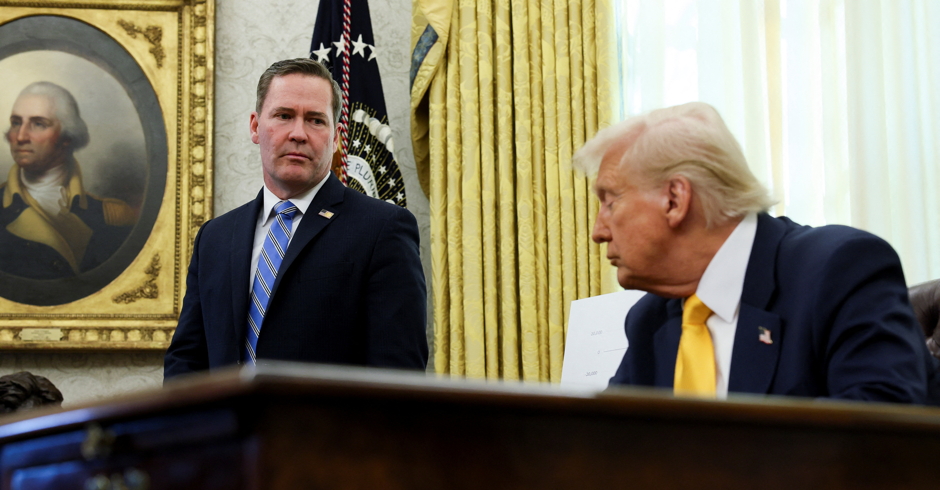
Less than two weeks ago there was SignalGate, the Trump administration’s national security scandal that potentially endangered the lives of U.S. service members, and risked exposing military plans, by using an insecure channel to discuss, map out, and announce progress of an attack in Yemen. Then there was the Trump administration’s passwords scandal, where passwords, email addresses, and phone numbers of top Trump national security officials were easily found online. And just yesterday, GmailGate, the Trump administration’s use of the even less-secure commercial email app, to conduct government business.
All three crises involved President Donald Trump’s national security team, including White House national security adviser Mike Waltz, who admitted to setting up the insecure Signal chat.
On Wednesday afternoon, Politico reported that Waltz’s team actually had set up 20 or more different Signal group chats, for national security crises.
“National security adviser Mike Waltz’s team regularly set up chats on Signal to coordinate official work on issues including Ukraine, China, Gaza, Middle East policy, Africa and Europe, according to four people who have been personally added to Signal chats,” according to Politico. “Two of the people said they were in or have direct knowledge of at least 20 such chats. All four said they saw instances of sensitive information being discussed.”
READ MORE: ‘Significant Political Rift’: Trump Faces Possible Defeat in First Tariff Test
“Waltz built the entire NSC communications process on Signal,” said one of the four sources.
Experts have warned that the use of Signal in certain circumstances may violate national security regulations, as well as federal law surrounding retention of government communications.
The use of Signal on personal cell phones is also problematic because those mobile devices can easily be compromised, experts say. CISA, the Department of Homeland Security’s Cybersecurity and Infrastructure Security Agency, has recommended the use of Signal instead of less secure platforms, but not for classified or sensitive communications.
“None of the four individuals said they were aware of whether any classified information was shared, but all said that posts in group chats did include sensitive details of national security work,” Politico noted.
Additionally, on Sunday, The Wall Street Journal reported more concerning national security lapses.
“Two U.S. officials also said that Waltz has created and hosted multiple other sensitive national-security conversations on Signal with cabinet members, including separate threads on how to broker peace between Russia and Ukraine as well as military operations. They declined to address if any classified information was posted in those chats,” the Journal reported. It was not clear if these were among the 20 or more chats Politico reported on Wednesday.
RELATED: ‘Just Plain Dumb’: Trump’s Smuggled Fentanyl Tariff Mocked
“In under 10 days, we’ve heard about journalists added to unclassified chats and sensitive data being shot around on personal emails,” lamented U.S. Senator Mark Warner (D-VA), the Vice Chair of the Senate Intelligence Committee. “And now we’re hearing there’s dozens more chats. It’s a never-ending parade of sloppy, reckless incompetence.”
U.S. Rep. Brad Schneider (D-IL), also responding to the latest news from Politico, wrote: “President Trump must put our troops and national security first. Waltz must step down. If he won’t, President Trump should fire him.”
Democratic congressional candidate Cait Conley is a former National Security Council official who “spent nearly 20 years in the military, including a stint working on counterterrorism for the National Security Council under former President Biden,” The New York Times has reported. She also worked at CISA, the Cybersecurity and Infrastructure Security Agency.
“This is not an Administration that’s serious about protecting America. Every person on those (20!) group chats should have known better,” Conley observed.
“The national security advisor continues to put our country at risk by using chats to discuss sensitive issues, allowing our adversaries to potentially intercept these messages,” commented former Deputy Pentagon Press Secretary and former Special Assistant to the President Sabrina Singh. “This is not putting America First – it’s the opposite.”
U.S. Rep. Ted Lieu (D-CA), a former Air Force JAG officer, wrote: “National Security Adviser Waltz should resign for repeatedly playing fast and loose with OpSec. Signal should not be used to discuss sensitive information. The Pentagon warned against using Signal even for unclassified information.”
MSNBC host Symone Sanders Townsend snarked, “Amateur hour at the OK Corral and that’s even offensive to the amateurs.”
“This is Trump’s CLOWN CAR CABINET!,” charged CNN commentator Maria Cardona. “Incompetent, unqualified, unserious. AND these massive national security blunders, put US all is SERIOUS danger! They need to go!!”
READ MORE: ‘Paralyzed’: Johnson Mocked for Shutting House Down After ‘Brutal’ Defeat
Image via Reuters
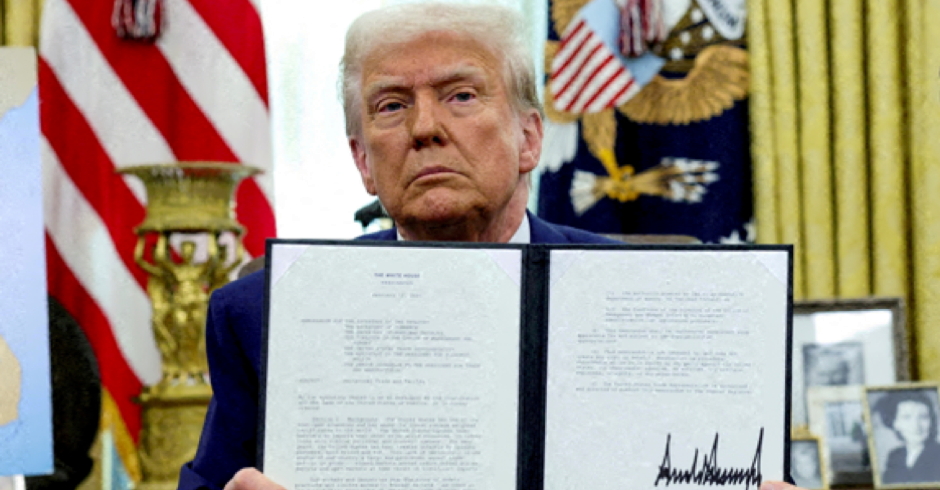
President Donald Trump’s midnight rant attacking four top Republican Senators appeared to reveal the President’s first big tariff test—on “Liberation Day” Wednesday, the day he is unveiling what is expected to be a highly unpopular global tariffs package—is off course, and may ultimately fail.
Democrats have proposed legislation to block Trump’s tariffs on Canada, one of America’s largest and oldest trading and military partners, by declaring Trump’s stated “national emergency” to have ended.
It appears Trump may lose this battle, at least in the Senate.
In his overnight tirade, Trump attacked four GOP Senators by name: Mitch McConnell, Rand Paul, Susan Collins, and Lisa Murkowski, who, reports suggest, will join with Democrats to support the legislation to block his Canadian tariffs.
RELATED: ‘Just Plain Dumb’: Trump’s Smuggled Fentanyl Tariff Mocked
Last year, even before Trump won the election, McConnell was a staunch “no” on tariffs.
“I’m not a fan of tariffs. They raise prices for American consumers. I’m more of a free trade kind of Republican that remembers how many jobs were created by the exports that we engage in,” the then-Senate Minority Leader told reporters.
McConnell is again a staunch no on tariffs, at least for Canada.
“I’m with you,” McConnell reportedly told U.S. Senator Tim Kaine (D-VA), who is sponsoring the legislation, CNN’s Haley Talbot reported.
“Kaine says rock solid GOP with him are Collins Murkowski Rand Paul and McConnell,” she added — the four Trump targeted.
It gets worse for Trump.
On Monday afternoon, U.S. Senator Thom Tillis (R-NC) warned that Trump’s tariffs could cause farmers in his state “irreparable” harm.
“Anyone who says there may be a little bit of pain before we get things right need[s] to talk to my farmers who are one crop away from bankruptcy,” Tillis told CNN’s Manu Raju, as HuffPost reported.
READ MORE: ‘Paralyzed’: Johnson Mocked for Shutting House Down After ‘Brutal’ Defeat
“They don’t have time. So we’ve got to be crisp on this implementation,” he added. “Otherwise, we could do damage that is irreparable to farmers.”
While Tillis has not yet indicated how he will vote, there may be other Republicans supporting the Democrats’ legislation.
“At a press conference Wednesday afternoon, Kaine said other Republicans are also reaching out to him to get information on the resolution, indicating the number of GOP supporters may grow,” Politico reports. “Kaine also said Trump’s announcement about a new wave of tariffs, which is expected to take place prior to the Senate resolution vote, ‘could increase pressure for more [Republicans] to join.'”
Politico earlier on Wednesday reported that GOP Senators “Chuck Grassley — one of many farm-state Republicans concerned about the Canadian tariffs — and John Cornyn were noncommittal Tuesday about how they might vote.”
Should things go south for Trump, Vice President JD Vance will be on hand to cast a vote if the resolution is a tie.
Importantly, Politico observes, “the GOP dissent on the Hill represents a significant political rift in the party about the sweeping economic consequences of his sometimes-unpredictable trade policies.”
House Democrats are also launching a concurrent resolution to declare that the national emergency with Canada is over, Punchbowl News reports. That version is believed to face stiffer odds. Should both pass, Trump has said he will not sign them into law.
Some are also mocking Trump, after the White House moved the announcement event time of his global tariff package from 3 PM to 4 PM — just after the stock markets close.
Always a good sign when you have to hold your announcement until after the stock market closes 👍 https://t.co/tH6u59WnOk
— Brian Tyler Cohen (@briantylercohen) April 2, 2025
See the social media post above or at this link.
READ MORE: ‘Trying to Understand’: Senator Who Backed RFK Jr. Now on Defense After Massive HHS Firing
Image via Reuters

Just months ago, a Trump White House advisor suggested that Elon Musk—a special government employee bound by law to step down after a limited tenure—was likely to overstay his term. Now, after a resounding defeat in Wisconsin’s state Supreme Court race, where voters overwhelmingly chose a Democrat—despite Musk injecting millions of dollars, his outsized persona, and million-dollar checks to voters—it seems the Tesla billionaire may have overstayed his welcome.
“President Donald Trump has told his inner circle, including members of his Cabinet, that Elon Musk will be stepping back in the coming weeks from his current role as governing partner, ubiquitous cheerleader and Washington hatchet man,” Politico reports in an exclusive. “The president remains pleased with Musk and his Department of Government Efficiency initiative but both men have decided in recent days that it will soon be time for Musk to return to his businesses and take on a supporting role, according to three Trump insiders who were granted anonymity to describe the evolving relationship.”
Politico also reports that “Musk’s looming retreat” comes as Trump’s allies — insiders and outsiders — increasingly are squawking at his “unpredictability, and increasingly view the billionaire as a political liability.”
READ MORE: ‘Just Plain Dumb’: Trump’s Smuggled Fentanyl Tariff Mocked
That “dynamic that was thrown into stark relief Tuesday when a conservative judge Musk vocally supported lost his bid for a Wisconsin Supreme Court seat by 10 points.”
The Politico report comes on “Liberation Day,” as Trump is calling Wednesday — the day he will announce his highly-controversial and some say, harmful, global tariffs.
Last week, Trump had already begun setting the stage for a smooth and face-saving exit, and on Monday he told reporters that “at some point Elon’s going to want to go back to his company.” (See video below.)
But Musk is unlikely to vanish from the scene entirely, according to Politico.
“They’re feeling the pressure,” U.S. Rep. Greg Casar (D-TX) commented, in response to the Politico report. “Keep up the fight to Fire Elon Musk.”
Iconic tech and business journalist Kara Swisher remarked, “Trump does not like a loser. The cheesehead antic was repellent to voters, and now to Elon’s BFF.”
READ MORE: ‘Paralyzed’: Johnson Mocked for Shutting House Down After ‘Brutal’ Defeat
Eoin Higgins, author of the book, “Owned: How Tech Billionaires on the Right Bought the Loudest Voices on the Left,” noted that “the dismantling of the agencies is in motion and will continue, but this is still a humiliation—all that money and power only to find out that people just don’t like you and you’re so unpopular you’re dragging everyone else down with you.”
Attorney, academic, and author Alberto Alemanno writes that “Musk’s political adventure is over (for now). He’s become a political liability and we can now ALL stop amplifying his omniscient takes.”
Chris Griswold, policy director at the conservative think tank American Compass, snarked, “When they do Liberation Day, they really do Liberation Day.”
Watch the video below or at this link.
Reporter: Elon Musk’s special government tenure is coming to an end,.. Do you want to stay longer or is it time to going back to running his companies?
Trump: I think he’s amazing but he has a big company to run. At some point he’ll be going back.
Reporter: Do you want to… pic.twitter.com/mX5jceYJ6S
— Acyn (@Acyn) March 31, 2025
READ MORE: ‘Trying to Understand’: Senator Who Backed RFK Jr. Now on Defense After Massive HHS Firing
Image via Reuters

‘Just Plain Dumb’: Trump’s Smuggled Fentanyl Tariff Mocked

‘Significant Political Rift’: Trump Faces Possible Defeat in First Tariff Test

‘Humiliation’: Musk to Step Back From White House Role, Trump Reportedly Tells Aides

‘Parade of Incompetence’: Trump Security Adviser Set Up Numerous Signal Chats on Key Crises
‘Parade of Incompetence’: Trump Security Adviser Set Up Numerous Signal Chats on Key Crises
‘Significant Political Rift’: Trump Faces Possible Defeat in First Tariff Test
‘Humiliation’: Musk to Step Back From White House Role, Trump Reportedly Tells Aides
‘Just Plain Dumb’: Trump’s Smuggled Fentanyl Tariff Mocked

‘Paralyzed’: Johnson Mocked for Shutting House Down After ‘Brutal’ Defeat

 News3 days ago
Trump Team Eyes Emergency Plan to Offset Tariff ‘Financial Devastation’ for Farmers: NYT
 News2 days ago
‘Paralyzed’: Johnson Mocked for Shutting House Down After ‘Brutal’ Defeat

 News3 days ago
‘We’re Gonna Boom’: Trump Mocks Wall Street’s Stagflation Predictions Despite Grim Data

 News2 days ago
‘Trying to Understand’: Senator Who Backed RFK Jr. Now on Defense After Massive HHS Firing

 News2 days ago
‘Bloodbath’: Shock as Trump Fires Thousands at HHS Amid Measles and Bird Flu Outbreaks
 News20 hours ago
‘Just Plain Dumb’: Trump’s Smuggled Fentanyl Tariff Mocked
 News16 hours ago
‘Significant Political Rift’: Trump Faces Possible Defeat in First Tariff Test
 News17 hours ago
‘Humiliation’: Musk to Step Back From White House Role, Trump Reportedly Tells Aides