Breaking: Anderson Cooper Says ‘The Fact Is, I’m Gay’
Anderson Cooper, long-time CNN reporter and long-believed to be gay, today just confirmed to gay conservative columnist Andrew Sullivan that he is, saying, “The fact is, I’m gay.” Cooper says he wanted to keep his private life private for both personal and professional reasons, including the fact that he began his work as a journalist in war zones and chose to not reveal his homosexuality for safety reasons for both him and his crew.
Â

The fact is, I’m gay, always have been, always will be, and I couldn’t be any more happy, comfortable with myself, and proud.
I have always been very open and honest about this part of my life with my friends, my family, and my colleagues. In a perfect world, I don’t think it’s anyone else’s business, but I do think there is value in standing up and being counted. I’m not an activist, but I am a human being and I don’t give that up by being a journalist.
Â
Andrew Sullivan notes his conversation, via email, came about after Entertainment Weekly’s story on how coming out is no longer done with pomp and circumstance.
“In many ways, it’s a great development: we’re evolved enough not to be gob-smacked when we find out someone’s gay,” Sullivan writing at The Daily Beast, notes. “But it does matter nonetheless, it seems to me, that this is on the record. We still have pastors calling for the death of gay people, bullying incidents and suicides among gay kids, and one major political party dedicated to ending the basic civil right to marry the person you love. So these “non-events” are still also events of a kind; and they matter. The visibility of gay people is one of the core means for our equality.”
Here is Anderson Cooper’s full email to Andrew Sullivan. Sullivan is careful to note that Cooper approved its publication.
Andrew, as you know, the issue you raise is one that I’ve thought about for years. Even though my job puts me in the public eye, I have tried to maintain some level of privacy in my life. Part of that has been for purely personal reasons. I think most people want some privacy for themselves and the people they are close to.
But I’ve also wanted to retain some privacy for professional reasons. Since I started as a reporter in war zones 20 years ago, I’ve often found myself in some very dangerous places. For my safety and the safety of those I work with, I try to blend in as much as possible, and prefer to stick to my job of telling other people’s stories, and not my own. I have found that sometimes the less an interview subject knows about me, the better I can safely and effectively do my job as a journalist.
I’ve always believed that who a reporter votes for, what religion they are, who they love, should not be something they have to discuss publicly. As long as a journalist shows fairness and honesty in his or her work, their private life shouldn’t matter. I’ve stuck to those principles for my entire professional career, even when I’ve been directly asked “the gay question,†which happens occasionally. I did not address my sexual orientation in the memoir I wrote several years ago because it was a book focused on war, disasters, loss and survival. I didn’t set out to write about other aspects of my life.
Recently, however, I’ve begun to consider whether the unintended outcomes of maintaining my privacy outweigh personal and professional principle. It’s become clear to me that by remaining silent on certain aspects of my personal life for so long, I have given some the mistaken impression that I am trying to hide something – something that makes me uncomfortable, ashamed or even afraid. This is distressing because it is simply not true.
I’ve also been reminded recently that while as a society we are moving toward greater inclusion and equality for all people, the tide of history only advances when people make themselves fully visible. There continue to be far too many incidences of bullying of young people, as well as discrimination and violence against people of all ages, based on their sexual orientation, and I believe there is value in making clear where I stand.
The fact is, I’m gay, always have been, always will be, and I couldn’t be any more happy, comfortable with myself, and proud.
I have always been very open and honest about this part of my life with my friends, my family, and my colleagues. In a perfect world, I don’t think it’s anyone else’s business, but I do think there is value in standing up and being counted. I’m not an activist, but I am a human being and I don’t give that up by being a journalist.
Since my early days as a reporter, I have worked hard to accurately and fairly portray gay and lesbian people in the media – and to fairly and accurately portray those who for whatever reason disapprove of them. It is not part of my job to push an agenda, but rather to be relentlessly honest in everything I see, say and do. I’ve never wanted to be any kind of reporter other than a good one, and I do not desire to promote any cause other than the truth.
Being a journalist, traveling to remote places, trying to understand people from all walks of life, telling their stories, has been the greatest joy of my professional career, and I hope to continue doing it for a long time to come. But while I feel very blessed to have had so many opportunities as a journalist, I am also blessed far beyond having a great career.
I love, and I am loved.
In my opinion, the ability to love another person is one of God’s greatest gifts, and I thank God every day for enabling me to give and share love with the people in my life. I appreciate your asking me to weigh in on this, and I would be happy for you to share my thoughts with your readers. I still consider myself a reserved person and I hope this doesn’t mean an end to a small amount of personal space. But I do think visibility is important, more important than preserving my reporter’s shield of privacy.
To those who say, “who cares?” and, “It’s doesn’t matter,” it does. For all the reasons Andrew and Anderson mentioned. People like Anderson Cooper who come out give hope and support to all our kids who get berated up, bullied, and despair, every single day.
Thanks, Anderson.
Images: Top via The Daily Beast and Anderson Cooper/CNN, young Anderson Cooper via Andrew Kaczynski/Buzzfeed via Twitpic.
Enjoy this piece?
… then let us make a small request. The New Civil Rights Movement depends on readers like you to meet our ongoing expenses and continue producing quality progressive journalism. Three Silicon Valley giants consume 70 percent of all online advertising dollars, so we need your help to continue doing what we do.
NCRM is independent. You won’t find mainstream media bias here. From unflinching coverage of religious extremism, to spotlighting efforts to roll back our rights, NCRM continues to speak truth to power. America needs independent voices like NCRM to be sure no one is forgotten.
Every reader contribution, whatever the amount, makes a tremendous difference. Help ensure NCRM remains independent long into the future. Support progressive journalism with a one-time contribution to NCRM, or click here to become a subscriber. Thank you. Click here to donate by check.
 |

The Dispatch‘s national correspondent, Kevin D. Williamson, wants to ask Republicans a question.
He points to the $270 it takes to fill up the tank of a Ford Super Duty truck in his neighborhood — 48 gallons at $5.60 a gallon for diesel — and asks, “Do you feel smart?”
Citing a column by The New York Times’ Bret Stephens, Williamson weighs the pros and cons of voters electing candidates to achieve results over voters choosing “paragons of moral rectitude.”
“There is something to be said for that approach,” writes Williamson. “One of the problems with our politics is that politicians—especially presidents—are treated as embodiments of the nation, the people, and our values, to such an extent that members of a party feel alienated and humiliated when the other party’s leader occupies the White House.”
He concludes that for partisans, “inconvenient facts necessitate a kind of rhetorical two-step.”
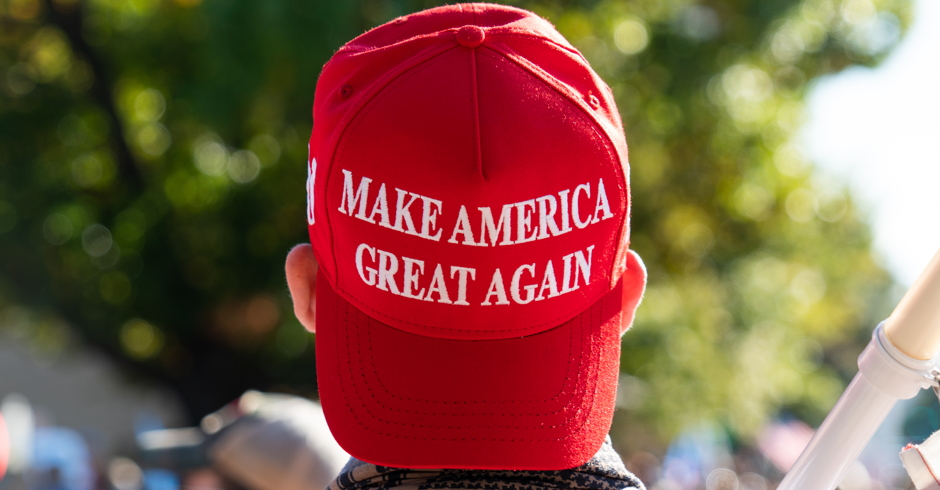
“There are proud Trump cultists and there are embarrassed Trump cultists, and, if you press one of the latter on Trump’s viciousness—his dishonesty, his infidelity, his venality, his susceptibility to flattery, his inconstancy—he often will retreat into comfortable pragmatism,” Williamson writes.
They will say they like Trump’s “policies,” which, Williamson charges, “mainly indicates the economic conditions coincident with Trump’s first term in office, pre-COVID, which were only to a very minor degree the result of any Trump policy.”
But press the embarrassed Trump cultist further — like on the $270 tank fill-up — and they will “retreat into moralism, albeit a negative kind of moralism based in the perceived deficiencies of the Democrats rather than in any of Trump’s particular moral virtues, which, it is plain, simply do not exist.”
When Republicans insist Americans “think of the policies,” Williamson says he wonders “what those beneficial policies are.”
“The illegally initiated and incompetently executed war in Iran that is the proximate cause of that $270 diesel bill? The obviously criminal massacres of civilians on the high seas? The gross self-dealing and corruption? The elevation of wildly unqualified yes-men such as Bill Pulte to high office? The deepening debt? The rising inflation?”
Williamson says that they like the policies, “Except for the inflation, and the trade chaos, and the war, and the corruption, and the enshrinement of utter incompetence.”
He says that you “can two-step around reality any way you like, but the fact is that right now Republicans are offering both Ken Paxton and $5.60 diesel. And so I repeat the question to my Republican friends: ‘Do you feel smart?'”
Image via Shutterstock
Port Charlotte, Florida, is part of Charlotte County — which voted for President Donald Trump by a solid two-to-one margin in 2024. It was named one of the top ten places to retire in 2012.
Still seen as a deeply red state, Democrats are making inroads into the Sunshine State. Ahead of the August primary, in the race for governor, Republican Byron Donalds often polls ahead of Democrat David Jolly but only by single digits, according to data from The New York Times. Donald Trump won the state by 13 points in 2024.
A letter to the editor highly critical of President Donald Trump and his MAGA base in a Port Charlotte news outlet could be seen as surprising.
“MAGA crowd, Trump are all about winning,” reads the headline.
“Donald Trump and the MAGA movement have turned American politics into a fan-based team sport,” writes its author, Gayle Yarnall.
“Governing has become an us versus them rivalry regardless of the consequences. It is all about winning,” she laments.
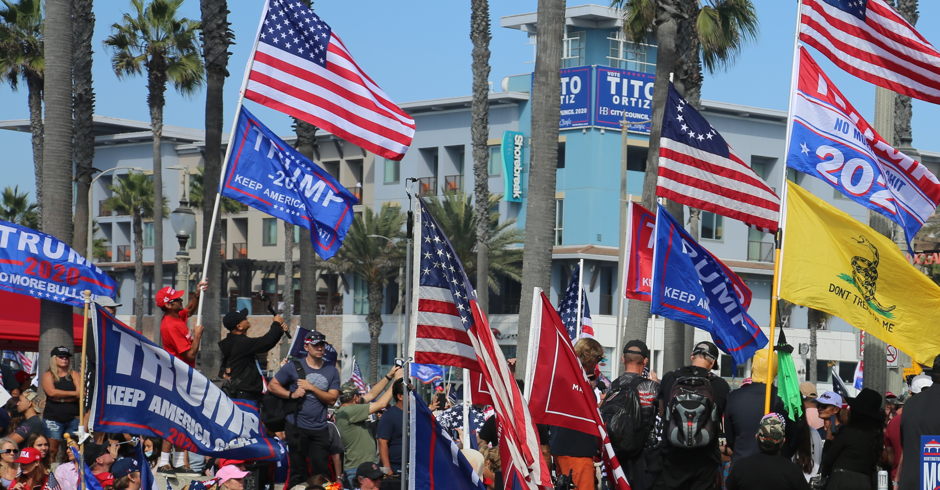
“The 2024 election is long over. Yet, there are Trump signs, banners, and flags still posted around. It is akin to displaying the flag of your favorite teams like the Patriots or the Buckeyes. What is the purpose except to express that, ‘I’m on a winning team’?” Yarnall asks.
“No one will be persuaded to vote for Trump. The election is done and he won. Is there any memory of Reagan, Biden, Bush, Obama, or Clinton flags or signs posted months or years after the election? Of course not.”
Yarnall calls the still-flying banners and flags “visual reminders” for “those with low self-esteem, feeling left out and unheard.”
“They scream, ‘look at me, we won, I’m on a winning team,'” she says.
“Even when gas prices spike, the cost of tariffs are passed on, a war continues, inflation is rising in all sectors it matters not because my team won.”
In a last-ditch plea, Yarnall asks her neighbors, “Please remember to vote!”
Image via Shutterstock

Right-wing journalist Ben Domenech isn’t aligned with GOP wisdom that the Republican Party should do well in the November midterm elections. In a lengthy written conversation with The New York Times, Domenech says he is “skeptical.”
“Republicans still seem to think that, thanks to redistricting and their advantages in fund-raising, they could buck historical trends and hold on, perhaps even in the House,” Domenech told the Times’ John Guida. “They’re just scared about gas prices. Personally, I’m skeptical.”
Looking specifically at Maine, which Republicans see as the “linchpin” to holding the Senate majority, according to Guida, Domenech also sends a warning. The race will be between U.S. Senator Susan Collins (R-ME) and Democratic insurgent newcomer Graham Platner, who has already faced numerous scandals.
“The interesting thing about this whole focus on Maine is that if you talk to Senate Republican staff and consultants, they’re actually less worried about it than other states,” says Domenech. “This is partially because of Platner’s shall we say unique collection of scandals and challenges, but it’s also because of enormous faith in Collins as a survivor.”
Collins, 73, is running for her sixth term after being first elected in 1996.
Guida points to a Politico report on a memo that states: “the political fundamentals in Maine remain challenging, and it is a fatal mistake to assume Platner is too damaged to win.”
“I think that’s correct,” says Domenech, “and top Republicans should actually be more concerned.”
“Platner clearly has energy behind him. He speaks to a desire on the left for a strong message, and he’s shown no signs of bowing to pressure to get out for a more centrist-coded candidate,” he adds. “Collins is absolutely capable of winning, but national assumptions are taking over based on her last election, in 2020, when she came back from what seemed like a deep hole by keeping her campaign hyperlocal.”
Domenech says that Republicans do have some concerns, specifically about three states Donald Trump won by double digits in 2024: Alaska, Iowa and Ohio.
In Ohio, former U.S. Senator Sherrod Brown is seeking to return to the Senate, and is running against “an appointee who has never won a Senate election, Jon Husted.”
In Alaska, Democrat Mary Peltola is running against Dan Sullivan, the Republican incumbent who “has the advantage there, but again, we’re talking about a unique state, and Peltola is an Alaska Native,” says Domenech. That race is now considered a “toss up” by The Center for Politics’ “Crystal Ball,” which also now rates the Ohio race as a “toss up.”
Iowa could become a difficult race for Republicans as well. Domenech warns it “could turn out to be a real test for Trump’s tariff policies, which have been a decidedly mixed bag in many of the states that backed him. The president will probably have to take that argument to the people of Iowa himself.”
Overall, says Domenech, Republicans’ confidence “comes from a belief that Democratic radicalism, particularly the various examples of what they view as a renewed cultural leftism in opposition to Trump during his first term, will play in their favor.”
Image via Shutterstock

Conservative Talk Radio Host’s Brutal New Label for Trump: ‘Clown’

Conservative Insider Throws Cold Water on GOP’s Midterm Confidence

Letter From Deep Red Florida Torches ‘Low Self-Esteem’ MAGA Voters

Conservative Columnist Torches Trump ‘Cultists’ Over Their ‘Two-Step Around Reality’
Conservative Columnist Torches Trump ‘Cultists’ Over Their ‘Two-Step Around Reality’
Letter From Deep Red Florida Torches ‘Low Self-Esteem’ MAGA Voters
Conservative Insider Throws Cold Water on GOP’s Midterm Confidence
Conservative Talk Radio Host’s Brutal New Label for Trump: ‘Clown’

What Democratic Voters Actually Want

 News2 days ago
Helicopter Circles as Gloved Officers Test Grass Over Apparent ?86 47? Mall Message

 News4 days ago
Letter From Deep Red Trump Country Blasts President as ‘Low-IQ Idiot’

 News4 days ago
Hard-Right Groups Expanded Power Across the Trump Administration in 2025: Report

 News3 days ago
Johnson Scrambles to Defend Trump’s ‘I Love the Inflation’ Remark — Critics Don’t Buy It
 News4 days ago
CNN Fact-Checker Scorches Trump Over the Price of Gas
 News3 days ago
GOP Leader Skips Trump’s Bill Signing—Then Pins Three-Year High Inflation on His Iran War

 News3 days ago
‘Hated and Alone’: Steve Schmidt Scorches Trump Ahead of His 80th Birthday

 News3 days ago
Steve Schmidt Slams ‘Decrepit’ Trump as a ‘Human Malignancy’ on America