
News
‘Unlikely to Ever Be Recovered’: Secret Service Says Missing J6 Texts Are Irretrievable – Report

The U.S. Secret Service says it is unable to retrieve text messages deleted after the Dept. of Homeland Security Inspector General’s Office, and later Congress, requested the data, despite federal law requiring its retention.
Secret Service “has determined it has no new texts to provide Congress relevant to its Jan. 6 investigation, and that any other texts its agents exchanged around the time of the 2021 attack on the Capitol were purged, according to a senior official briefed on the matter,” The Washington Post reports.
Citing two people familiar with the matter the Post adds that the missing texts are “unlikely to ever be recovered.”
READ MORE: Watchdog to DOJ: Secret Service ‘Likely’ Broke Federal Criminal Law by Deleting Text Messages
Washington Post reporter Carol Leonnig tweeted, “PURGED — Here’s the news. Those @SecretService texts are gone, gone, gone . Agency scoured records and said it found nothing new to give Congress . National Archives now investigating if USSS broke the law.”
The Post’s report adds that the “National Archives on Tuesday sought more information on ‘the potential unauthorized deletion’ of agency text messages. The U.S. government’s chief record-keeper asked the Secret Service to report back to the Archives within 30 days about the deletion of any records, including describing what was purged and the circumstances of how the documentation was lost.”
According to the agency, which has been accused of changing stories, texts sent on the day of the insurrection and the day prior, were deleted during a device exchange program after not being backed up. While the Inspector General stated “many” text messages were lost, there does not appear to be a complete accounting of how many, nor answers on why messages for just those two days were deleted.
“Secret Service agents, many of whom protect the president, vice president and other senior government leaders, were instructed to upload any old text messages involving government business to an internal agency drive before the reset,” last year, The Post reports, citing a senior official, “but many agents appear not to have done so.”
The result is that potentially valuable evidence — the real-time communications and reactions of agents who interacted directly with Trump or helped coordinate his plans before and during Jan. 6 — is unlikely to ever be recovered, two people familiar with the Secret Service communications system said. They requested anonymity to discuss sensitive matters without agency authorization.
The U.S. House Select Committee on the January 6 Attack issued a subpoena for the missing text messages after news reports revealed their deletion. The DHS Inspector General (OIG) in letters to House and Senate Homeland Security Committees stated not only had the texts been deleted, but Secret Service has repeatedly refused to provide him with requested records.
“DHS personnel have repeatedly told OIG inspectors that they were not permitted to provide records directly to OIG and that such records had to first undergo review by DHS attorneys,” DHS IG Joseph Cuffari wrote.
On Saturday The Guardian noted that “January 6 investigators believe that the texts from the day of the Capitol attack could shed light on how the Secret Service wanted to move Donald Trump and Mike Pence, while texts from the day before could provide greater clarity on how security plans developed, the sources said.”
Image: Official White House Photo by Amanda Lucidon via Flickr
Enjoy this piece?
… then let us make a small request. The New Civil Rights Movement depends on readers like you to meet our ongoing expenses and continue producing quality progressive journalism. Three Silicon Valley giants consume 70 percent of all online advertising dollars, so we need your help to continue doing what we do.
NCRM is independent. You won’t find mainstream media bias here. From unflinching coverage of religious extremism, to spotlighting efforts to roll back our rights, NCRM continues to speak truth to power. America needs independent voices like NCRM to be sure no one is forgotten.
Every reader contribution, whatever the amount, makes a tremendous difference. Help ensure NCRM remains independent long into the future. Support progressive journalism with a one-time contribution to NCRM, or click here to become a subscriber. Thank you. Click here to donate by check.
 |


President Donald Trump thrilled his supporters in New York on Friday as he shared how he came up with his latest nickname for Democrats — his explanation included a spelling lesson.
“Blue means Dumocrat,” the president said. “That’s a new name I came up with.”
“I was, I was thinking about this character we have in the House. His name is Hakeem Jeffries,” Trump said to boos from the audience.
“And he’s a low IQ person, very low IQ.”
“And I watched what he was saying, and what the horrible things he was saying, and I said, ‘He’s a dumb guy.’ I said, Wait a minute, he’s a Dumocrat. That’s how I got the name,” Trump excitedly said.
“You take the ‘e’ out, you don’t use the ‘b’. A lot of people don’t know ‘dumb’ has a ‘b’ in it, actually. You don’t need it. You discard the ‘b.’
“But you take the ‘e’ out, and you replace it with a ‘u.'”
“They are Dumocrats. You know why? ‘Cause their policies are dumb. Their policies are very dumb. All of their policies.”
Critics mocked the president.
“His uncle taught at MIT, but Trump just recently learned there is a b in dumb,” wrote political strategist Jeff Timmer.
“Dumbo @realDonaldTrump here is the only one who doesn’t know there’s a b in DUMB,” said former GOP Congresswoman Barbara Comstock.
“It’s impossible to overstate how f— — stupid Trump looks on the world stage,” wrote another online commenter.
Image via Reuters

President Donald Trump’s controversial Director of National Intelligence, Tulsi Gabbard, is resigning.
“Unfortunately, I must submit my resignation, effective June 30, 2026,” DNI Gabbard wrote to President Trump, Fox News reports. “My husband, Abraham, has recently been diagnosed with an extremely rare form of bone cancer.”
“During pivotal moments,” NBC News reports, “as Trump deliberated over possible military action or watched live video feeds of operations in Iran or Venezuela, Gabbard was often not in the room, underscoring her outsider status.”
“Gabbard has had a tough tenure being sidelined on Venezuela and Iran. Last month, Trump floated replacing her with Pam Bondi, but some advisers saved her,” reported WIRED’s Hugo Lowell.
President Trump wrote that Gabbard had done an “incredible job,” and “we will miss her,” while Reuters reports that the White House ”forced” Gabbard “to resign from her post, a person familiar with the matter said on Friday.”
The Wall Street Journal’s Dave Brown called Gabbard’s tenure “tumultuous.”
Critics were quick to respond.
“Good riddance. The Iran war has been the biggest display of intelligence incompetence in decades,” wrote U.S. Rep. Shri Thanedar (D-MI).
“Tulsi Gabbard leaves this administration in disgrace after helping Trump drag the country into yet another forever war in the Middle East,” wrote political strategist Mike Nellis. “She built her entire image on opposing these wars, then abandoned that principle the second it became politically inconvenient. That’s her legacy: a complete fraud, completely full of s— — about the one thing people thought she genuinely believed in. Good f— — riddance.”
“Also, is anybody in Congress or the media going to get to the bottom of the whistleblower’s story about Tulsi Gabbard withholding classified intercepted intel for political reasons?” Nellis continued. “What the hell happened there, or are we just going to pretend that didn’t happen?”
“Are we ever going to found out if Tulsi Gabbard broke how many different national security laws by allegedly refusing to hand over investigative documents, or is that just going away now?” asked writer Charlotte Clymer.
Professor and policy analyst Adam Cochran called Gabbard’s resignation “shocking,” and added: “Can’t imagine what they would ask to do that is too out of line for her…”
Associate Professor of Political Science Christopher Clary said Gabbard “will go down as perhaps the most ineffective and incompetent DNI in the short history of that position.”
Image via Reuters
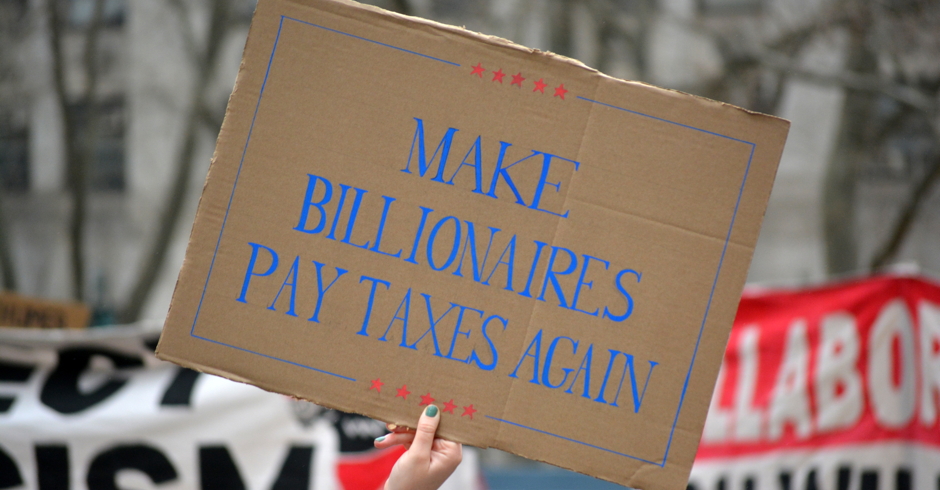
President Donald Trump managed to effectively raise taxes on the majority of Americans through his tax policies, while handing the richest five percent a tax cut. Now, many Americans want to see the rich pay their fair share — and that could mean increasing their taxes.
The former chief economist of the White House Office of Management and Budget, Professor Zachary Liscow, argues there’s a “slow, boring” yet “easy” way to do so.
“The United States is seeing an increasing concentration of wealth at the very top and a worsening national debt,” Liscow writes in an op-ed at The New York Times. “For many Americans, taxing the rich more is an obvious move.”
He details some of the “novel proposals to curb the many intricate ways the rich make and hide their money,” including a wealth tax, a tax on unrealized gains, and a tax on “loans that billionaires take against their stock.”
But, Liscow warns, while novel, these methods would not raise the substantial amount of money the U.S. needs.
“The boring truth is that Congress can accomplish a lot simply by raising the rates of the taxes already on the books,” Liscow explains.
He examines U.S. Senator Elizabeth Warren’s (D-MA) proposal to tax “fortunes above $50 million,” and says there are “serious constitutional and policy arguments for this idea, but the Supreme Court’s current members would probably strike it down.”
There is a billionaire’s tax proposal by U.S. Senator Ron Wyden (D-OR) that would tax unrealized capital gains, “the appreciation in the paper value of assets such as stocks.” That would likely find a Supreme Court challenge.
There are other tax vehicles, like fixing the “buy, borrow, die” loophole, which would tax loans taken against stock portfolios, but that would likely not raise sufficient funds: “It’s just not where the money is.”
He finds that “the most powerful lever is also the simplest one,” and concludes that “Congress has a simpler, tried-and-true tax policy to choose from: raising the rates.”
Liscow is advocating to restore the “top marginal ordinary income tax rate to its pre-2017 level of 39.6 percent” — where it was before Trump’s first term in office.
“In addition, raising the corporate tax rate from 21 percent toward the 35 percent it had been set at historically would add hundreds of billions in revenue for the government,” he says.
“Raising the rates,” Liscow concludes, “the simple, boring answer — is where the real money lies.”
Image: Christopher Penler / Shutterstock.com

Trump Explains ‘Dumb’ Has a ‘B’

‘Good Riddance’: Critics Cheer Tulsi Gabbard’s ‘Shocking’ Resignation

The ‘Slow, Boring’ and ‘Easy’ Way to Tax the Rich: Expert

Trump’s Latest ‘Executive Time’ Grievance Session Reveals What He’s Really Worried About

‘Political Survival’ Fears Driving Senate GOP to ‘Breaking Point’ With Trump: Report
 News3 days ago
Trump Explains ‘Dumb’ Has a ‘B’
 News3 days ago
‘Good Riddance’: Critics Cheer Tulsi Gabbard’s ‘Shocking’ Resignation
 News3 days ago
Trump’s Latest ‘Executive Time’ Grievance Session Reveals What He’s Really Worried About
 News4 days ago
‘Political Survival’ Fears Driving Senate GOP to ‘Breaking Point’ With Trump: Report
 News3 days ago
The ‘Slow, Boring’ and ‘Easy’ Way to Tax the Rich: Expert