America’s Gun Problem: How To Help Solve Our Mass Shooting Epidemic
The United States has a gun problem, but can we do anything to fix it?
Unless you’ve been hiding under a rock, you’ve most likely heard about the numerous shootings recently, including the shocking incident that occurred on live TV last month. We’ve decided it is time to have a serious conversation about gun violence – but first, here’s a little quiz.
Can you guess which product was considered so dangerous, the United States government changed the way it was sold? Here’s a description of the product. See if you can guess what it is.
This product has a federal regulation requiring the purchaser to present photo identification at the time of purchase, and stores are required to keep personal information about purchasers in a written or electronic “logbook†for at least two years. The log must identify the products by name, quantity sold, names and addresses of purchasers, and the dates and times of the sales. Regulated sellers must ensure that customers do not have direct access to this product before the sale is made, and there is a limit to how many an individual can purchase in a single day, and in a month.
Were you able to guess what the product was? The answer is pseudoephedrine, a decongestant found in cold and allergy medicines like Sudafed and Allegra. That’s right. There are more restrictions on the amount of medicine (which helps relieve pain) a person can buy, than there are for the amount of bullets (which are used to harm people) a person can buy. Maybe that’s part of the problem with America’s mass shooting epidemic. See the FDA’s allergy medicine regulation here.
According to the New York Times, more Americans have died from guns in the United States since 1968 than on battlefields of all the wars in American history. So why is it that the United States strongly resists implementing life saving regulations when it comes to gun and bullet sales?

A crazed disgruntled employee made national headlines a few weeks ago when he gunned down a reporter and cameraman on live TV, but that’s not the only horrific gun incident that occurred recently. Here’s a sampling:
Christopher Starks, 22, died after being shot at Savannah State University on August 27. If gun shootings at college campuses aren’t enough to spark change, how about guns in elementary schools? A third grader brought a .380 semi-automatic handgun to school on August 25, and a bullet grazed the leg of a little girl after the gun went off in class! To top things off, Chicago had their deadliest day in more than a decade when nine people were killed and twelve others were wounded in shootings across the city on September 2.Â

Columbine, Virginia Tech, Sandy Hook, the Aurora, Colorado movie theater, South Carolina’s Emanuel African Methodist Episcopal Church. What’s it going to take America?Â
Let’s be clear about one thing. Gun control does not mean banning guns. It means controlling and regulating them. It means implementing practices like mandatory background checks, increasing access to some mental health records, limiting the monthly and daily sales quantities of guns and bullets to individuals, requiring pins on guns before they can be used (similar to how you access your smart phone), and gun locks, to name a few options. There are numerous ways to pass gun safety laws without taking away a person’s right to own a gun.

Gun control opponents like to say that many people die from auto accidents each year, so why don’t we ban cars? Nicholas Kristof from the New York Times explains how we should use car laws as an example for how we should treat gun laws.
Cars are actually the best example of the public health approach that we should apply to guns. Over the decades, we have systematically taken steps to make cars safer: We adopted seatbelts and airbags, limited licenses for teenage drivers, cracked down on drunken driving and established roundabouts and better crosswalks, auto safety inspections and rules about texting while driving.
This approach has been stunningly successful. By my calculations, if we had the same auto fatality rate as in 1921, we would have 715,000 Americans dying annually from cars. We have reduced the fatality rate by more than 95 percent.
The number one thing you can do to inflict change is to contact your Congressman and your Senator and demand they take appropriate action to advance gun control. Last, but not least, make sure you know where candidates stand on gun control laws during the next election.Â

Do you have ideas on how we can lower gun violence in our country? If so, let us know in the comments section below.
Â
Images: March On Washington For Gun Control 26 January 2013. Photos by Elvert Barnes via Flickr and a CC license
Â

Enjoy this piece?
… then let us make a small request. The New Civil Rights Movement depends on readers like you to meet our ongoing expenses and continue producing quality progressive journalism. Three Silicon Valley giants consume 70 percent of all online advertising dollars, so we need your help to continue doing what we do.
NCRM is independent. You won’t find mainstream media bias here. From unflinching coverage of religious extremism, to spotlighting efforts to roll back our rights, NCRM continues to speak truth to power. America needs independent voices like NCRM to be sure no one is forgotten.
Every reader contribution, whatever the amount, makes a tremendous difference. Help ensure NCRM remains independent long into the future. Support progressive journalism with a one-time contribution to NCRM, or click here to become a subscriber. Thank you. Click here to donate by check.
 |


A New York Times op-ed by a military expert argues that blockades don’t work the way President Trump thinks — and that his blockade of Iran is “unlikely” to succeed.
Jennifer Kavanagh, director of military analysis at Defense Priorities, a foreign policy think tank, explains that Trump’s blockade should not have come as a surprise — he’s used them already against Venezuela and Cuba.
While the Strait of Hormuz was open before Trump started his war against Iran, Iran chose to close it. Trump’s response was to launch a blockade of Iranian ports, to force a deal.
“But Tehran’s effective closure of the strait since the United States and Israel attacked two months ago has emerged as the war’s most bedeviling problem and one Mr. Trump is desperate to fix,” Kavanagh writes. Trump’s goal is to “choke Iran’s economy and force the country’s leaders to reopen the strait and accept Washington’s terms of surrender.”
READ MORE: Trump: ‘Extraordinarily Brilliant’ — Yet Stumped by Virginia’s ‘Rigged’ Referendum
That tactic is “unlikely to work for the same reasons the United States finds itself facing strategic defeat by a weaker adversary: a mismatch of stakes and time horizons.”
Kavanagh explains that the way blockades work is an equation of time and will. And Iran has both. Trump, she suggests, does not.
“While Iran has gained the upper hand in this conflict by extending and surviving what it considers an existential war,” Kavanagh writes, “Mr. Trump wants a fast and decisive victory, something a blockade cannot deliver.”
She points to President Abraham Lincoln’s blockade against the Confederacy during the Civil War. The war lasted four more years. And she points to the British naval blockade of Germany in World War I. That war also lasted another four years. Today, “Iran can likely endure the U.S. blockade for months without facing economic collapse.”
For Trump, “this timeline is likely to be unacceptable. His impatience with the war is evident in his increasingly erratic Truth Social posts and near-constant assertions that the war is already over,” Kavanagh says. “In a test of wills, Tehran has the advantage and a higher pain tolerance. With their survival on the line, Iran’s leaders can afford to be patient.”
READ MORE: ‘Weak, Stupid, and Bad’: Trump Slams Conservative Supreme Court Justices in Wild Rant
Image via Reuters

President Donald Trump is being criticized for his latest Truth Social post in which he describes himself as an “extraordinarily brilliant person” yet admits he cannot understand the language in Virginia’s redistricting referendum — which more than 1.5 million voters passed Tuesday night.
The president also claimed the election was “rigged,” while offering no evidence, and was frustrated because ballot counting went more heavily in Democrats’ favor (the “Yes” vote) as results were counted.
“A RIGGED ELECTION TOOK PLACE LAST NIGHT IN THE GREAT COMMONWEALTH OF VIRGINIA!” Trump declared.
“All day long Republicans were winning, the Spirit was unbelievable, until the very end when, of course, there was a massive ‘Mail In Ballot Drop!’ Where have I heard that before — And the Democrats eked out another Crooked Victory!”
READ MORE: ‘Weak, Stupid, and Bad’: Trump Slams Conservative Supreme Court Justices in Wild Rant
“In addition to everything else,” he continued, “the language on the Referendum was purposefully unintelligible and deceptive.”
“As everyone knows, I am an extraordinarily brilliant person, and even I had no idea what the hell they were talking about in the Referendum, and neither do they! Let’s see if the Courts will fix this travesty of ‘Justice.'”
Critics blasted Trump’s remarks.
“I am begging for someone to explain to the President how election returns work,” wrote Sarah Longwell, the founder and editor of The Bulwark.
“You weren’t ‘winning all day,’ you were ahead before counting finished,” wrote progressive commentator Alex Cole. “Those are not the same thing. The real conspiracy is how MAGA convinces itself losing = cheating instead of… losing.”
READ MORE: Republicans Have to Make a Choice Between ‘Reality-Based Data’ and Trump: Benen
Image via Reuters
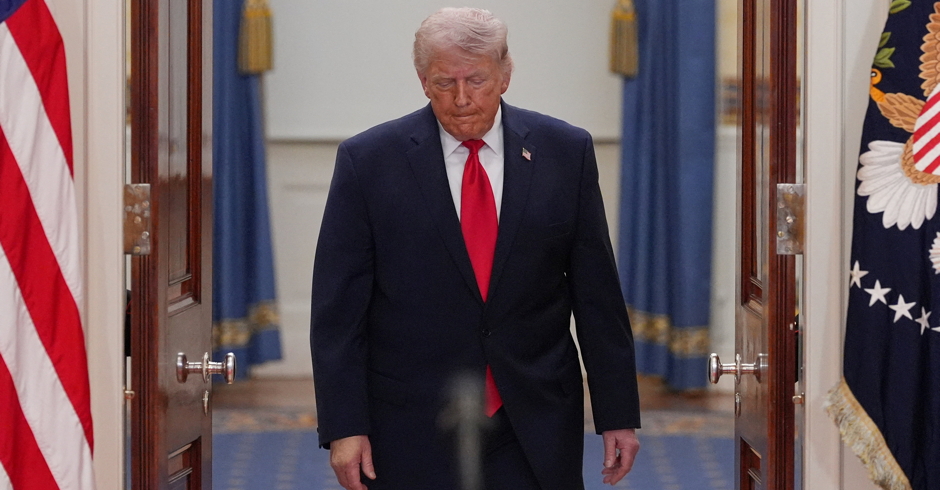
President Donald Trump’s job approval stands at its lowest point of his second term, and since he won’t be on the ballot in November or in 2028, Republicans will have to ask themselves at what point do they accept “reality-based data” and distance themselves from him?
So asks Steve Benen at MS NOW, where he notes that the latest Reuters/Ipsos poll “found Trump’s approval rating at just 36%, which was roughly in line with the latest NBC News survey. For the White House, the Associated Press’ latest national poll was even worse” — coming in at 33%.
The AP reported that even Republicans are showing less faith in his leadership, and added their findings “show a president who is struggling with unfulfilled promises to tame inflation and testing Americans’ patience with a conflict in the Middle East that has dragged on longer than expected.”
Benen notes that it’s been widely assumed that there is a floor below which Trump cannot sink — his base will never leave him. But, he posits, “the AP poll suggests it’s time to reassess earlier assumptions about just how low his support can go.”
READ MORE: ‘Weak, Stupid, and Bad’: Trump Slams Conservative Supreme Court Justices in Wild Rant
Some believe that focusing on Trump’s approval rating is “misplaced,” since he is constitutionally prohibited from running again.
But the trouble with that argument is that congressional Republicans are indeed preparing for midterm elections “as the American electorate turns sharply against a GOP president — whom those same congressional Republicans have championed since his return to power.”
The lower Trump’s approval rating drops, the lower his support gets, “the more the party confronts a question about what to do with reality-based data,” says Benen. “Do they take new, sizable steps to distance themselves from a failing and woefully unpopular president, or do they continue to carry Trump’s water and take their chances with a dissatisfied electorate?”
READ MORE: How Trump’s Corruption Is Like a Thermonuclear Bomb: NYT Columnist
Image via Reuters

‘Weak, Stupid, and Bad’: Trump Slams Conservative Supreme Court Justices in Wild Rant

How Trump’s Corruption Is Like a Thermonuclear Bomb: NYT Columnist

Trump: ‘Extraordinarily Brilliant’ — Yet Stumped by Virginia’s ‘Rigged’ Referendum

Republicans Have to Make a Choice Between ‘Reality-Based Data’ and Trump: Benen

Why Trump’s Blockade Is ‘Unlikely to Work’: Military Expert
Why Trump’s Blockade Is ‘Unlikely to Work’: Military Expert
Trump: ‘Extraordinarily Brilliant’ — Yet Stumped by Virginia’s ‘Rigged’ Referendum
Republicans Have to Make a Choice Between ‘Reality-Based Data’ and Trump: Benen
‘Weak, Stupid, and Bad’: Trump Slams Conservative Supreme Court Justices in Wild Rant
How Trump’s Corruption Is Like a Thermonuclear Bomb: NYT Columnist

 News3 days ago
‘What Evil Looks Like’: Columnist Says Trump Presides Over a ‘Circus of Death and Chaos’

 News2 days ago
The Supreme Court Is at War — With Itself: Columnist
 News3 days ago
‘I’m in Charge!’: Trump Declares ‘I’m Winning a War’ in Series of Wild Rants

 News3 days ago
Why a Democratic Senate Takeover Has Become a ‘Real Possibility’: NYT

 News2 days ago
Breaking From Trump Republican Says Families Are ‘Struggling’ — But Points Finger at Biden

 News2 days ago
Amid ‘Confusion and Disorder’ Prosecutors ‘Hit the Brakes’ on Brennan Probe: Report

 News3 days ago
Supreme Court Justices Making Bank on Books: Report
 News2 days ago
‘Dropping Like Flies’: Which of Trump’s Cabinet Secretaries Will Be Next?