An Embarrassing Reconciliation On Gay Marriage
The Internet is abuzz today with an Op-Ed in Sunday’s New York Times entitled, “A Reconciliation On Gay Marriage.” Co-authored by two men on opposite sides of the camp, David Blankenhorn of the Institute for American Values, and Jonathan Rauch of the Brookings Institution, the piece supposes a lot, offers a little, and ignores much. An analysis.
From the very beginning of reading “A Reconciliation On Gay Marriage“, one can’t help but notice the title feels a bit odd. “A Treaty On Gay Marriage”, or “A Bridge To Gay Marriage” would make more sense. The authors’ attempt at “reconciliation” is, at best, shrouded in sectarian mischief, and at worst, is no attempt at all. One wonders of their true motivation. As you know, a word used by the church, “reconciliation” is,
“A sacrament in some Christian churches that includes contrition, confession to a priest, acceptance of punishment, and absolution.”
So, from the very beginning, we realize this piece has a deep religious undertone and is written in service to the church. How? Once you read the article thoroughly you realize the authors have written it so delicately that it leads the reader to assume the church actually has a deciding vote in the battle on gay marriage. They do it from the start. And there need be no contrition, no absolution, and no apologies for the need for gay marriage. Certainly none from the church.
The authors pre-suppose a few items and need to be called on them. First, this is a country of laws. The Church, indeed any religious entity, has no say whatsoever in the law.
Second, going back to our earlier experiment in “separate but equal”, the vast majority of Americans were against equality for blacks when President Johnson convinced Congress to pass the Civil Rights Act of 1964. “Majority rules” has never been an acceptable argument or principle where the Constitution, the law, and human rights are concerned. “Separate but equal” gave us five decades of separate not equal. It was insufficient then, it is insufficient now.
Overall, my conversations with members of the gay community, whether in person, or on social networking sites like Twitter and Facebook, are that, as authors Blankenhorn and Rauch write, yes, “most, of course, want the right to marry, and nothing less.” In fact, the vast majority tell me their outrage at being treated as second-class citizens, and, while civil union is a step in the right direction, they feel it is but a step. Equal marriage, with the word marriage, is the goal of the vast majority.
Ignored is the fact that still, only two states offer same-sex marriage. So, the statement “Congress would bestow the status of federal civil unions on same-sex marriages and civil unions granted at the state level” really doesn’t do much for the millions of gays who don’t live in, or don’t want to, or can’t, travel to Connecticut or Massachusetts. The authors should have proposed an avenue to the repeal of DOMA and federal encouragement to the states to ensure an offer of same-sex civil unions.
The authors also ignore the elephant in the room. Gays could care less about the sectarian position on same-sex marriage. In fact, I took a poll recently on the social networking site “Twitter”. In response to my question, “Acceptable definition of legalized gay marriage: must it include religious marriage recognition? Is being married by “the church” a must?”, 74% chose the answer, “Hell, who cares? As long as you call it marriage and we get all the benefits, I don’t care who marries us!” 26% chose “It would be nice, but the religious aspect of marriage is not a deal-breaker.” And no one voted for, “Absolutely. If I can’t get married in a church/synagogue/mosque, etc., then I wouldn’t consider myself married.” Me thinks the church doth protest too much.
The authors’ solution, “federal civil unions on same-sex marriages and civil unions granted at the state level”? Yes. “Religious organizations need not recognize same-sex unions against their will”? Yes.
But make no mistake. The Church has no say in the matter of same-sex marriage. It is not a sectarian issue but a secular one. Gays have no desire to get into bed with the church and are happy to leave the church out of our business. But civil unions and domestic partnerships are merely the final steps to our rightful goal, full and equal marriage, called marriage, and not sanctioned by the church, but by man himself. No contrition, confession to a priest, acceptance of punishment, or absolution for that which is rightfully ours, necessary.
Â
Also, take a look at these posts on Gay Marriage, here, at The New Civil Rights Movement.
Elsewhere, these pieces on the Times’ Op-Ed are interesting:
Aw cute, some people still think the church opposes gay marriage in good faith

Enjoy this piece?
… then let us make a small request. The New Civil Rights Movement depends on readers like you to meet our ongoing expenses and continue producing quality progressive journalism. Three Silicon Valley giants consume 70 percent of all online advertising dollars, so we need your help to continue doing what we do.
NCRM is independent. You won’t find mainstream media bias here. From unflinching coverage of religious extremism, to spotlighting efforts to roll back our rights, NCRM continues to speak truth to power. America needs independent voices like NCRM to be sure no one is forgotten.
Every reader contribution, whatever the amount, makes a tremendous difference. Help ensure NCRM remains independent long into the future. Support progressive journalism with a one-time contribution to NCRM, or click here to become a subscriber. Thank you. Click here to donate by check.
 |


An election expert told a federal judge that the witnesses the FBI relied on during its investigation that led to the seizure of ballots from the 2020 election in Fulton County, Georgia, misunderstood elections.
Former U.S. Election Assistance Commission official Ryan Macias, “testified that the list of irregularities the FBI identified didn’t represent a crime and that the witnesses the government based their investigation on appeared misinformed,” NBC News reported.
The witnesses the FBI cited “use contradictory terminology and it represents a misunderstanding of how elections work,” Macias said.
Macias also told a judge that the evidence the Bureau used to justify the controversial seizure of the ballots “doesn’t make sense.”
READ MORE: ‘Wrong Answer’: Conservative CPAC Audience Cheers Impeachment
Fulton County officials submitted a sworn declaration from Macias, who had advised the county during the 2020 election, the Associated Press reported. He said the Justice Department’s affidavit contains “a multitude of false or misleading statements and omissions” and offered explanations for the alleged “deficiencies.”
Fulton County is suing to force the return of its election materials. Its attorney, Abbe Lowell “criticized the government’s witnesses and information, which were laid out in a since-unsealed sworn affidavit that is ‘full of inaccuracies,'” NBC reported.
Lowell also argued that the government’s witness list couldn’t be trusted because it included “someone who was sanctioned twice by the courts for lying about elections.”
The person Lowell referred to, NBC reported, was Kurt Olsen, “a Republican who tried to overturn the 2020 election results. Olsen was appointed by President Donald Trump to investigate the 2020 election from within his administration.”
Lowell also told the judge that there was no crime because there was no proof of intentional wrongdoing.
“The only element that turns normal election irregularities into crime is intent,” he said.
READ MORE: Rubio Vows to ‘Destroy’ Parts of Iran’s Military Trump Bragged Were Already Decimated
Image via Reuters
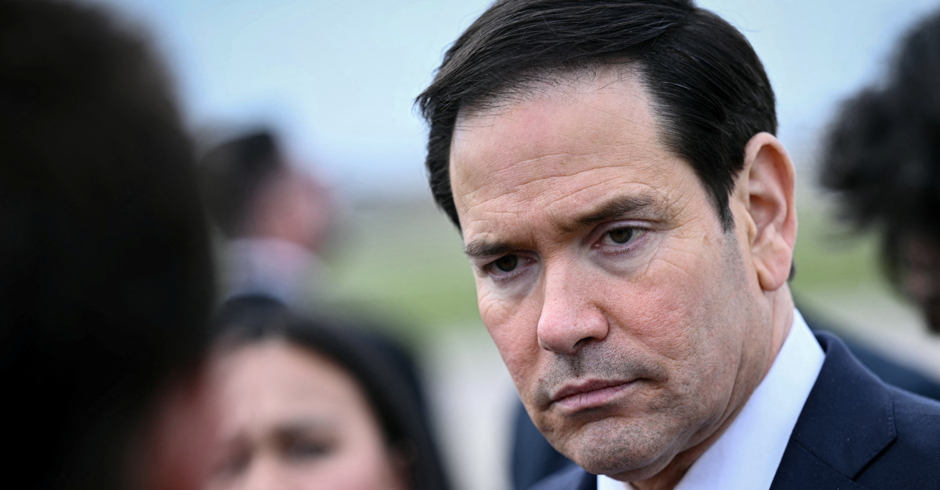
U.S. Secretary of State Marco Rubio appeared to contradict the commander-in-chief on Friday, speaking on the administration’s war efforts in Iran.
“We’re going to destroy their navy, we are going to destroy their air force, and we are going to significantly destroy their missile launchers so they can never hide behind these things to get a nuclear weapon,” Secretary Rubio said, according to CNN. He also insisted the U.S. military is “ahead of schedule” on these goals.
But according to President Donald Trump, those goals were already completed.
“We’re having, by the way, a tremendous success, as you know, in Iran,” Trump told reporters on Tuesday. “We had one in Venezuela, and now we’re having one in Iran.”
“They have no Navy left. They have no Air Force left. They have no anti aircraft equipment left, no radar left, no leaders left. The leaders are all gone,” he said.
“Nobody knows who to talk to,” Trump continued, despite having also insisted that he is in productive negotiations with Iran. “But we’re actually talking to the right people and they want to make a deal so badly. You have no idea how badly they want to make a deal.”
Iran has publicly denied it is negotiating with the United States.
CNN also reported that Rubio said “that the US can achieve its objectives in the Iran war ‘without any ground troops,’ as more than 1000 extra service members have been ordered to deploy to the region.”
PRESIDENT TRUMP: We’re having tremendous success in Iran. They have no navy, no air force, no anti-aircraft equipment, no radar, no leaders left.
You have no idea how badly they want to make a deal and we’ll see what happens. pic.twitter.com/VXD0fokxxw
— Department of State (@StateDept) March 24, 2026
READ MORE: ‘Wrong Answer’: Conservative CPAC Audience Cheers Impeachment
Image via Reuters

The chairman of the influential Conservative Political Action Conference was stunned on Friday when his audience delivered an unexpectedly awkward response.
“How many of you would like to see impeachment hearings?” Matt Schlapp asked.
The audience cheered, applauded, and cried, “yeah!”
Schlapp quickly cut them off.
“No. That was the wrong answer,” he retorted, appearing somewhat embarrassed.
“How many of you would like to see impeachment hearings?” Schlapp was forced to ask again.
“No,” he quickly directed.
Things did not appear to be going as planned.
“Can someone bring some coffee out?” Schlapp asked.
“We’ve got to keep this House majority!” he then declared, apparently cognizant that impeachment of the president could be possible were Republicans to lose control.
An attempt by @mschlapp to hype up the CPAC crowd goes horribly wrong —
“How many of you would like to see impeachment hearings?”
[cheers]
“That was the wrong answer…” pic.twitter.com/PQUCThdgV3
— Andrew Feinberg (@AndrewFeinberg) March 27, 2026
READ MORE: The GOP’s Secret Weapon? A ‘Known Unknown’ That Could Swing the Midterms: Columnist
Image via Reuters

FBI Witnesses in Georgia Case Didn’t Understand ‘How Elections Work’ Says Expert

Rubio Vows to ‘Destroy’ Parts of Iran’s Military Trump Bragged Were Already Decimated

‘Wrong Answer’: Conservative CPAC Audience Cheers Impeachment

American Credibility Has Collapsed — Only the ‘Strange’ Reality TV Show Remains: Columnist

‘Enough Tacos for a Restaurant’: Trump’s Latest Iran Retreat Ripped for ‘Winging It’
 News4 days ago
‘Blank Check’: Trump’s Board of Peace to Get $1.25 Billion From State Department
 News3 days ago
‘Wrong Answer’: Conservative CPAC Audience Cheers Impeachment

 News4 days ago
Trump Unleashes Unhinged Early Morning Tirade Targeting Enemies and Allies
 News2 days ago
FBI Witnesses in Georgia Case Didn’t Understand ‘How Elections Work’ Says Expert
 News3 days ago
‘Enough Tacos for a Restaurant’: Trump’s Latest Iran Retreat Ripped for ‘Winging It’

 News4 days ago
Trump Is So Desperate to End the War He Doesn’t Even Want to Call It One: Columnist

 News3 days ago
How Iran Hoodwinked Trump With America’s Own Strategies: Columnist
 News2 days ago
Rubio Vows to ‘Destroy’ Parts of Iran’s Military Trump Bragged Were Already Decimated