
News
New Poll Sends Trump Damning Message About 2024 if He’s Criminally Indicted
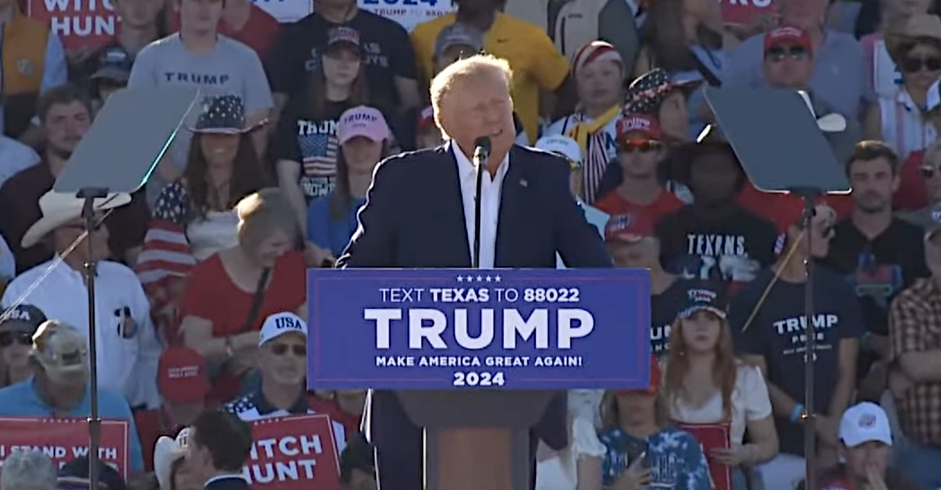
Biden Beats Trump – But Barely – in Latest Poll
A new Quinnipiac poll is offering damning news to Donald Trump: The majority of Americans think he should not even be allowed to run for president if criminal charges are filed against him.
That majority, 57%, includes nearly nine in ten Democrats (88%), more than half (55%) of independents, and even close to one-quarter (23%) of Republicans.
“Yes, say Americans, it was all about him and not the country’s well-being when Trump proclaimed he was targeted for arrest,” says Quinnipiac University Polling Analyst Tim Malloy. “And, yes he should be forever banished from office if he is charged as a criminal.”
The poll serves up even more bad news for the ex-president. Despite the right’s attempts to paint Trump’s alleged hush money payoff as a mere bookkeeping issue, or Manhattan District Attorney Alvin Bragg‘s case against him, as one GOP lawmaker said recently, “wrongful persecution,” the majority of Americans – 55% – say the accusations against Trump are “serious.”
READ MORE: New WSJ Poll Is Devastating for DeSantis and His ‘Anti-Woke’ Policies
Conservatives’ attempts to paint the investigation as political, however, appear to be working, at least among Republicans and independents.
More than nine out of ten Republicans (93%) and 70% of independents say they believe the investigation is motivated by politics, while two-thirds of Democrats (66%) say it is motived by the law.
Still more troubling news for the Trump team.
Exposing the growing partisan divide across the country, the majority of Americans, nearly six in ten (58%) say Trump has had a mainly negative impact on the Republican Party.
But inside the GOP, the view is far different.
The vast majority of Republicans (72%) say Trump has had a positive impact. Just 21% say he has had a negative impact. (The poll does not appear to take into account former Republicans who left the GOP because of Trump.)
Echoing the “positive impact” they believe Trump has had on their party, 79% of registered Republicans say they are supporters of his MAGA movement. The poll does not appear to define “support,” nor the various “levels” of support some Republicans now express, including “ultra MAGA.”
Meanwhile, when offered a choice between Donald Trump, Ron DeSantis, Mike Pence, Nikki Haley, or 11 other Republican candidates or potential candidates, Trump gets a plurality of voters: 47%. DeSantis gets one-third, 33%. Pence gets just 5%, and Haley – who has already officially declared she is running – gets even less, at 4%.
There’s little change when GOP voters are asked who they would choose in a head-to-head matchup between Trump and DeSantis. Trump gets 52%, DeSantis 42%.
And even more bad news for Team Trump: In a head-to-head matchup among registered voters, President Joe Biden would beat Donald Trump, although by a slim margin: 48% to 46%.
There is one piece of good news for the DeSantis campaign, which technically does not exist yet. DeSantis would beat Biden, also by a slim margin: 48% to 46%.
But some believe DeSantis will not run, especially given his poor campaign pre-launch. Others, like top Trump critic and former Republican George Conway, say DeSantis shouldn’t even bother.
“It makes no sense for DeSantis to run this cycle,” Conway said Thursday morning, unrelated to the Quinnipiac poll. “To beat Trump, DeSantis would have to go hammer and tong in a one-on-one race against him. DeSantis isn’t capable of that, it isn’t going to be one-on-one, and even if he were and it was, DeSantis would end up alienating a good chunk of the GOP base. And no matter what, Trump would try to destroy the GOP if it ever became clear he wouldn’t get the nomination. Trump would run as a third-party candidate to take the GOP nominee down. The smart play for DeSantis is to fleece donors by pretending to run, and pocket the cash for 2028, when he’ll still be only 49.”
Enjoy this piece?
… then let us make a small request. The New Civil Rights Movement depends on readers like you to meet our ongoing expenses and continue producing quality progressive journalism. Three Silicon Valley giants consume 70 percent of all online advertising dollars, so we need your help to continue doing what we do.
NCRM is independent. You won’t find mainstream media bias here. From unflinching coverage of religious extremism, to spotlighting efforts to roll back our rights, NCRM continues to speak truth to power. America needs independent voices like NCRM to be sure no one is forgotten.
Every reader contribution, whatever the amount, makes a tremendous difference. Help ensure NCRM remains independent long into the future. Support progressive journalism with a one-time contribution to NCRM, or click here to become a subscriber. Thank you. Click here to donate by check.
 |
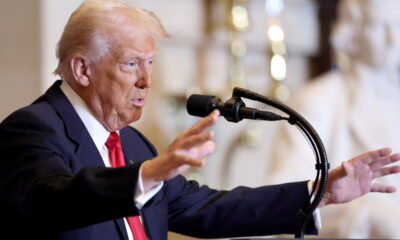


Democratic strategist and political commentator James Carville is blasting what he says is the “one thing” President Donald Trump is thinking about on his trip to China, and it has nothing to do with diplomacy, the U.S. economy, or the war in Iran.
Carville told Al Hunt on their Politicon podcast that it was “really interesting” that all the people he took to China were essentially the people who were in the “first three rows” from his inaugural address. He “put them on Air Force One, and he took Eric — who handles the business end of his business.”
“You’re going to watch a grift and graft over there, like you can’t imagine,” Carville continued. “That’s all this trip is about, and I got news for you, Mr. and Mrs. Joe Sixpack, or whoever you are out there, he doesn’t give a s—— about you, your future, your finances, your retirement, your anything.”
“He just cares about making all the money he can as fast as he can, and people [who] don’t realize that are just, just woefully stupid.”
Hunt reminded Carville that earlier this week Trump said, “I don’t think about Americans’ financial situation.”
READ MORE: Republicans Are Now Doing to Trump What Few in the GOP Have Ever Dared to Do
“Oh, you don’t, Donald,” Hunt responded. “Well, you know something? I think a lot of Americans think about their financial situation, and I’m sure those billionaire oligarchs you’re traveling with don’t, but a lot of voters do, and, uh, you’re gonna pay, you’re gonna pay a price.”
Carville added that Trump also said that he doesn’t even think of Iran.
“I think there’s only one thing that he’s thinking about in his trip to China. And that is a big grift,” Carville said. “Look at who he’s taking with him.”
Carville said there would be “economic exchanges” and “investment opportunities” during the China trip.
“You can see, this is where this is going,” he continued. “They just buy him off. He does not care.”
“He doesn’t care if he, as long as he can go there and make as much money, as fast as he can make it, that’s all what he cares about.”
READ MORE: ‘Rededicating the Country to God’: Trump White House Hosts Evangelical Christian Festival
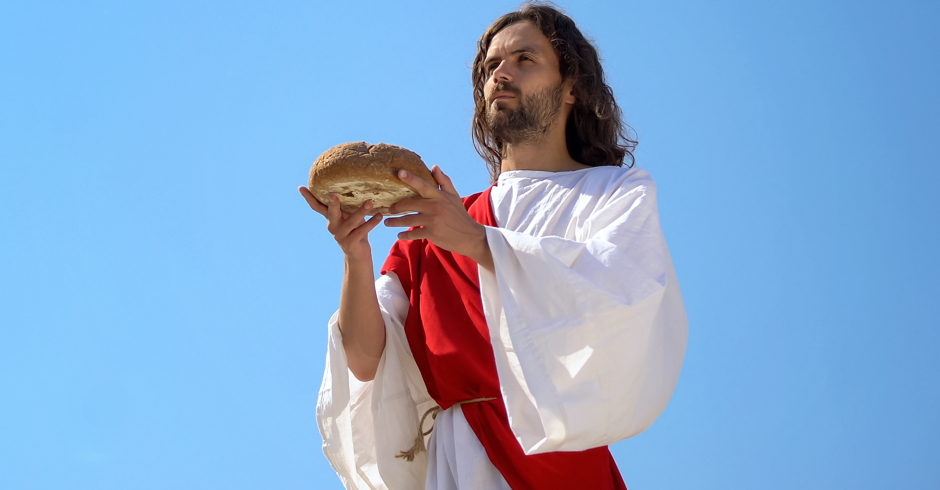
27-year-old Michigan-raised Kayla Bundy is a Christian content creator who turned to the Bible for ways to eat healthy — but her lifestyle is also part of a “higher calling,” The New York Times reports, explaining that she is “a biblical eater, someone who consumes mostly foods mentioned in the Bible.”
“Sin entered into the world through food,” Bundy told the Times, “and Satan doesn’t stop there. Food, for me, is really like a weapon of how I can fight back.”
According to the Times, a “diet inspired by the Bible has found new audiences online in the Make America Healthy Again era.”
Bundy, who has over 500,000 followers on TikTok, and has been eating biblically for eight years, “claims that her diet ‘fixed’ her skin, her hair and her depression, and she sells coaching sessions to help others with their diets,” The Times reports. She “is open about not having nutrition credentials, but she sells a $28 digital guide to biblical superfoods, as well as coaching sessions that start around $700 for a month, she said.”
READ MORE: Republicans Are Now Doing to Trump What Few in the GOP Have Ever Dared to Do
She buys raw milk, eats sardines and authentic sourdough bread without commercial yeast, and tries to cook with locally sourced foods.
“I had never really thought to look to the Bible for a recipe book,” said Bundy, who now lives in Bali. Cutting out refined sugar made her feel good, and she started “studying scripture from that lens of noticing what they are eating.”
32-year old Georgia stay-at-home mom Annalies Xaviera “posts biblical eating tips,” and “said her Facebook following had jumped from scant thousands to over 300,000 in just a few weeks this spring. She sells a digital cookbook.”
“The Bible says that God appreciates and celebrates small steps of obedience,” Xaviera told the Times.
“When you’re in a craving,” she said, “have you ever thought to stop and pray?”
READ MORE: ‘Rededicating the Country to God’: Trump White House Hosts Evangelical Christian Festival
Image via Shutterstock

The Trump White House is hosting an unprecedented Christian prayer festival Sunday on the National Mall — a nine-hour event that a Trump advisor describes as “rededicating the country to God.” Defense Secretary Pete Hegseth, Secretary of State Marco Rubio, and House Speaker Mike Johnson are all expected to appear.
The funding for “Rededicate 250: National Jubilee of Prayer, Praise & Thanksgiving,” comes in part from taxpayer dollars earmarked for America’s 250th birthday celebration, organizers say, according to The Washington Post.
The speakers are almost all Christian, and expected to largely be evangelical Protestant leaders and members of the Trump administration, “many of whom have embraced the message that America’s founders wanted the country to be explicitly Christian,” the Post reports. The event will have a “focus on American identity as aligned with a specific slice of conservative Protestantism.”
Pastor Paula White-Cain, Senior Advisor to the White House Faith Office who delivered the invocation at President Donald Trump’s first inauguration, said the Jubilee “is about the history and the foundations of our nation, which was built on Christian values, on the Bible.”
“This is really truly rededicating the country to God,” she added.
READ MORE: Republicans Are Now Doing to Trump What Few in the GOP Have Ever Dared to Do
According to The Guardian, the invited speakers include those who experts have been “characterized as Christian nationalist or extremist.”
Among them, a pastor who has called the Democratic platform “demonic,” the Guardian says, along with “a rabbi who has defended the use of torture,” and “a Christian author and radio host who said in 2020 he would die in the fight to keep Joe Biden out of the White House and was later named in a defamation suit over 2020 election fraud claims.”
Scholars have deemed the event unprecedented in the modern era.
“I’m unaware of anything like this, with this involvement of senior government officials, on this scale, trying to paint this false picture of the United States as a quote unquote Christian nation,” Amanda Tyler told the Post. Tyler is executive director of BJC, a Baptist group that promotes religious liberty through church-state separation. “Trump’s rhetoric in the past 18 months is how he’s ‘going to make America Christian again,’ that it’s his job to push religion. This is all part of that piece.”
Princeton University historian Kevin Kruse told the Post, “There’s a difference between saying America is a nation with many Christians in it and that America is a nation dedicated to Christianity and defined by it.”
“Those are very different things,” he said.
Kruse also noted that the only rules about religion that the framers of the Constitution wrote “were ones that keep religion at arm’s length. No establishment, no limits on free exercise, no religious test for office.”
But the Trump White House defended the event, its focus, and its list of speakers.
Brittany Baldwin, executive director of the White House’s 250 Task Force, in an April webinar, said: “We worked very hard with the faith leaders we trust … to ensure that we hear their concerns and we have the right focus for our community of believers, across the country. So I think if you do see another religion represented, it would probably be in a modest way.”
Paula White-Cain went even further, saying that the jubilee would not include leaders “praying to all these different Gods.”
READ MORE: Republicans Are Using a Secret Super PAC to Pour $1 Million Into Democratic Primaries
Image via Reuters

Carville Says There’s Only ‘One Thing’ Trump Is Thinking About on His China Trip

Christian Content Creator Fighting Sin Is Teaching Others How to Eat Biblically: NYT

‘Rededicating the Country to God’: Trump White House Hosts Evangelical Christian Festival

Republicans Are Now Doing to Trump What Few in the GOP Have Ever Dared to Do

Republicans Are Using a Secret Super PAC to Pour $1 Million Into Democratic Primaries
 News3 days ago
Republicans Moving to Give Trump Something He’s Wanted Since 2019
 News2 days ago
Carville Says There’s Only ‘One Thing’ Trump Is Thinking About on His China Trip

 News4 days ago
Ex-National Security Official Is Already Warning About the Next ‘Trump Pandemic’

 News4 days ago
Taxpayers to Pick Up Massive Cost Overrun of Another Trump Project
 News2 days ago
Republicans Are Now Doing to Trump What Few in the GOP Have Ever Dared to Do

 News3 days ago
‘Bad All Around’: Republicans Privately Fear Backing Trump Request Sends Tone-Deaf Message
 News2 days ago
Republicans Are Using a Secret Super PAC to Pour $1 Million Into Democratic Primaries

 News4 days ago
‘Empty’ Case Against Mark Kelly Shows Pentagon in ‘Disarray’: Expert