Oh Look, Yet Another Flawed Study That Portrays Gay People Negatively
A new study from Texas claims to have found that same-sex couples suffer much higher rates of intimate partner domestic violence, but the data is ancient history, and thus, worthless — and potentially harmful
It’s likely just a coincidence that Mark Regnerus and his debunked anti-gay “study” of supposedly adult children of gay parents has been in the news this week. (No, his study was not of adult children of gay parents.) Regnerus testified before a federal judge deciding the future of same-sex marriage in Michigan this week, and, of course, his beliefs were thoroughly yet again debunked.
LOOK:Â Read What Mark Regnerus Just Said In Court About Kids Of Same-Sex Couples
So imagine my surprise when I came across an article yesterday, supposedly from a science news site, titled, “Who Has More Intimate Partner Violence, Gays Or Straights?” And imagine my surprise when the answer was, of course, “gays.” And as I debated publishing this article, yet another article has come out about the flawed study, titled, “Intimate Partner Violence More Common Among Non-Heterosexual Partners.”
Both authors should have, but did not, bother to explain that the old data is essentially useless if applied to today’s society.
LOOK:Â As Regnerus Testifies Against Marriage In Court, His University Denounces His Research
The “study,” (technically, two studies, published together,) coincidentally was also out of Texas, just as Regnerus’ “study” was. Its title is “The Consequences of Intimate Partner Violence Victimization By Sexual Orientation.” (PDF)
“The first study found that homosexuals and bisexuals were more likely to be involved in intimate partner violence,” reads the article at Science 2.0. “In the second study, homosexual or bisexual victims of intimate partner violence were more likely to use drugs and alcohol and have health issues compared to heterosexual victims.”
“Homosexuals and bisexuals had 36 percent more likelihood than heterosexuals of being involved in intimate partner violence – in the dataset the totals were 50 percent and 32 percent respectively.”
Tucked away in the article (from the researchers’ published report) is this particularly important yet wholly glossed-over fact:
“The dataset was a sample of 7,216 women and 6,893 men from the National Violence Against Women Survey from 1995 and 1996.”
Yes, the National Violence Against Women Survey from 1995 and 1996.
We’re talking about data that was collected nearly two decades ago. Many of you reading this might not even have been born when the information was collected. The average age of the study’s respondents — the people who participated in the study — was 45. This means that the incidents of abuse occurred, actually between, probably, 1965 and 1996.
If the study were titled “The Consequences of Intimate Partner Violence Victimization Between 1965-1996 By Sexual Orientation” then, fine.
Heck, Lawrence v. Texas, which, in essence, made homosexuality legal, wasn’t decided by the Supreme Court until 2003. Meaning that all these incidents of reported violence (no one’s suggesting they aren’t legitimate) happened when being gay was in essence illegal.
One of the study’s authors, Maria Koeppel, told me in an email conversation in response to my question about the dataset:
The study did use data pulled from the National Violence Against Women Survey. That survey originally had about 16,000 participants, however, the sample that we used for our study only included individuals who had reported being in current or former romantic cohabiting or marital relationships. As a result the number of people included in our study was about 14,100.
The study itself claims that, “[m]irroring other measurements of sexual orientation, one percent of our sample was identified as non-heterosexual.” I know of no study that finds just one percent of the population is non-heterosexual. (See below for more.) Also, the study at points  identifies “non-heterosexual” as homosexual, which is incorrect.
So, the study focuses on one-percent of its data to draw conclusions about intimate partner violence in same-sex relationships from the 1960s to the 1990s. And this is relevant in what way to today, exactly how?
If you were to say in no way whatsoever, except as a look into history, you would be correct — certainly in my opinion.
The study also is based on a dataset in which a full 30 percent of respondents are unemployed, and the balance are not necessarily employed full-time. So, one might automatically expect overall incidence of violence, and alcohol and drug use to be higher.
What is truly sad is this study, released by the Crime Victims’ Institute at Sam Houston State University, actually seems to be well-intentioned — unlike the Regnerus “study.”
The authors, Maria Koeppel and Leana A. Bouffard, Ph.D., write that “by determining which specific IPV [Intimate Partner Violence] effects have the greatest impact on non-heterosexual victims, shelters and programs can allocate proper funding to specific issues.”
Totally agreed!
But the LGBT community has changed dramatically since the 1960s-1990s, and this study paints us just a bit better than the “article” Michigan RNC Committeeman Dave Agema used that called gay people “filthy.”
To be fair, and in her defense, here’s what Koeppel told me, again via email:
The dated nature of the dataset, as well as the small sample size of sexual minorities are limitations of the study, and as such, conclusions drawn from this study should be not be used to make generalized statements. It should be noted however, that 1.0% of the sample being identified as not heterosexual closely emulates the same-sex cohabitation rate from the 2008 U.S Census, and that research, by necessity, will have to look at this population with smaller numbers since they are a minority. Regardless of such limitations, one goal of this study was to determine if differences in consequences varied between sexual orientation groups. To date, there have been no published studies which look specifically at that, and the dataset we used was unique in that it had measures for both sexual orientation, and various forms of intimate partner violence. Secondly, the study wanted to bring attention to the potential differences between groups as justification for further research comparing aspects of intimate partner violence between sexual orientation groups. Future research would benefit from including a larger number of same-sex couples, being nationally representative, measuring minority stress in same-sex couples, and using comprehensive and innovated measures of intimate partner violence to allow for stronger conclusions and comparisons to be made.
Note to all researchers: you do not publish in a vacuum. You can claim all you want that your research “should be not be used to make generalized statements.”
Too bad, it is, and you all have a responsibility to foresee how it will be misused, twisted, and made into a weapon that is against the ultimate goal you probably have.
Case in point:
“Who Has More Intimate Partner Violence, Gays Or Straights?
The LGBT community absolutely needs and deserves more research and more funding for that research, but using ancient history and claiming it’s relevant to today is not just pointless, it’s harmful.
Â
Image: Photo of artist George Segal’s commemoration of New York City’s 1969 Stonewall Rebellion, by Tony Fischer via Flickr
Enjoy this piece?
… then let us make a small request. The New Civil Rights Movement depends on readers like you to meet our ongoing expenses and continue producing quality progressive journalism. Three Silicon Valley giants consume 70 percent of all online advertising dollars, so we need your help to continue doing what we do.
NCRM is independent. You won’t find mainstream media bias here. From unflinching coverage of religious extremism, to spotlighting efforts to roll back our rights, NCRM continues to speak truth to power. America needs independent voices like NCRM to be sure no one is forgotten.
Every reader contribution, whatever the amount, makes a tremendous difference. Help ensure NCRM remains independent long into the future. Support progressive journalism with a one-time contribution to NCRM, or click here to become a subscriber. Thank you. Click here to donate by check.
 |


President Donald Trump thrilled his supporters in New York on Friday as he shared how he came up with his latest nickname for Democrats — his explanation included a spelling lesson.
“Blue means Dumocrat,” the president said. “That’s a new name I came up with.”
“I was, I was thinking about this character we have in the House. His name is Hakeem Jeffries,” Trump said to boos from the audience.
“And he’s a low IQ person, very low IQ.”
“And I watched what he was saying, and what the horrible things he was saying, and I said, ‘He’s a dumb guy.’ I said, Wait a minute, he’s a Dumocrat. That’s how I got the name,” Trump excitedly said.
“You take the ‘e’ out, you don’t use the ‘b’. A lot of people don’t know ‘dumb’ has a ‘b’ in it, actually. You don’t need it. You discard the ‘b.’
“But you take the ‘e’ out, and you replace it with a ‘u.'”
“They are Dumocrats. You know why? ‘Cause their policies are dumb. Their policies are very dumb. All of their policies.”
Critics mocked the president.
“His uncle taught at MIT, but Trump just recently learned there is a b in dumb,” wrote political strategist Jeff Timmer.
“Dumbo @realDonaldTrump here is the only one who doesn’t know there’s a b in DUMB,” said former GOP Congresswoman Barbara Comstock.
“It’s impossible to overstate how f— — stupid Trump looks on the world stage,” wrote another online commenter.
Image via Reuters

President Donald Trump’s controversial Director of National Intelligence, Tulsi Gabbard, is resigning.
“Unfortunately, I must submit my resignation, effective June 30, 2026,” DNI Gabbard wrote to President Trump, Fox News reports. “My husband, Abraham, has recently been diagnosed with an extremely rare form of bone cancer.”
“During pivotal moments,” NBC News reports, “as Trump deliberated over possible military action or watched live video feeds of operations in Iran or Venezuela, Gabbard was often not in the room, underscoring her outsider status.”
“Gabbard has had a tough tenure being sidelined on Venezuela and Iran. Last month, Trump floated replacing her with Pam Bondi, but some advisers saved her,” reported WIRED’s Hugo Lowell.
President Trump wrote that Gabbard had done an “incredible job,” and “we will miss her,” while Reuters reports that the White House ”forced” Gabbard “to resign from her post, a person familiar with the matter said on Friday.”
The Wall Street Journal’s Dave Brown called Gabbard’s tenure “tumultuous.”
Critics were quick to respond.
“Good riddance. The Iran war has been the biggest display of intelligence incompetence in decades,” wrote U.S. Rep. Shri Thanedar (D-MI).
“Tulsi Gabbard leaves this administration in disgrace after helping Trump drag the country into yet another forever war in the Middle East,” wrote political strategist Mike Nellis. “She built her entire image on opposing these wars, then abandoned that principle the second it became politically inconvenient. That’s her legacy: a complete fraud, completely full of s— — about the one thing people thought she genuinely believed in. Good f— — riddance.”
“Also, is anybody in Congress or the media going to get to the bottom of the whistleblower’s story about Tulsi Gabbard withholding classified intercepted intel for political reasons?” Nellis continued. “What the hell happened there, or are we just going to pretend that didn’t happen?”
“Are we ever going to found out if Tulsi Gabbard broke how many different national security laws by allegedly refusing to hand over investigative documents, or is that just going away now?” asked writer Charlotte Clymer.
Professor and policy analyst Adam Cochran called Gabbard’s resignation “shocking,” and added: “Can’t imagine what they would ask to do that is too out of line for her…”
Associate Professor of Political Science Christopher Clary said Gabbard “will go down as perhaps the most ineffective and incompetent DNI in the short history of that position.”
Image via Reuters
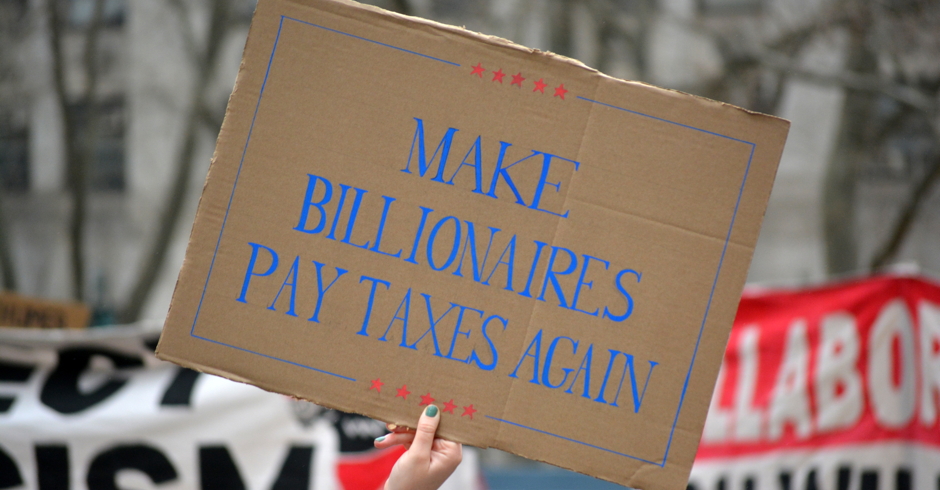
President Donald Trump managed to effectively raise taxes on the majority of Americans through his tax policies, while handing the richest five percent a tax cut. Now, many Americans want to see the rich pay their fair share — and that could mean increasing their taxes.
The former chief economist of the White House Office of Management and Budget, Professor Zachary Liscow, argues there’s a “slow, boring” yet “easy” way to do so.
“The United States is seeing an increasing concentration of wealth at the very top and a worsening national debt,” Liscow writes in an op-ed at The New York Times. “For many Americans, taxing the rich more is an obvious move.”
He details some of the “novel proposals to curb the many intricate ways the rich make and hide their money,” including a wealth tax, a tax on unrealized gains, and a tax on “loans that billionaires take against their stock.”
But, Liscow warns, while novel, these methods would not raise the substantial amount of money the U.S. needs.
“The boring truth is that Congress can accomplish a lot simply by raising the rates of the taxes already on the books,” Liscow explains.
He examines U.S. Senator Elizabeth Warren’s (D-MA) proposal to tax “fortunes above $50 million,” and says there are “serious constitutional and policy arguments for this idea, but the Supreme Court’s current members would probably strike it down.”
There is a billionaire’s tax proposal by U.S. Senator Ron Wyden (D-OR) that would tax unrealized capital gains, “the appreciation in the paper value of assets such as stocks.” That would likely find a Supreme Court challenge.
There are other tax vehicles, like fixing the “buy, borrow, die” loophole, which would tax loans taken against stock portfolios, but that would likely not raise sufficient funds: “It’s just not where the money is.”
He finds that “the most powerful lever is also the simplest one,” and concludes that “Congress has a simpler, tried-and-true tax policy to choose from: raising the rates.”
Liscow is advocating to restore the “top marginal ordinary income tax rate to its pre-2017 level of 39.6 percent” — where it was before Trump’s first term in office.
“In addition, raising the corporate tax rate from 21 percent toward the 35 percent it had been set at historically would add hundreds of billions in revenue for the government,” he says.
“Raising the rates,” Liscow concludes, “the simple, boring answer — is where the real money lies.”
Image: Christopher Penler / Shutterstock.com

Trump Explains ‘Dumb’ Has a ‘B’

‘Good Riddance’: Critics Cheer Tulsi Gabbard’s ‘Shocking’ Resignation

The ‘Slow, Boring’ and ‘Easy’ Way to Tax the Rich: Expert

Trump’s Latest ‘Executive Time’ Grievance Session Reveals What He’s Really Worried About

‘Political Survival’ Fears Driving Senate GOP to ‘Breaking Point’ With Trump: Report
 News3 days ago
Trump Explains ‘Dumb’ Has a ‘B’

 News4 days ago
‘Galactic Blunder’: Republicans Furious Over Timing of Trump’s $1.8 Billion Fund

 News4 days ago
‘Incredibly Hostile’: Blanche’s Capitol Hill Visit With Senate GOP ‘Did Not Go Well’
 News4 days ago
Rove Warns Trump Is ‘Helping Democrats’ Take Back the House

 News4 days ago
Trump: ‘I Don’t Know’ If I’m Losing Control of Senate Republicans
 News3 days ago
Trump’s Latest ‘Executive Time’ Grievance Session Reveals What He’s Really Worried About
 News3 days ago
‘Good Riddance’: Critics Cheer Tulsi Gabbard’s ‘Shocking’ Resignation

 News4 days ago
‘Go Home USA’: Greenlanders Protest New American Consulate as PM Snubs Opening