Equality Forum: Transgender Panel Members ‘Still Have To Do These 101s’
The New Civil Rights Movement’s John Culhane is the official blogger for Equality Forum, Philadelphia’s internationally known and always interesting cavalcade of events that celebrates, informs and provokes on all (or many, anyway) things LGBT. John will be sharing reports daily over the next few days. Read all John’s Equality Forum posts here.Â
It’s fair to say that the Transgender Panel is the one I always await most eagerly at the annual Equality Forum. It’s uniformly interesting and edgy. And it’s nice to get beyond the formal equality that most often drives our sprawling community(ies) and into the murkier waters of social justice. Last night’s panel did not disappoint.
The room was packed by about 70 people, many of whom engaged the panelists in a dialogue that can only loosely be described as Q&A. As invited by moderator Joe Ippolito, the mostly transgender audience wove their compelling personal narratives into their exchanges with the willing panelists, who were very free about ceding air time. The panelists were: Jeanine Ruhsam, President of TransCentral Pennsylvania (an advocacy group); Melissa Sklarz, President of the Stonewall Democratic Club of NYC; and Kye Allums, who made history by playing for a women’s Division 1 basketball team at George Washington University while identifying as a male (despite female biological origin).
The evening had two themes. First, were the gay and lesbian advocates the natural advocates of the trans-community?
Second, what is the teaching role of transpeople? (Do they “still have to do these Trans 101s?” as Ippolito so perfectly asked.)
Addressing these themes allowed both panelists and audience members to share their personal stories and experiences in illuminating ways. For example, one audience member bemoaned the fact that she’s been doing trans-activism for almost “40 years, and [is] tired of it.” She also felt as though she was often a “trans-token” on LGB (not so much T) panels and boards.
Well, who wouldn’t get tired of this? And Ruhsam gently agreed that sometimes one just needs a break. But generally, the panelists and some of the audience members were committed to the on-going project of education, and thought that such education had already helped make lesbians and gays into the allies that we should have been long ago. Ruhsam noted that we all “mess with gender” in ways that are discomfiting to the sexual majority. (I’d agree, although it’s fair to say that some gay men and a few lesbians have tried to cover “our hurt with a show of gladness,” to quote Smokey Robinson. But no amount of adoption, mainstreaming or wishful thinking can change the brute facts.)
Sklarz thought that gays and lesbians were “maybe” natural allies to the transcommunity, but agreed with one astute audience member (me) that perhaps more support had come from the public health community. It’s easy to see why Sklarz — whom I’d describe, not uncharitably, as the most world-weary of the group — would be likely to view public health advocates as natural allies. She described her own long journey, a bumpy ride that included substance abuse and long-term unemployment (that started as soon as she began transitioning by taking hormones). It’s really the public health community that would look to particular communities to find practical solutions to these problems rather than the rights-driven approach of the mainstream lesbian and gay community. Yet Sklarz — now a high-profile Democrat, after all –Â understood the importance of alliances toward the goal of transrights, and said she’d take anyone who’d work with her. And some of these mainstream legal struggles — even for marriage equality — have resonance (although not in exactly the same way) for transfolks, too. (As Ippolito pointed out, even when they identify as man and woman, transpeople push the marriage equality movement in a way by undermining the gender norms of marriage.)
Allums had the least to say, and I’ll confess I wanted to hear more. He says he’s committed to traveling around the country and talking to whomever will listen about his experiences and the problems of bullying. He talks to the bulliers — a courageous act that, it seems, has changed at least some hearts and minds. Yet there’s so much rich ore to be mined in the whole area of transmen and women in sports. Although Allums didn’t talk much about his journey, I saw some parallels to Caster Semenya, the South African track star whose gender was notoriously called into question because she (1) “looks” more male than female; and (2) is very freaking fast. What determines who’s male and female? And how does the occasionally complex issue of gender affect the male-female to which sports is committed like few other areas of human striving?
Well, few other areas: Another is public bathrooms. As Sklarz painfully pointed out, the bathroom excuse for denying trans-equality emphasizes exactly the wrong class of victims — those who might have to share a public bathroom with those whose gender presentation makes them uncomfortable. But the law is really needed to protect the trans-community members themselves from violence and corrosive assumptions about “normalcy.”
Will things be better in twenty years? Answering an audience member’s question to that effect, the panelists were divided. But perhaps we can hope that we’re at least up to Trans 102 by then.
 Were he born 10,000 years ago, John Culhane would not have survived to adulthood; he has no useful, practical skills. He is a law professor who writes about various and sundry topics, including: disaster compensation; tort law; public health law; literature; science; sports; his own personal life (when he can bear the humanity); and, especially, LGBT rights and issues. He teaches at the Widener University School of Law and is a Senior Fellow at the Thomas Jefferson School of Population Health.
He is also a contributor to Slate Magazine, and writes his own eclectic blog. You can follow him on Facebook and Twitter if you’re blessed with lots of time.
John Culhane lives in the Powelton Village area of Philadelphia with his partner David and their twin daughters, Courtnee and Alexa. Each month, he awaits the third Saturday evening for the neighborhood Wine Club gathering.

Enjoy this piece?
… then let us make a small request. The New Civil Rights Movement depends on readers like you to meet our ongoing expenses and continue producing quality progressive journalism. Three Silicon Valley giants consume 70 percent of all online advertising dollars, so we need your help to continue doing what we do.
NCRM is independent. You won’t find mainstream media bias here. From unflinching coverage of religious extremism, to spotlighting efforts to roll back our rights, NCRM continues to speak truth to power. America needs independent voices like NCRM to be sure no one is forgotten.
Every reader contribution, whatever the amount, makes a tremendous difference. Help ensure NCRM remains independent long into the future. Support progressive journalism with a one-time contribution to NCRM, or click here to become a subscriber. Thank you. Click here to donate by check.
 |

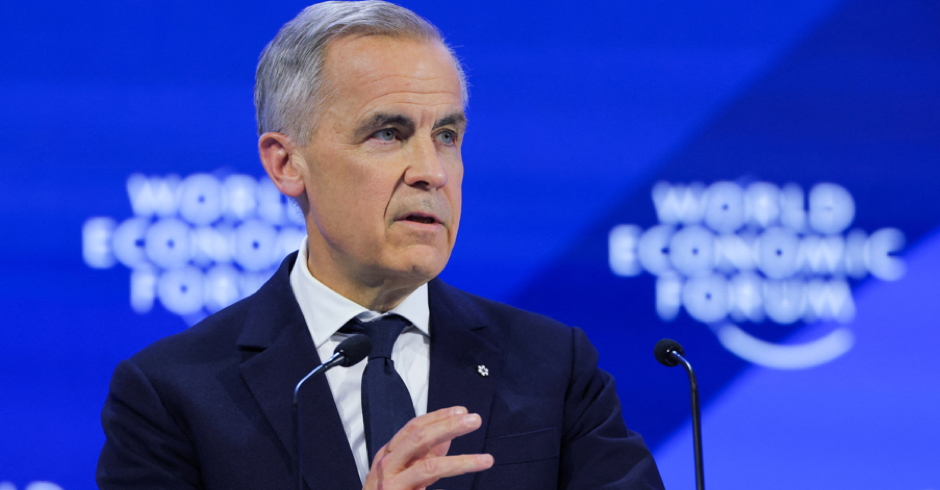
Canada’s Prime Minister Mark Carney drew a standing ovation at the World Economic Forum in Davos after warning that the global order has ruptured.
“Let me be direct: We are in the midst of a rupture, not a transition,” Carney said, as The New York Times reported.
“I will talk today about the breaking of the world order, the end of a pleasant fiction and the beginning of a brutal reality where the geopolitics of the great powers is not subject to any constraint,” he explained.
“Every day we are reminded that we live in an era of great power rivalry,” he said. “That the rules-based order is fading. That the strong do what they can, and the weak suffer what they must.”
Carney did not say President Donald Trump’s name, but he did tell his audience, “recently, great powers began using economic integration as weapons. Tariffs as leverage. Financial infrastructure as coercion. Supply chains as vulnerabilities to be exploited.”
READ MORE: ‘Enemy Is Within’: Trump Boosts Post Casting NATO as a ‘Threat’ in Social Media Spree
“You cannot live within the lie of mutual benefit through integration, when integration becomes the source of your subordination.”
He also said that “there is a strong tendency for countries to go along to get along. To accommodate. To avoid trouble. To hope that compliance will buy safety.”
“It won’t,” he warned.
Carney said that “intermediate powers like Canada, are not powerless. They have the capacity to build a new order that encompasses our values, such as respect for human rights, sustainable development, solidarity, sovereignty and territorial integrity of the various states.”
And he warned that those powers “must act together, because if we’re not at the table, we’re on the menu.”
The Times noted that Carney’s speech came “not long after” President Donald Trump “posted an A.I. image on social media that included a map of American flags superimposed over both Canada and the United States,” along with the U.S. flag on Greenland, Venezuela, and Cuba.
Very important and very well put remarks by 🇨🇦 PM Mark Carney. It’s time to take down the sign and speak up. pic.twitter.com/Ky00CNMYVM
— Carl Bildt (@carlbildt) January 20, 2026
READ MORE: ‘Code Red’: Newsom Tells Europe They’ve Been Played by ‘T-Rex’ Trump
Image via Reuters

In a stark warning on the first anniversary of President Donald Trump’s second term in office, The Bulwark’s editor, Jonathan V. Last, suggests that under Trump, America may adopt Putinism as its domestic policy, having already adopted it for its foreign policy.
“Will Putinism take over American domestic politics, too?” Last asks, in an opinion piece titled, “This Is the End.”
“America has adopted Putinism as its modus operandi for foreign affairs,” he says. “Why would America not also adopt Putinism in its domestic affairs? Why would the American regime tolerate free and fair elections or the transfer of power to an opposition party?”
Pursuing the question, Last continued: “Are there examples of expansionist, rogue regimes which ignored international law and attempted to subjugate free people abroad, but respected liberal democratic outcomes that terminated their possession of power at home?”
READ MORE: ‘Dictators’ Tea Party’: Trump’s Board of Peace Ridiculed as New Details Revealed
To those who suggest Trumpism is temporary, Last suggests he disagrees.
“Many people comfort themselves by saying some version of ‘Donald Trump is an aberration’ or ‘This isn’t who we are,'” he writes.
But, he continues, “If Trump was an aberration and his actions did not have sufficient public support, then he would be removed from office. There are two mechanisms for doing so—impeachment and the 25th Amendment.”
“Trump will not be removed from office; which allows one of two conclusions. Either: Trump’s policies are supported by a sufficient percentage of Americans to be viable; or America’s constitutional order is so ossified that it no longer functions to safeguard the will of the people.”
“Neither of these is an alibi,” Last warns, noting that, “either one supports the conclusion that the problem is not Trump. It is America and Americans. This is who we are. Like it or not.”
Last also makes several other predictions:
“The days of intelligence sharing between America and our former allies are drawing to a close.”
“The death of NATO.”
“Germany, Poland, and Canada will acquire nuclear weapons. So will Japan. Sweden, Australia, and South Korea may develop nuclear capabilities as well.”
“Europe will draw closer to China.”
“Greenland will become disputed territory.”
READ MORE: ‘Enemy Is Within’: Trump Boosts Post Casting NATO as a ‘Threat’ in Social Media Spree
Image via Reuters
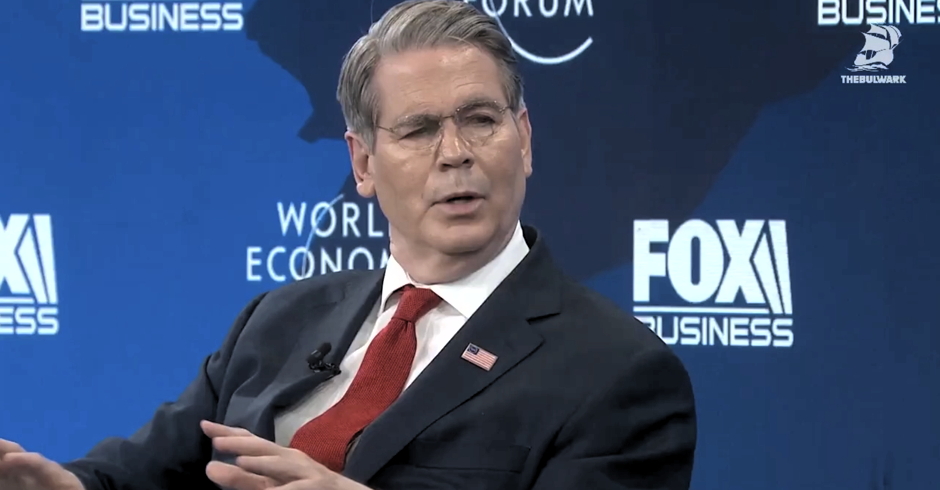
Secretary of the Treasury Scott Bessent was met with mockery after explaining he wants to protect “mom and pop” owners who have up to a dozen homes they’ve bought as retirement investments.
Bessent and President Donald Trump have declared they want to ban large institutional investors from purchasing single-family homes as housing becomes more scarce and less affordable.
“We are going to give guidance at some point to see what is a mom and pop, that someone — maybe your parents — for their retirement, [bought] about 5, 10, 12 homes,” Bessent told Fox Business’ Maria Bartiromo at the World Economic Forum in Davos.
“So we don’t want to push the mom and pops out,” he continued. “We just want to push everyone else out.”
READ MORE: ‘Enemy Is Within’: Trump Boosts Post Casting NATO as a ‘Threat’ in Social Media Spree
Bessent, a former hedge fund manager, has an estimated net worth of $521 million, according to The Street.
Critics were quick to ridicule Bessent as out of touch.
“Good news for the forgotten man,” declared The Bulwark’s Tim Miller. “The mom and pop real estate investor who has purchased 12 homes can breathe easy, the Treasury Secretary is looking out for you.”
“These people are completely out of touch with how life is for you,” observed The Lincoln Project.
Governor Gavin Newsom’s Press Office commented, “Scott, people are trying to buy 1 house — to live in. Could the Trump Admin be any more out of touch?”
Bessent: “Someone, maybe your parents for their retirement have bought 5, 10, 12 homes.” pic.twitter.com/eUZXTmnhpH
— The Bulwark (@BulwarkOnline) January 20, 2026
READ MORE: ‘Code Red’: Newsom Tells Europe They’ve Been Played by ‘T-Rex’ Trump

‘Code Red’: Newsom Tells Europe They’ve Been Played by ‘T-Rex’ Trump

Treasury Chief Draws Ridicule for Wanting to Protect Americans With ‘5, 10, 12 Homes’

Canadian Prime Minister Warns World Order Has Ruptured

‘Enemy Is Within’: Trump Boosts Post Casting NATO as a ‘Threat’ in Social Media Spree

US Could Slide Into Putin-Style Rule After Trump Foreign Policy Shift: Journalist
Canadian Prime Minister Warns World Order Has Ruptured
US Could Slide Into Putin-Style Rule After Trump Foreign Policy Shift: Journalist
Treasury Chief Draws Ridicule for Wanting to Protect Americans With ‘5, 10, 12 Homes’
‘Enemy Is Within’: Trump Boosts Post Casting NATO as a ‘Threat’ in Social Media Spree
‘Code Red’: Newsom Tells Europe They’ve Been Played by ‘T-Rex’ Trump

 News1 day ago
‘Dictators’ Tea Party’: Trump’s Board of Peace Ridiculed as New Details Revealed

 News1 day ago
‘25th Amendment Territory’: Critics Warn Trump Impeachment Is ‘Not Enough’

 News2 days ago
Europe Divorcing America Now Seen as ‘Inevitable’: Report

 News1 day ago
‘Is Canada Next?’ Ex-Trump Official Says Greenland Threat Worse Than Imagined

 News2 days ago
Anti-Gay Bias Surges ‘Sharply’ — Even Among These Least Expected Groups: Report
 News14 hours ago
‘Code Red’: Newsom Tells Europe They’ve Been Played by ‘T-Rex’ Trump
 News12 hours ago
Treasury Chief Draws Ridicule for Wanting to Protect Americans With ‘5, 10, 12 Homes’
 News7 hours ago
Canadian Prime Minister Warns World Order Has Ruptured