US Votes Against UN Resolution Condemning Death Penalty for Blasphemy, Adultery and Same-Sex Relations
In 13 Countries the Penalty for Being Gay or Bisexual is Death
The United States has voted against a United Nations resolution that condemns the use of the death penalty as punishment for a variety of acts, including religious blasphemy, adultery, and same-sex relations. The resolution passed 27-13, with seven nations abstaining. America joined just 12 other countries – among them Burundi, China, Egypt, India, Iraq, Japan, Qatar, and Saudi Arabia – in voting against the United Nations Human Rights Council’s resolution.
The Trump administration, which has actively been unraveling LGBT advances in the U.S., does not appear to have explained its vote on the U.S. State Dept. website.
The UN resolution asks countries “that have not yet abolished the death penalty to ensure that it is not imposed as a sanction for specific forms of conduct such as apostasy, blasphemy, adultery and consensual same-sex relations.”
The resolution itself does not even condemn the use of the death penalty, but rather requests countries that have yet to ban the death penalty to “ensure that it is not applied on the basis of discriminatory laws or as a result of discriminatory or arbitrary application of the law.”
It also urges nations “that have not yet abolished the death penalty to ensure that the death penalty is not applied against persons with mental or intellectual disabilities and persons below 18 years of age at the time of the commission of the crime, as well as pregnant women.”
One LGBT organization is speaking out.
“It is unconscionable to think that there are hundreds of millions of people living in States [countries] where somebody may be executed simply because of whom they love,†Renato Sabbadini, Executive Director of The International Lesbian, Gay, Bisexual, Trans and Intersex Association (ILGA), said in a statement. “This is a monumental moment where the international community has publicly highlighted that these horrific laws simply must end.â€
The ILGA notes there were six “attempts by Egypt, Russia and Saudi Arabia to amend the resolution and dilute its impact.” They all failed.
There are well-over 70 countries ( numbers vary, but generally seen as between 74 and 77) where homosexuality is illegal. In 13 of those countries, the penalty is death.
Hat tip: Forbes
To comment on this article and other NCRM content, visit our Facebook page.
Image via Facebook
If you find NCRM valuable, would you please consider making a donation to support our independent journalism?
Enjoy this piece?
… then let us make a small request. The New Civil Rights Movement depends on readers like you to meet our ongoing expenses and continue producing quality progressive journalism. Three Silicon Valley giants consume 70 percent of all online advertising dollars, so we need your help to continue doing what we do.
NCRM is independent. You won’t find mainstream media bias here. From unflinching coverage of religious extremism, to spotlighting efforts to roll back our rights, NCRM continues to speak truth to power. America needs independent voices like NCRM to be sure no one is forgotten.
Every reader contribution, whatever the amount, makes a tremendous difference. Help ensure NCRM remains independent long into the future. Support progressive journalism with a one-time contribution to NCRM, or click here to become a subscriber. Thank you. Click here to donate by check.
 |

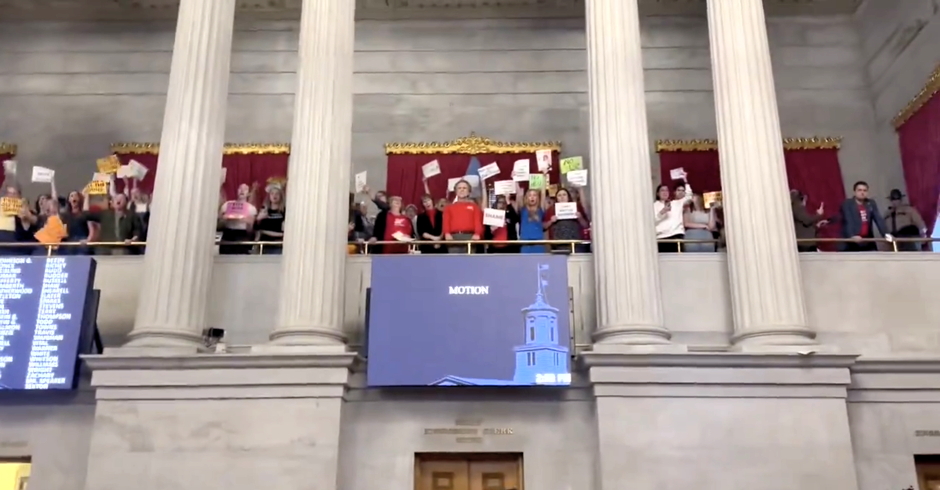
Republicans in the Tennessee House passed legislation Tuesday afternoon allowing teachers to carry concealed weapons in classrooms across the state, thirteen months after a 28-year old shooter slaughtered three children and three adults at a Christian elementary school in Nashville.
The measure is reportedly not popular statewide, with Democrats, teachers, and parents from the school, Covenant Elementary, largely opposed. The Republican Speaker of the House, Cameron Sexton, at one point literally shut down debate on the bill by shutting off a Democratic lawmaker’s microphone and then smiling.
During debate on a bill to arm teachers, Tennessee House Speaker Cameron Sexton (R-Crossville) mutes and laughs at State Rep. Bo Mitchell (D-Nashville) as he tries to apologize for Covenant School shooting victims for what the legislature is doing.
SEXTON: “His mic’s not on.” pic.twitter.com/CeN3viAdm9
— Heartland Signal (@HeartlandSignal) April 23, 2024
Ultimately, Republican Rep. Ryan Williams’s legislation passed the GOP majority House as protestors in the gallery shouted their objections: “Blood on your hands.”
READ MORE: Trump Complains He’s ‘Not Allowed to Talk’ as He Gripes Live on Camera
The legislation bars parents from being informed if their child’s teacher has a gun in the classroom.
HAPPENING NOW: @tnhousegop House Republicans are stuffing their faces with CHIC-FIL-A as they kill amendments on the @RyanWilliamsTN arming teachers bill
The amendments from Dems would require safe storage in schools, notify teachers, etc… all blocked on party lines. pic.twitter.com/cXGjFmN3g4
— The Tennessee Holler (@TheTNHoller) April 23, 2024
State Troopers were called to “prevent people from getting close to the House chambers,” WSMV’s Marissa Sulek reports.
State troopers are forming a wall to prevent people from getting close to the House chambers. @WSMV pic.twitter.com/BGQPHzJwUR
— Marissa Sulek (@marissa_sulek) April 23, 2024
I just spoke with this local teacher before the session. She spoke out during it and shouted “this is insane” she is now being escorted out. @WSMV pic.twitter.com/TmveqEldBX
— Marissa Sulek (@marissa_sulek) April 23, 2024
“You’re going to kill kids,” one woman had yelled at Rep. Williams from the gallery on Monday, The Tennessean reports. “You’re going to be responsible for the death of children. Shame on you.”
READ MORE: Biden Campaign Hammers Trump Over Infamous COVID Comment
Democratic state Rep. Justin Jones said on social media, “This is what fascism looks like.”
Tennessee Republicans just cut off debate and passed a bill to arm teachers in our schools.
The public chanted “Blood on your hands!” as the Speaker ordered troopers to clear the gallery.
This is what fascism looks like. pic.twitter.com/9mg67oWMxM
— Rep. Justin Jones (@brotherjones_) April 23, 2024
“In recent weeks,” the paper also reports, “parents of school shooting survivors, students and gun-reform advocates have heavily lobbied against the bill, with one Covenant School mom delivering a letter to the House on Monday with more than 5,300 signatures asking lawmakers to kill the bill.”
The bill, which already passed the state Senate, now heads to Republican Governor Bill Lee’s desk. He is expected to sign it into law.
Watch the videos above or at this link.
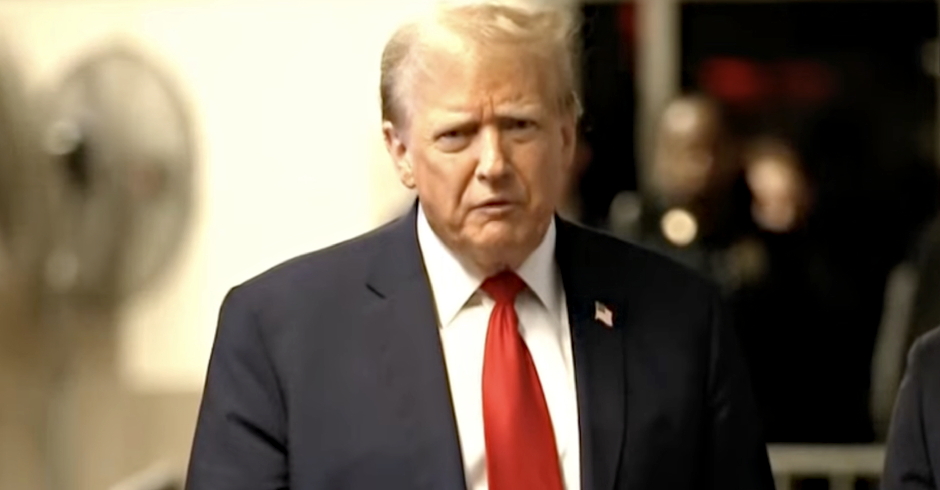
At the end of another short courtroom day that required barely three hours of Donald Trump’s time, the ex-president spoke to reporters inside Manhattan’s Criminal Courts Building to complain about a wide variety of perceived and alleged wrongs he is suffering, including, not being “allowed to talk.”
The ex-president’s presence was required only from 11 AM until just 2 PM. Judge Juan Merchan is overseeing Manhattan District Attorney Alvin Bragg’s prosecution of the ex-president in a case that has already drawn a straight line through the “hush money” headlines to correct them to alleged criminal conspiracy and election interference.
Judge Merchan, for nearly two hours Tuesday morning, heard prosecutors’ allegations that Trump has violated his gag order ten times, and heard defense counsel’s claims that he had not.
It did not go well for the Trump legal team, with Judge Merchan toward the end of the hearing, during which no jurors were allowed, telling Trump lead attorney Todd Blanche, “You’re losing all credibility.”
READ MORE: Biden Campaign Hammers Trump Over Infamous COVID Comment
During the day’s hearing, jurors heard prosecutors’ lead witness, the former head of the company that publishes the National Enquirer tabloid, David Pecker, explain how he was working to help the Trump campaign.
“David Pecker testifies that, following his 2015 meeting with Trump and [Michael] Cohen, he met with former National Enquirer editor-in-chief Dylan Howard,” MSNBC’s Kyle Griffin reports. “Pecker outlined the arrangement and described it as ‘highly private and confidential.’ Pecker asked Howard to notify the tabloid’s West Coast and East Coast bureau chiefs that any stories that came in about Trump or the 2016 election must be vetted and brought straight to Pecker — and ‘they’ll have to be brought to Cohen.’ Pecker told Howard the arrangement needed to stay a secret because it was being carried out to help Trump’s campaign.”
Trump did not discuss any evidence against him with reporters, but he did complain about the gag order. And President Joe Biden. And the temperature in the courtroom. And his apparent attempt to stay awake, which has been a problem for him almost every day in court.
“We have a gag order, which to me is totally unconstitutional, I’m not allowed to talk but people are allowed to talk about me,” Trump told reporters, emphasizing the last word in that sentence.
“So they can talk about me, they can say whatever they want, they can lie. But I’m not allowed to say anything, I just have to sit back and look at why a conflicted judge has ordered me to have a gag order.”
READ MORE: ‘Rally Behind MAGA’: Trump Advocates Courthouse ‘Protests’ Nationwide
“I don’t think anybody’s ever seen anything like this,” Trump claimed, falsely implying no criminal defendant has ever had a gag order imposed on them previously. “I’d love to talk to you people, I’d love to say everything that’s on my mind, but I’m restricted because I have a gag order, and I’m not sure that anybody’s ever seen anything like this before.”
Trump then started to discuss the “articles” in his hand, what appeared to be dozens of articles he said had “all good headlines,” while implying they claimed “the case is a sham.”
Trump oversimplified the legal arguments attached to his gag order, as discussed with Judge Merchan Tuesday morning. The judge has yet to rule on prosecutors’ request to hold Trump in contempt.
“So I put an article in and then somebody’s name is mentioned somewhere deep in the article and I end up in violation of a gag order,” he told reporters, apparently referring to his posts on Truth Social with persecutes say violated his gag order. “I think it’s a disgrace. It’s totally unconstitutional. I don’t believe it’s ever – not to this extent – ever happened before. I’m not allowed to defend myself and yet other people are allowed to say whatever they want about me. Very, very unfair.”
“Having to do with the schools and the closings – that’s Biden’s fault,” Trump said, strangely, as if the COVID pandemic were still officially in process. “And by the way, this trial is all Biden, this is all Biden just in case anybody has any question. And they’re keeping me, in a courtroom that’s freezing by the way, all day long while he’s out campaigning, that’s probably an advantage because he can’t campaign.”
“Nobody knows what he’s doing. he can’t put two sentences together. But he’s out campaigning. He’s campaigning and I’m here and I’m sitting here sitting up as straight as I can all day long because you know, it’s a very unfair situation,” Trump lamented. “So we’re locked up in a courtroom and this guy’s out there campaigning, if you call it a campaign, every time he opens his mouth he gets himself into trouble.”
Watch below or at this link.
Trump completely melts down, “This trial is all this is all Biden-run just in case anybody has any questions and then keeping me in a court for it’s freezing by the way.” pic.twitter.com/qKGWFPLCzC
— Sarah Reese Jones (@PoliticusSarah) April 23, 2024
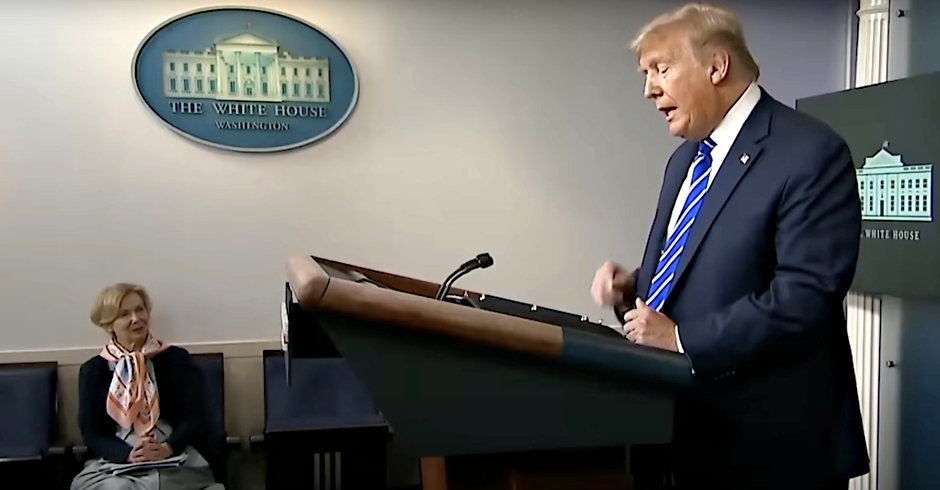
Four years ago today then-President Donald Trump, on live national television during what would be known as merely the early days and weeks of the COVID-19 pandemic, suggested an injection of a household “disinfectant” could cure the deadly coronavirus.
The Biden campaign on Tuesday has already posted five times on social media about Trump’s 2020 remarks, including by saying, “Four years ago today, Dr. Birx reacted in horror as Trump told Americans to inject bleach on national television.”
Less than 24 hours after Trump’s remarks calls to the New York City Poison Control Center more than doubled, including people complaining of Lysol and bleach exposure. Across the country, the CDC reported, calls to state and local poison control centers jumped 20 percent.
“It was a watershed moment, soon to become iconic in the annals of presidential briefings. It arguably changed the course of political history,” Politico reported on the one-year anniversary of Trump’s beach debacle. “It quickly came to symbolize the chaotic essence of his presidency and his handling of the pandemic.”
How did it happen?
“The Covid task force had met earlier that day — as usual, without Trump — to discuss the most recent findings, including the effects of light and humidity on how the virus spreads. Trump was briefed by a small group of aides. But it was clear to some aides that he hadn’t processed all the details before he left to speak to the press,” Politico added.
READ MORE: ‘Cutting Him to Shreds’: ‘Pissed’ Judge Tells Trump’s Attorney ‘You’re Losing All Credibility’
“’A few of us actually tried to stop it in the West Wing hallway,’ said one former senior Trump White House official. ‘I actually argued that President Trump wouldn’t have the time to absorb it and understand it. But I lost, and it went how it did.'”
The manufacturer of Lysol issued a strong statement saying, “under no circumstance should our disinfectant products be administered into the human body (through injection, ingestion or any other route),” with “under no circumstance” in bold type.
Trump’s “disinfectant” remarks were part of a much larger crisis during the pandemic: misinformation and disinformation. In 2021, a Cornell University study found the President was the “single largest driver” of COVID misinformation.
What did Trump actually say?
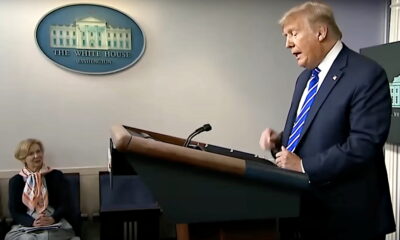
“And then I see the disinfectant, where it knocks it out, in a minute,” Trump said from the podium at the White House press briefing room, as Coronavirus Task Force Coordinator Dr. Deborah Birx looked on without speaking up. “Is there a way we can do something like that? By injection, inside, or almost a cleaning, ’cause you see it gets in the lungs and it does a tremendous number on the lungs. So it would be interesting to check that. You’re going to have to use medical doctors, right? But it sounds interesting to me.”
READ MORE: ‘Rally Behind MAGA’: Trump Advocates Courthouse ‘Protests’ Nationwide
Within hours comedian Sarah Cooper, who had a good run mocking Donald Trump, released a video based on his remarks that went viral:
How to medical pic.twitter.com/0EDqJcy38p
— Sarah Cooper (@sarahcpr) April 24, 2020
The Biden campaign at least 12 times on the social media platform X has mentioned Trump’s infamous and dangerous remarks about injecting “disinfectant,” although, like many, they have substituted the word “bleach” for “disinfectant.”
Hours after Trump’s remarks, from his personal account, Joe Biden posted this tweet:
I can’t believe I have to say this, but please don’t drink bleach.
— Joe Biden (@JoeBiden) April 24, 2020
Tuesday morning the Biden campaign released this video marking the four-year anniversary of Trump’s “disinfectant” remarks.
Four years ago today, Dr. Birx reacted in horror as Trump told Americans to inject bleach on national television pic.twitter.com/1dwgmxMpEK
— Biden-Harris HQ (@BidenHQ) April 23, 2024
See the social media posts and videos above or at this link.
READ MORE: ‘Election Interference’ and ‘Corruption’: Experts Explain Trump Prosecution Opening Argument

‘Cutting Him to Shreds’: ‘Pissed’ Judge Tells Trump’s Attorney ‘You’re Losing All Credibility’

Biden Campaign Hammers Trump Over Infamous COVID Comment

Trump Complains He’s ‘Not Allowed to Talk’ as He Gripes Live on Camera

‘Blood on Your Hands’: Tennessee Republicans OK Arming Teachers After Deadly School Shooting
‘Blood on Your Hands’: Tennessee Republicans OK Arming Teachers After Deadly School Shooting
Trump Complains He’s ‘Not Allowed to Talk’ as He Gripes Live on Camera
Biden Campaign Hammers Trump Over Infamous COVID Comment
‘Cutting Him to Shreds’: ‘Pissed’ Judge Tells Trump’s Attorney ‘You’re Losing All Credibility’

‘I’m Not Suicidal’: Kari Lake Pushes Hillary Clinton Murder Conspiracy Theory
 News2 days ago
‘Rally Behind MAGA’: Trump Advocates Courthouse ‘Protests’ Nationwide
 News1 day ago
‘I’m Not Suicidal’: Kari Lake Pushes Hillary Clinton Murder Conspiracy Theory
 News2 days ago
‘Old and Tired and Mad’: Trump’s Demeanor in Court Detailed by Rachel Maddow
 News2 days ago
‘Election Interference’ and ‘Corruption’: Experts Explain Trump Prosecution Opening Argument
 News16 hours ago
‘Cutting Him to Shreds’: ‘Pissed’ Judge Tells Trump’s Attorney ‘You’re Losing All Credibility’
 News15 hours ago
Biden Campaign Hammers Trump Over Infamous COVID Comment
 OPINION12 hours ago
Trump Complains He’s ‘Not Allowed to Talk’ as He Gripes Live on Camera
 News9 hours ago
‘Blood on Your Hands’: Tennessee Republicans OK Arming Teachers After Deadly School Shooting