REPORT: There Have Already Been More Anti-LGBT Hate Violence Homicides This Year Than in All of Last Year
‘The Message This Sends to LGBTQ Folks Is Clear: That We May Not Be Safe Anywhere’
Reports from the National Coalition of Anti-Violence Programs, examined by Buzzfeed, show there have already been more anti-LGBT hate-motivated homicides this year than in all of 2016.Â
According to BuzzFeed News reporter Nidhi Prakash, not counting the Pulse nightclub terror attack hate crime murders of 49 people, in 2016 there were 28 hate-violence-related homicides of LGBT people. Already this year, there have been 33 anti-LGBT hate violence murders across the country.
“The numbers translate to roughly one hate-violence-related death every 13 days in 2016. So far in 2017, the pace of those deaths is at about one every six days,” Buzzfeed reports.Â
At this rate, these hate murders are on track to double last year’s count.
“Fifteen of those who were killed in 2017 were transgender women of color, and at least 12 were cisgender gay men,” Buzzfeed adds. “The reports came from all over the US, from Texas to New York to Wisconsin.”
One important question is why.Â
“I think whether it’s an increase in reporting, an increase in violence, or some combination thereof, it should be a wake-up call for us across our communities that hate violence is not going away,” Beverly Tillery, executive director of the New York City Anti-Violence Project told Buzzfeed. The NYC AVP coordinates with the National Coalition of Anti-Violence Programs and creates the violence report.Â
Tillery adds that hate violence is “certainly not decreasing, and it’s symptomatic of larger and deeper problems in our society that we still haven’t addressed.”Â
And while this spike in hate murders is alarming, there likely are more that have not been included. Law enforcement officials may not know, or may choose to not report a victim as being transgender, for example, or may not know the motivation for their murder.
“There are a lot more homicides of LGBT people than what they report,” Dallas Drake, senior researcher at the Center for Homicide Research, tells Buzzfeed. “They don’t report generally from communities that are smaller or where cases are not easily identifiable as LGBT homicides.”
Old Dominion University assistant professor of sociology and criminal justice Vanessa Panfil tells Buzzfeed there’s a backlash against LGBT people.
That backlash, she says, has been encouraged in part by the Trump administration walking back Obama-era guidances and policies that were LGBT-inclusive, such as supporting trans students’ rights and signaling a ban on allowing trans people to serve in the military. As a result, transgender people across the country are relying on courts to decide if they’re allowed to access bathrooms in line with their gender identities — a decision the Supreme Court decided not to weigh in on when it sent a landmark trans rights case back to a lower court earlier this year.Â
Pulling back from anti-LGBT homicides and looking at all hate crimes, is there a Trump effect, an unleashing of hate into society, as has been documented repeatedly?
Just look at these headlines:
“Anti-LGBT hate crimes in D.C. up 59% in 2016“
“A Fifth of Hate Crimes Reported Done in Trump’s Name, Researchers Say“
“Donald Trump Has Unleashed a New Wave of Bullying in Schools“
“‘Trump effect’ led to hate crime surge, report finds“
“Q&A: ‘There’s a virus in our country’: The ‘Trump effect’ and rise of hate groups, explained“
“The Trump Effect: The Impact of The 2016 Presidential Election on Our Nation’s Schools“
Kathy Flores, an LGBTQ anti-violence program manager for Wisconsin’s Diverse & Resilient says, “The message this sends to LGBTQ folks is clear: that we may not be safe anywhere.”
To comment on this article and other NCRM content, visit our Facebook page.
Image by Michael Fleshman via Flickr and a CC license

Enjoy this piece?
… then let us make a small request. The New Civil Rights Movement depends on readers like you to meet our ongoing expenses and continue producing quality progressive journalism. Three Silicon Valley giants consume 70 percent of all online advertising dollars, so we need your help to continue doing what we do.
NCRM is independent. You won’t find mainstream media bias here. From unflinching coverage of religious extremism, to spotlighting efforts to roll back our rights, NCRM continues to speak truth to power. America needs independent voices like NCRM to be sure no one is forgotten.
Every reader contribution, whatever the amount, makes a tremendous difference. Help ensure NCRM remains independent long into the future. Support progressive journalism with a one-time contribution to NCRM, or click here to become a subscriber. Thank you. Click here to donate by check.
 |

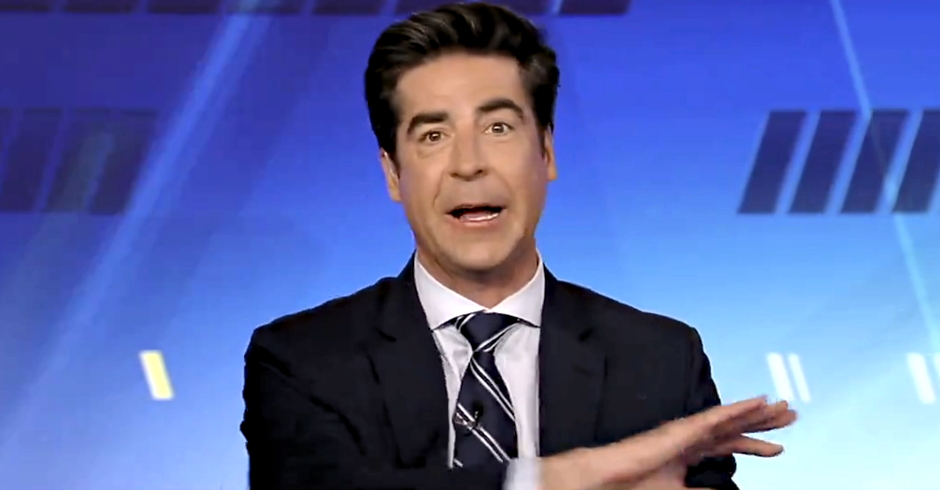
The Fox News host who targeted a juror serving on Donald Trump’s criminal New York trial is now suggesting the ex-president should violate his gag order and “force” the court to throw him in jail, by quoting the Fox News host.
Jesse Watters came under fire earlier this week for profiling juror number two, sharing possibly identifying information published by a myriad of reporters but then using that information to pass judgment on her ability to serve.
“I’m not so sure about juror number two,” Watters concluded on Fox News.
Jurors, at the judge’s direction, were to remain anonymous, for their protection and the protection of the trial.
The judge excused her, after she said she felt she was not able to be impartial because friends and family were calling her asking if she had been chosen to serve on the Trump trial, after the media blitz.
New York Supreme Court Judge Juan Merchan admonished the press for reporting the information, but some news outlets appeared to ignore his warning.
Watters on Wednesday “did a segment with a jury consultant, revealing details about people who had been seated on the jury and questioning whether some were ‘stealth liberals’ who would be out to convict Trump,” the Associated Press reported.
READ MORE: Gaetz: ‘Corrupt’ Republicans Could ‘Take a Bribe’ and Throw House to Dems, Blocking Trump Run
Trump later posted Watters’ quote on his Truth Social platform, leading some, including New York prosecutors, to ask the judge to cite him for allegedly breaking his gag order.
Judge Merchan ordered Trump to not mention witnesses, jurors, prosecutors, court staff, or the family members of prosecutors and court staff, CNN has reported.
New York prosecutors told Juge Merchan Trump has violated the gag order at least ten times.
“Prosecutor Christopher Conroy described the ‘most disturbing’ example as a social media message Trump posted on Wednesday evening quoting a Fox News host as saying, ‘They are catching undercover Liberal Activists lying to the Judge in order to get on the Trump Jury,'” Politico reports.
That host was Jesse Watters.
RELATED: ‘Afraid and Intimidated’: Trump Trial Juror Targeted by Fox News Dismissed
Friday afternoon, Watters appeared to egg Trump on, urging the ex-president to violate the gag order.
“I would make them put me in jail,” Watters said on Fox News. “I would have a tweet about something perhaps I said on ‘The Five’ or ‘Jesse Watters Primetime,’ and I would force them to throw me in jail.”
Watch Watters’ remark below or at this link.
Watters floating the suggestion that Trump should force the court to throw him in jail by posting statements made by Watters on Fox pic.twitter.com/9FYXtLr4uw
— Acyn (@Acyn) April 19, 2024

U.S. Rep. Matt Gaetz (R-FL) says some of his fellow House Republicans would “take a bribe” to throw the razor-thin GOP majority to the Democrats if a far-right faction calls up a motion to oust Speaker of the House Mike Johnson, allowing Democrats to hand the gavel to the Minority Leader, Hakeem Jeffries. he warned if that happens, Democrats would immediately declare Trump ineligible to be President, pack the U.S. Supreme Court, and pass numerous laws like the American Rescue Plan.
“I do believe in a one seat majority there could be one or two or three of my colleagues who would take a bribe in one form or another in order to deprive the Republicans of a majority at all,” Gaetz said Friday on his podcast (video below.)
He added, “the risk that one or two of my corrupt Republican colleagues might take a bribe, take a walk, feign an ailment and flip this thing to the Democrats is a risk that is too high for me at this time.”
Gaetz’s fellow far-right Florida Republican member of Congress, Anna Paulina Luna, told listeners, “I heard that when, if and when the motion vacate is introduced, that there will be immediate resignations of a couple of more moderate members of Congress. And in the event that that happens, that ultimately means it does go to a Democrat speaker.”
RELATED: Jeffries Vows Democrats Will Ensure Ukraine Aid Passes as Johnson Defectors Grow
U.S. Rep. Marjorie Taylor Greene (R-GA) last month filed a “motion to vacate,” which she can use at any time to force a vote to oust the GOP Speaker, Mike Johnson. U.S. Rep. Tim Massie (R-KY) and just today, U.S. Rep. Paul Gosar (R-AZ) has signed on as co-sponsors.
Congressman Gaetz told listeners if Democrats do take the House through a force vote to remove Johnson, Democrats would “be declaring Donald Trump an insurrectionist and setting up a barrier to him being able to become the president United States.”
“That’ll be their leadoff hitter, and then the chaser to that shot will be a massive spending package that looks a lot more like the American Rescue Plan. They will blow past every concept of every cap ever imagined. You’ll be looking at Universal Basic Income, you could be looking at packing the Supreme Court.”
Watch a short clip of Gaetz’s remarks below or at this link.
Gaetz says that he thinks that at least 1-3 of his “corrupt Republican colleagues” will take a bribe and vote for Hakeem Jeffries once a motion to vacate is successful. pic.twitter.com/cT7XlW7rkj
— Ron Filipkowski (@RonFilipkowski) April 19, 2024
READ MORE: ‘Stop Bringing Up Nazis and Hitler’: Marjorie Taylor Greene Smacked Down by Democrats
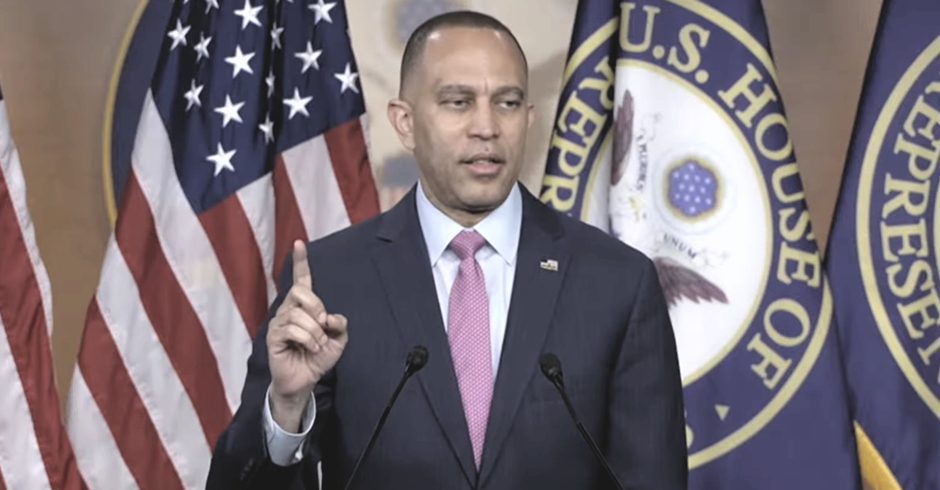
Democratic House Minority Leader Hakeem Jeffries vowed Friday the majority of Democrats will support Republicans’ Ukraine, Israel, Taiwan, and Gaza foreign aid legislation as Republican Speaker Mike Johnson lost support of another member of his conference to a faction determined to oust him.
“Democrats will provide a majority of our majority as it relates to funding Israel, humanitarian assistance, Ukraine, and our allies in the Indo Pacific,” Minority Leader Jeffries said. “It remains to be seen what Republicans will do in terms of meeting the national security needs of the American people, but it was important for House Democrats to ensure that the national security bills are going to be considered.”
“Democrats will provide a majority of our majority as it relates to funding Israel, humanitarian assistance, Ukraine, and our allies in the Indo Pacific.”
— House Minority Leader Hakeem Jeffries (D-NY), ahead of Saturday vote on foreign aid bills pic.twitter.com/aAfqOlEC5h
— The Recount (@therecount) April 19, 2024
Despite Republicans having a one-vote majority, more Democrats on Friday voted to move the critical and long-awaited foreign aid bills forward than did Republicans.
READ MORE: ‘Stop Bringing Up Nazis and Hitler’: Marjorie Taylor Greene Smacked Down by Democrats
The 316-94 vote included 165 Democrats and 151 Republicans voting yes, and 55 Republicans and 39 Democrats voting no.
Axios’ Juliegrace Brufke posted the list of Republicans voting against their party’s legislation.
Republicans who voted against the rule pic.twitter.com/M9MI8BZc5D
— Juliegrace Brufke (@juliegraceb) April 19, 2024
Calling it a “rare” moment in modern congressional history to have to rely on opposition party votes to pass legislation, BBC News reports Speaker Johnson’s “hold on power is tenuous, and the legislators who oppose him – and his bid to provide aid to Ukraine – occupy some key positions within the House’s power structure.”
Amid the procedural vote to move the foreign aid funding bills forward, U.S. Rep. Paul Gosar, a far-right Republican of Arizona, announced he is joining Congresswoman Marjorie Taylor Greene (R-GA), and Congressman Tim Massie (R-KY) in formally announcing their will vote to oust Speaker Johnson.
Gosar, like Greene, is reportedly a Christian nationalist. In 2022 CNN reported his “lengthy ties to White nationalists, [a] pro-Nazi blogger and far-right fringe received little pushback for years.”
RELATED: ‘Repercussions’: Democrats and Republicans Stand Against ‘Pro-Putin’ House GOP Faction
“We’ve been very honest in our assessment of the situation from the beginning,” Jeffries on Friday also declared. “At the appropriate time as House Democrats, we will have a conversation about how to deal with any hypothetical motion to vacate.”
“Moscow Marjorie Taylor Greene, Massie, and Gosar are quite a group. But central to our conversation is to make sure that the national security legislation in totality is passed by the House of Representatives.”
“At the appropriate time as House Democrats, we will have a conversation about how to deal with any hypothetical motion to vacate. … Moscow Marjorie Taylor Greene, [Thomas] Massie, and [Paul] Gosar are quite a group.”
— House Minority Leader Hakeem Jeffries (D-NY) pic.twitter.com/HbkhiNlQCZ
— The Recount (@therecount) April 19, 2024
Watch the videos above or at this link.

Jeffries Vows Democrats Will Ensure Ukraine Aid Passes as Johnson Defectors Grow

Biden Amps Up Field Offices, Trump to Mobilize Thousands of Lawyers to Monitor Vote Counts

Gaetz: ‘Corrupt’ Republicans Could ‘Take a Bribe’ and Throw House to Dems, Blocking Trump Run

Fox News Host Suggests Trump ‘Force’ Court to Throw Him in Jail – by Quoting Him
Fox News Host Suggests Trump ‘Force’ Court to Throw Him in Jail – by Quoting Him
Gaetz: ‘Corrupt’ Republicans Could ‘Take a Bribe’ and Throw House to Dems, Blocking Trump Run
Jeffries Vows Democrats Will Ensure Ukraine Aid Passes as Johnson Defectors Grow
Biden Amps Up Field Offices, Trump to Mobilize Thousands of Lawyers to Monitor Vote Counts

‘Repercussions’: Democrats and Republicans Stand Against ‘Pro-Putin’ House GOP Faction
 OPINION2 days ago
‘Stop Bringing Up Nazis and Hitler’: Marjorie Taylor Greene Smacked Down by Democrats

 OPINION3 days ago
‘Big Journalism Fail’: Mainstream Media Blasted Over Coverage of Historic Trump Trial

 News3 days ago
‘Used by the Russians’: Moskowitz Mocks Comer’s Biden Impeachment Failure
- News1 day ago
‘Repercussions’: Democrats and Republicans Stand Against ‘Pro-Putin’ House GOP Faction
- News2 days ago
‘Afraid and Intimidated’: Trump Trial Juror Targeted by Fox News Dismissed
 OPINION2 days ago
Marjorie Taylor Greene, ‘Putin’s Envoy’? Democrat’s Bills Mock Republican’s Actions

 News2 days ago
‘They Want Russia to Win So Badly’: GOP Congressman Blasts Far-Right House Republicans
 News14 hours ago
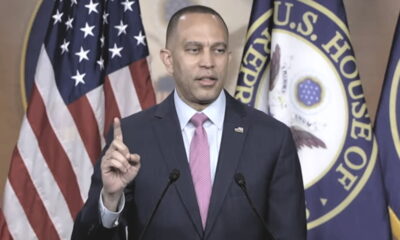
Jeffries Vows Democrats Will Ensure Ukraine Aid Passes as Johnson Defectors Grow