Being an Ally in the Wake of Orlando
Being a good ally is challenging. Here are some thoughts on how to do it better.
For me, the word “ally†is sacred.Â
An ally, to me, is someone I can trust and turn to when I need help. It’s someone who’s not like me, but who “gets†me. Someone who does their best to understand, learn, and act.
There’s been a lot of talk this week about who is an ally and how to be an ally, especially on social media. But the thing is, there’s good action and there’s bad action, and this week, some folks have had a really hard time figuring out the difference between the two.Â
Here are some tips I’ve got based on the social media interactions I’ve had recently:Â
- Don’t go to gay bars just to “show solidarity.â€Â
I know that in the wake of Orlando people all across the country are looking for ways to be supportive. For many, that seems to mean invading our sacred spaces. I can’t believe I have to say it, but, don’t do this. You’ve seen article after article describing how gay bars are our places of refuge, our sanctuaries, and some of the only places many of us felt like we were “home.†Please, let us have them to ourselves. If you’re invited to go to a gay bar with a queer friend, go and enjoy, but remember, this place isn’t for you, and you’re a guest. Be respectful.Â
- Don’t be self-congratulatory just for doing the right thing.
Being an ally is awesome, it really is, so let your work speak for itself. if you’re doing it truly selflessly and because you believe in the cause, you’ll get noticed, I promise. We still live in a world where being an ally isn’t the default. We notice when straight people are stepping up for us. There’s no need write an article or op/ed to tell the world just how fantastic you are becuase you’re treating a marginalized group with respect. Think of “ally†like a college nickname. You can’t declare it for yourself. You have to earn it through action.Â
- Listen to your LGBTQ family and friends. Seriously, listen.
The number of people who’ve told me this week that I’m wrong about how to be an ally to my own community is astounding. LGBTQ people aren’t shy about telling you what we need. Seriously, we’re not afraid to let everyone know what we want. Listen to us, and then act on that. If you’re not ready to put aside your own desires, you’re probably not ready to be an ally.
- Ask good questions and respect our answers.
If you want to be there for LGBTQ people but you’re not sure what the best way for you to do that is, ask. Say: “I want to be there for you the best way I can, but I’m not sure what you need right now. What would you like from me?†From there, do what’s needed. It’s not glamorous to be the person who brings over a pint of ice cream and a bag of chips to a friend in need, but at that moment, it might be exactly the right thing to do. Every situation is different, but being a person we can count on and trust is universal.
- Look inward, both personally and communally.
In my book, an ally looks inward – both at themselves and at their own communities. They are reflective and pensive and make changes internally. An ally’s job is to speak to the people who are like them. If you’re an active member of your church and you want to be an ally to LGBTQ people, start by looking at what systems of oppression your church is complicit in and work to take those down. Listen to the language your pastors and congregants use – is it inclusive or exclusive? Challenge the people who are like yourself before going out into the broader community. Â
And if you’ve got a past full of anti-LGBTQ work and action? Before you can even think of becoming an ally you’ll have to overcome all of the damage you’ve done. Apologizing is just the first step. You’ll also need to actively work to reverse the policies and climate you’ve helped create.
- Don’t confuse being a decent person with being an ally.Â
Many people have said to me, “I can disagree with someone’s lifestyle and still respect them and not want to see them suffer from violence.†Yes, you can. And I would hope you wouldn’t want to see anyone suffer from violence, but that doesn’t make you an ally. That just makes you a decent person. A decent person values tolerance. An ally values affirmation and celebration.Â
 (Also, you’re gross for continuing to use the word “lifestyle†when it’s not 1998.)
A decent person says, “I’m going to be nice to you even when the system says I shouldn’t,†while an ally says, “I’m going to help you change the system.â€
- When you’re called out, accept the criticism and change your behavior.Â
If someone says to you, “I know that you’re trying to help, but what you’re doing actually hurts me,†don’t argue. If you’re not sure why, ask and listen to what they say. Too many times this week people have argued back when their so-called allyship was challenged. If you want to be an ally to a certain community, you must accept that community’s criticisms and take them seriously.
-  Don’t threaten to revoke your allyship if you get called out.
More than a few times this week someone has said to me, “Good luck getting more allies with that attitude!†or “You better be nice to me – you NEED us!†In short? No. No we don’t. If your allyship is contingent on one person being nice you to you, you’re not really an ally. If your feelings are more important than the safety of the group you’re trying to help? Not even a little bit of an ally.Â
Look, I get it. Being an ally is hard, it is. It’s hard to speak up for someone else when you have everything you need. It’s hard to put yourself into harm’s way when you could just as easily roll over and go back to sleep, safe and sound. But that’s what allies do – they put themselves into challenging situations so that LGBTQ people don’t have to. They make themselves uncomfortable in order to make others comfortable. You’re probably not going to get kicked out of your house or fired for speaking up. We very well might be.Â
Being an ally can be a thankless job – no one does it for the fame. But the great thing is? When it’s done right? We all get to enjoy the better world we’ve created, together.
Â
Robbie Medwed is an Atlanta-based LGBTQ activist and educator. His column appears here weekly. Follow him on Twitter: @rjmedwed.

Enjoy this piece?
… then let us make a small request. The New Civil Rights Movement depends on readers like you to meet our ongoing expenses and continue producing quality progressive journalism. Three Silicon Valley giants consume 70 percent of all online advertising dollars, so we need your help to continue doing what we do.
NCRM is independent. You won’t find mainstream media bias here. From unflinching coverage of religious extremism, to spotlighting efforts to roll back our rights, NCRM continues to speak truth to power. America needs independent voices like NCRM to be sure no one is forgotten.
Every reader contribution, whatever the amount, makes a tremendous difference. Help ensure NCRM remains independent long into the future. Support progressive journalism with a one-time contribution to NCRM, or click here to become a subscriber. Thank you. Click here to donate by check.
 |


U.S. Rep. Matt Gaetz (R-FL) says some of his fellow House Republicans would “take a bribe” to throw the razor-thin GOP majority to the Democrats if a far-right faction calls up a motion to oust Speaker of the House Mike Johnson, allowing Democrats to hand the gavel to the Minority Leader, Hakeem Jeffries. he warned if that happens, Democrats would immediately declare Trump ineligible to be President, pack the U.S. Supreme Court, and pass numerous laws like the American Rescue Plan.
“I do believe in a one seat majority there could be one or two or three of my colleagues who would take a bribe in one form or another in order to deprive the Republicans of a majority at all,” Gaetz said Friday on his podcast (video below.)
He added, “the risk that one or two of my corrupt Republican colleagues might take a bribe, take a walk, feign an ailment and flip this thing to the Democrats is a risk that is too high for me at this time.”
Gaetz’s fellow far-right Florida Republican member of Congress, Anna Paulina Luna, told listeners, “I heard that when, if and when the motion vacate is introduced, that there will be immediate resignations of a couple of more moderate members of Congress. And in the event that that happens, that ultimately means it does go to a Democrat speaker.”
RELATED: Jeffries Vows Democrats Will Ensure Ukraine Aid Passes as Johnson Defectors Grow
U.S. Rep. Marjorie Taylor Greene (R-GA) last month filed a “motion to vacate,” which she can use at any time to force a vote to oust the GOP Speaker, Mike Johnson. U.S. Rep. Tim Massie (R-KY) and just today, U.S. Rep. Paul Gosar (R-AZ) has signed on as co-sponsors.
Congressman Gaetz told listeners if Democrats do take the House through a force vote to remove Johnson, Democrats would “be declaring Donald Trump an insurrectionist and setting up a barrier to him being able to become the president United States.”
“That’ll be their leadoff hitter, and then the chaser to that shot will be a massive spending package that looks a lot more like the American Rescue Plan. They will blow past every concept of every cap ever imagined. You’ll be looking at Universal Basic Income, you could be looking at packing the Supreme Court.”
Watch a short clip of Gaetz’s remarks below or at this link.
Gaetz says that he thinks that at least 1-3 of his “corrupt Republican colleagues” will take a bribe and vote for Hakeem Jeffries once a motion to vacate is successful. pic.twitter.com/cT7XlW7rkj
— Ron Filipkowski (@RonFilipkowski) April 19, 2024
READ MORE: ‘Stop Bringing Up Nazis and Hitler’: Marjorie Taylor Greene Smacked Down by Democrats
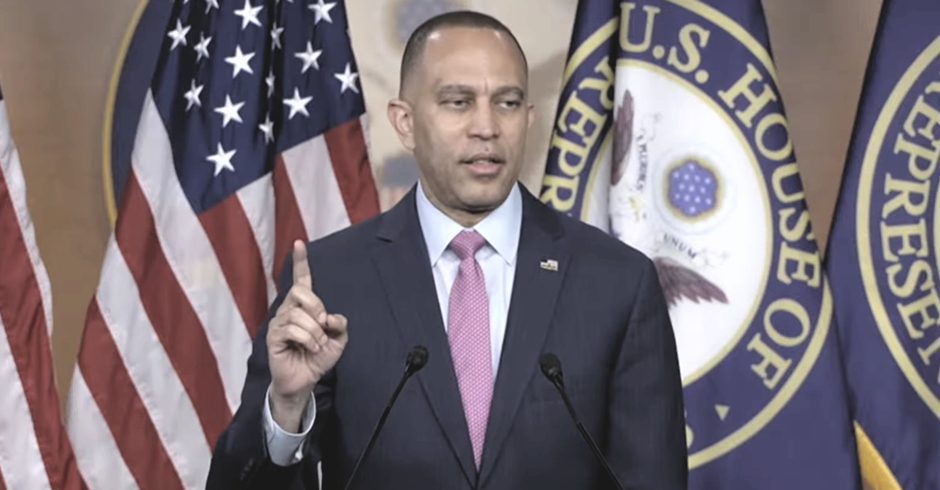
Democratic House Minority Leader Hakeem Jeffries vowed Friday the majority of Democrats will support Republicans’ Ukraine, Israel, Taiwan, and Gaza foreign aid legislation as Republican Speaker Mike Johnson lost support of another member of his conference to a faction determined to oust him.
“Democrats will provide a majority of our majority as it relates to funding Israel, humanitarian assistance, Ukraine, and our allies in the Indo Pacific,” Minority Leader Jeffries said. “It remains to be seen what Republicans will do in terms of meeting the national security needs of the American people, but it was important for House Democrats to ensure that the national security bills are going to be considered.”
“Democrats will provide a majority of our majority as it relates to funding Israel, humanitarian assistance, Ukraine, and our allies in the Indo Pacific.”
— House Minority Leader Hakeem Jeffries (D-NY), ahead of Saturday vote on foreign aid bills pic.twitter.com/aAfqOlEC5h
— The Recount (@therecount) April 19, 2024
Despite Republicans having a one-vote majority, more Democrats on Friday voted to move the critical and long-awaited foreign aid bills forward than did Republicans.
READ MORE: ‘Stop Bringing Up Nazis and Hitler’: Marjorie Taylor Greene Smacked Down by Democrats
The 316-94 vote included 165 Democrats and 151 Republicans voting yes, and 55 Republicans and 39 Democrats voting no.
Axios’ Juliegrace Brufke posted the list of Republicans voting against their party’s legislation.
Republicans who voted against the rule pic.twitter.com/M9MI8BZc5D
— Juliegrace Brufke (@juliegraceb) April 19, 2024
Calling it a “rare” moment in modern congressional history to have to rely on opposition party votes to pass legislation, BBC News reports Speaker Johnson’s “hold on power is tenuous, and the legislators who oppose him – and his bid to provide aid to Ukraine – occupy some key positions within the House’s power structure.”
Amid the procedural vote to move the foreign aid funding bills forward, U.S. Rep. Paul Gosar, a far-right Republican of Arizona, announced he is joining Congresswoman Marjorie Taylor Greene (R-GA), and Congressman Tim Massie (R-KY) in formally announcing their will vote to oust Speaker Johnson.
Gosar, like Greene, is reportedly a Christian nationalist. In 2022 CNN reported his “lengthy ties to White nationalists, [a] pro-Nazi blogger and far-right fringe received little pushback for years.”
RELATED: ‘Repercussions’: Democrats and Republicans Stand Against ‘Pro-Putin’ House GOP Faction
“We’ve been very honest in our assessment of the situation from the beginning,” Jeffries on Friday also declared. “At the appropriate time as House Democrats, we will have a conversation about how to deal with any hypothetical motion to vacate.”
“Moscow Marjorie Taylor Greene, Massie, and Gosar are quite a group. But central to our conversation is to make sure that the national security legislation in totality is passed by the House of Representatives.”
“At the appropriate time as House Democrats, we will have a conversation about how to deal with any hypothetical motion to vacate. … Moscow Marjorie Taylor Greene, [Thomas] Massie, and [Paul] Gosar are quite a group.”
— House Minority Leader Hakeem Jeffries (D-NY) pic.twitter.com/HbkhiNlQCZ
— The Recount (@therecount) April 19, 2024
Watch the videos above or at this link.
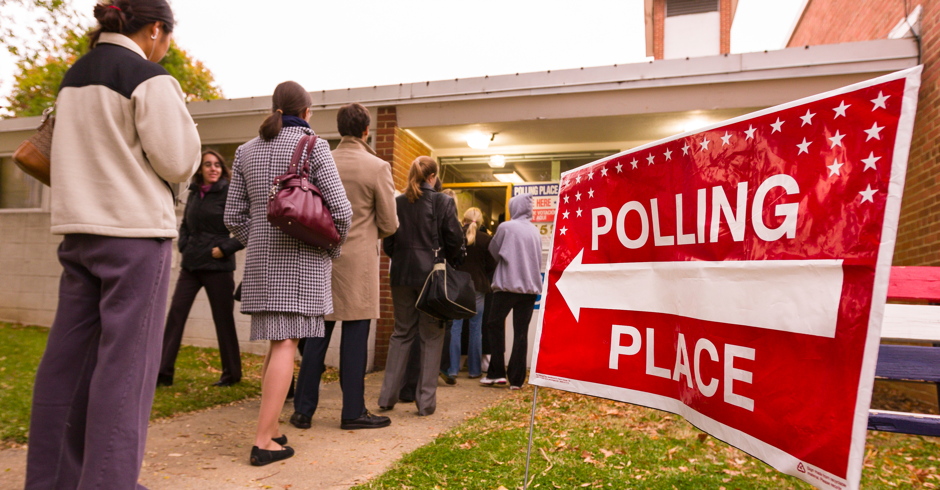
With less than seven months before Election Day the Biden campaign and the Trump campaign are taking shape, and like their politics they could not be more different.
President Biden is “scooping up record-making donations,” “flush with cash,” “building a behemoth of a campaign,” and “plowing the money into an expanding campaign operation in battleground states that appears to surpass what Donald Trump has built,” NBC News reported earlier this month.
Ex-President Donald Trump, struggling with donations, has “raised $75 million less for his presidential bid than Joe Biden and has 270,000 fewer unique donors now than at the same stage of his run for the White House four years ago,” the Financial Times reported Wednesday.
Now, as the Biden campaign invests in a massive ground game, Trump’s strategy is emerging, and it appears to be built on his “Big Lie,” the false and debunked conspiracy theory that there was and is tremendous election fraud.
READ MORE: ‘Repercussions’: Democrats and Republicans Stand Against ‘Pro-Putin’ House GOP Faction
Politico reports the Trump campaign plans to dispatch “more than 100,000 attorneys and volunteers across battleground states to monitor — and potentially challenge — vote counting in November.”
The Trump campaign and the Republican National Committee are calling their plan “the most extensive and monumental election integrity program in the nation’s history.” The RNC is chaired by Trump’s hand-picked elections specialist who worked on the Bush 2000 election Florida recount team, and co-chaired by Trump’s daughter-in-law.
Despite Trump’s claims of a stolen election in 2020, his own Attorney General, Bill Barr, his own FBI Director, Chris Wray, his own Director of the Cybersecurity and Infrastructure Security Agency, Chris Krebs, all concluded there was no widespread election fraud and none that would have changed any election results. An independent federal agency, the U.S. Election Assistance Commission, came to the same conclusion, all as The Brennan Center for Justice reported more than a month after the 2020 election.
Politico warns, “should Trump once again attempt to overturn the election, he will already have in place tens of thousands of workers who could help with that effort.”
“Having the right people to count the ballots is just as important as turning out voters on Election Day,” Trump said in a statement.
The Trump campaign “plans to deploy lawyers to monitor voter machine testing, early voting, election day voting, mail ballot processing and post-election canvassing, auditing and recounts. The campaign also plans to station lawyers at mail-in voting processing centers and set up a hotline that poll watchers and voters can use to report problems,” Politico adds. “The RNC also stated that attorneys will be stationed at ‘every single target processing center where mail ballots are tabulated.'”
READ MORE: ‘Big Journalism Fail’: Mainstream Media Blasted Over Coverage of Historic Trump Trial
The announcement of that massive operation comes on the heels of a convention this week hosted by the far-right Constitutional Sheriffs and Peace Officers Association that “drew a parade of felons, disgraced politicians, election deniers, conspiracy theorists and, in the end, a few sheriffs,” NBC News reports. Also among attendees were “MAGA celebrities.”
“The group sees sheriffs as the highest authority in the U.S., more powerful than the federal government, and it wants these county officers to form posses to patrol polling places, seize voting machines and investigate the Democrats and foreign nations behind what they claim is a criminal effort to rig the vote by flooding the country with immigrants who vote illegally.”
David Gilbert at Wired reported: “Far-Right Sheriffs Want a Citizen Army to Stop ‘Illegal Immigrant’ Voters.”
Their plan perfectly dovetails with Donald Trump’s campaign push.
Gilbert writes, “election deniers and conspiracists have coalesced around a narrative they plan to push ahead of November: Blame the immigrants.”
At a Constitutional Sheriffs’ event this week, they — and figures like Mike Flynn, Mike Lindell, Patrick Byrne and others — laid out their plans to counter the “flood of illegal immigrants” voting in November’s election with militias & citizen armieshttps://t.co/Jn3oxohRG3 pic.twitter.com/2TrfDfwDF3
— David Gilbert (@daithaigilbert) April 18, 2024
Richard Mack, founder of the Constitutional Sheriffs and Peace Officers Association told Wired that immigrants “have already disrupted the election because they are getting registered to vote.”
“That is election fraud,” Mack added, “these people are not qualified to vote. They are going to vote for whoever got them here and gave them a bunch of free stuff to get here, and of course that’s the Democrat Party, who are complicit in all of this.”
There are no reports of undocumented immigrants registering to vote in any substantial number. NBC News last week reported, “noncitizen voting” is “already illegal and very rare.”
READ MORE: ‘They Want Russia to Win So Badly’: GOP Congressman Blasts Far-Right House Republicans
Those claims, however, echo some made by the Republican Speaker of the House Mike Johnson one week ago in his joint press conference with Donald Trump at Mar-a-Lago.
“We only want U.S. citizens to vote in U.S. elections,” Johnson said, standing next to Trump, “but there are some Democrats who don’t want to do that. We believe that one of their designs, one of the reasons for this open border, which everybody asked all around the country, why would they do this? Why would they allow all this chaos? Why the violence? Because they want to turn these people into voters.”
“Right now the administration is encouraging illegals to go to their local welfare office to sign up for benefits,” Johnson, one of the top election deniers in the country, claimed as he explained his conspiracy theory. He did not state how the Biden Administration is communicating with undocumented immigrants, nor did he offer proof of these communications. He also did not state that the vast majority of undocumented immigrants are ineligible for any government welfare program.
Image via Shutterstock

‘Repercussions’: Democrats and Republicans Stand Against ‘Pro-Putin’ House GOP Faction

Biden Amps Up Field Offices, Trump to Mobilize Thousands of Lawyers to Monitor Vote Counts

Jeffries Vows Democrats Will Ensure Ukraine Aid Passes as Johnson Defectors Grow

Gaetz: ‘Corrupt’ Republicans Could ‘Take a Bribe’ and Throw House to Dems, Blocking Trump Run
Gaetz: ‘Corrupt’ Republicans Could ‘Take a Bribe’ and Throw House to Dems, Blocking Trump Run
Jeffries Vows Democrats Will Ensure Ukraine Aid Passes as Johnson Defectors Grow
Biden Amps Up Field Offices, Trump to Mobilize Thousands of Lawyers to Monitor Vote Counts
‘Repercussions’: Democrats and Republicans Stand Against ‘Pro-Putin’ House GOP Faction

‘They Want Russia to Win So Badly’: GOP Congressman Blasts Far-Right House Republicans

 OPINION2 days ago
‘Big Journalism Fail’: Mainstream Media Blasted Over Coverage of Historic Trump Trial
 OPINION2 days ago
‘Stop Bringing Up Nazis and Hitler’: Marjorie Taylor Greene Smacked Down by Democrats

 News2 days ago
‘Used by the Russians’: Moskowitz Mocks Comer’s Biden Impeachment Failure
- News22 hours ago
‘Repercussions’: Democrats and Republicans Stand Against ‘Pro-Putin’ House GOP Faction
- News1 day ago
‘Afraid and Intimidated’: Trump Trial Juror Targeted by Fox News Dismissed
 OPINION1 day ago
Marjorie Taylor Greene, ‘Putin’s Envoy’? Democrat’s Bills Mock Republican’s Actions
 News1 day ago
‘They Want Russia to Win So Badly’: GOP Congressman Blasts Far-Right House Republicans
 News5 hours ago
Biden Amps Up Field Offices, Trump to Mobilize Thousands of Lawyers to Monitor Vote Counts