Putting it All On the Line: Giving Up Freedom for a Little Equality
//
We’ve all “liked” a post on Facebook advocating for LGBTQ rights, whether that be marriage equality, adoption, non-discrimination, or anti-bullying. Many of us have shown up for rallies, blogged, or even picked up the phone and called a lawmaker. Â But there are those, a rare few, who are willing to put it all on the line and go to jail so the rest of us gain equality.
Around the nation, the community has watched in fascination as Judge Robert Shelby struck down the Beehive State’s ban on same-sex marriage in December, setting off a marriage frenzy over the next 17 days as roughly 1,400 couples got hitched before SCOTUS granted an emergency stay while Utah appeals the ruling with the 10th Circuit Court. But behind the glitz and glitter of the fight over marriage equality, tireless activists in the reddest of red states have stepped up their game for a law that’s even more important: workplace and housing protections.
A non-discrimination law, barring employers or landlords from discriminating against anyone based on their sexual orientation or gender identity has been pushed every year in Utah for the past five years, with little to no results. During the 2013 legislative session, the law successfully passed out of committee for the very first time (after which it promptly died on the floor of the state senate without receiving a debate).
Despite the state’s image, the only place a non-discrimination law is unpopular in Utah is in the state legislature itself. Multiple statewide polls have all shown support for the law hovering between 67 and 77 percent, and a few weeks ago hundreds of blue slips of paper were taped to the doors of the Utah Senate by citizens of all political stripes demanding a hearing on the non-discrimination law.
 Image by Ben Winslow via Instagram
This year, Republican lawmakers (who hold a super-majority in both the House and Senate) were advised by State Attorney General Sean Reyes and outside counsel Gene Schaerr to deny the non-discrimination bill a public hearing—regardless of whether it would pass or not—for fear that some lawmaker would make an extremely bigoted statement against LGBTQ people and hurt the state’s appeal with the 10th Circuit which is set to begin April 10th. That fear seems pretty founded, as one Senator recently penned an op-ed calling marriage equality a “massacre.”
Senate President Wayne Niederhauser heeded the Attorney General’s advice, and told the media that he was not going to allow the bill to receive a hearing because LGBTQ issues are “too emotional” right now.
That was enough to push 15 LGBTQ activists over the edge.
Without warning or announcement, the group showed up at the capitol building with “We are the 72%” and “Hear SB100” signs around their necks, forming a human-barricade in front of Governor Gary Herbert’s (R) main office doors. “If the democratic process won’t work, and if we’re allowed for procedural things like tabling to stop hearing things like the nondiscrimination bill, it’s time for regular citizens to engage in peaceful acts like civil disobedience,†said Dustin Trent.
“I don’t even have a parking ticket,” added Donna Weinholtz, “but I’m willing to be arrested today.”
Several lawmakers spoke with the group, thanking them for their passion and trying to negotiate an agreement to get them to stand down. But after each offer, including a private meeting with both the Senate President and the Governor, the activists responded with a resounding “NO.” The only way they were going to move, they said, was if the Senate agreed to give the bill a public hearing, or if they were arrested.
Eventually, the governor’s staff were bustled out a side door in an attempt to take away the power of the human-blockade. But the protesters responded by moving from the governor’s office to a legislative committee room, where crowds of people and lobbyists were trying to get in and out. The crowd was not happy they couldn’t get into the room, and shouts of “Arrest them!” rang out in the cramped space. Utah Highway Patrolmen, who handle security at the capitol building, immediately placed 13 of the protesters under arrest for suspicion of disruption of a public meeting, a class B misdemeanor; and disorderly conduct, a class C misdemeanor.
As they were being led away in handcuffs, protester Troy Williams shouted out “With liberty and justice for ALL!”
Was it worth it? Well, Senate Republicans have still refused to give the non-discrimination bill a hearing. But on the other hand, the Utah Legislature received a pretty fat black eye as the story of the protesters spread throughout not only local media, but on national sites like MSNÂ (and now here on NCRM!).
While those of us who live in blue states sit back and enjoy the fruits of old labors, eagerly watching as marriage equality battles unfold, it’s easy to forget that there are many places left in the country where basic protections don’t exist and our LGBTQ brothers and sisters are still vulnerable. But with heroes like this, willing to step up and put it all on the line for the sake of everyone else, I’m not too worried. Bigotry cannot long stand against the tide of justice and understanding.
 The 13 arrested protesters, after being released from the Salt Lake County Jail.
Photo credit: @JimDabakis
Image, top, by Ben Winslow via Twitter
Follow Eric Ethington on Twitter @EricEthington
 Eric Ethington has been specializing in political messaging, communications strategy, and public relations for more than a decade. Originally hailing from Salt Lake City, he now works in Boston for a social justice think tank. Eric’s writing, advocacy work, and research have been featured on MSNBC, CNN, Fox News, CNBC, the New York Times, The Telegraph, and The Public Eye magazine. He’s worked as a radio host, pundit, blogger, activist and electoral campaign strategist. He also writes at NuanceStillMatters.com

Enjoy this piece?
… then let us make a small request. The New Civil Rights Movement depends on readers like you to meet our ongoing expenses and continue producing quality progressive journalism. Three Silicon Valley giants consume 70 percent of all online advertising dollars, so we need your help to continue doing what we do.
NCRM is independent. You won’t find mainstream media bias here. From unflinching coverage of religious extremism, to spotlighting efforts to roll back our rights, NCRM continues to speak truth to power. America needs independent voices like NCRM to be sure no one is forgotten.
Every reader contribution, whatever the amount, makes a tremendous difference. Help ensure NCRM remains independent long into the future. Support progressive journalism with a one-time contribution to NCRM, or click here to become a subscriber. Thank you. Click here to donate by check.
 |

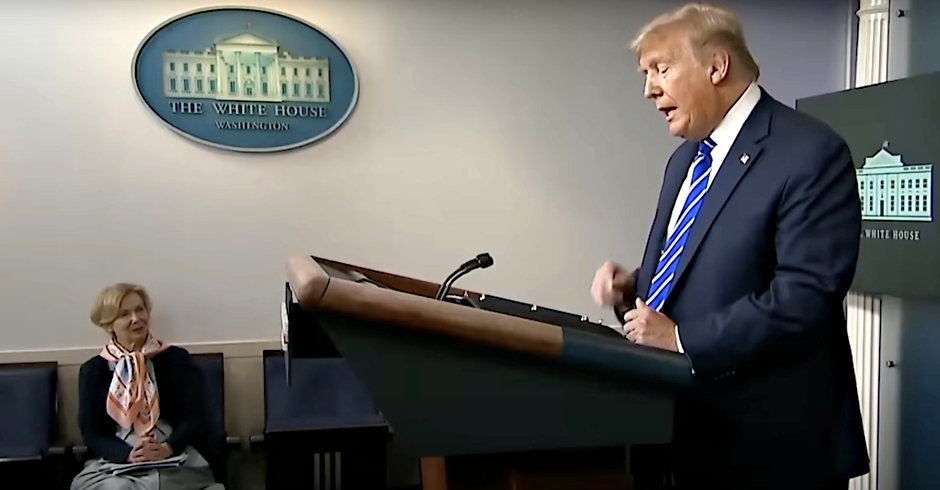
Four years ago today then-President Donald Trump, on live national television during what would be known as merely the early days and weeks of the COVID-19 pandemic, suggested an injection of a household “disinfectant” could cure the deadly coronavirus.
The Biden campaign on Tuesday has already posted five times on social media about Trump’s 2020 remarks, including by saying, “Four years ago today, Dr. Birx reacted in horror as Trump told Americans to inject bleach on national television.”
Less than 24 hours after Trump’s remarks calls to the New York City Poison Control Center more than doubled, including people complaining of Lysol and bleach exposure. Across the country, the CDC reported, calls to state and local poison control centers jumped 20 percent.
“It was a watershed moment, soon to become iconic in the annals of presidential briefings. It arguably changed the course of political history,” Politico reported on the one-year anniversary of Trump’s beach debacle. “It quickly came to symbolize the chaotic essence of his presidency and his handling of the pandemic.”
How did it happen?
“The Covid task force had met earlier that day — as usual, without Trump — to discuss the most recent findings, including the effects of light and humidity on how the virus spreads. Trump was briefed by a small group of aides. But it was clear to some aides that he hadn’t processed all the details before he left to speak to the press,” Politico added.
READ MORE: ‘Cutting Him to Shreds’: ‘Pissed’ Judge Tells Trump’s Attorney ‘You’re Losing All Credibility’
“’A few of us actually tried to stop it in the West Wing hallway,’ said one former senior Trump White House official. ‘I actually argued that President Trump wouldn’t have the time to absorb it and understand it. But I lost, and it went how it did.'”
The manufacturer of Lysol issued a strong statement saying, “under no circumstance should our disinfectant products be administered into the human body (through injection, ingestion or any other route),” with “under no circumstance” in bold type.
Trump’s “disinfectant” remarks were part of a much larger crisis during the pandemic: misinformation and disinformation. In 2021, a Cornell University study found the President was the “single largest driver” of COVID misinformation.
What did Trump actually say?
“And then I see the disinfectant, where it knocks it out, in a minute,” Trump said from the podium at the White House press briefing room, as Coronavirus Task Force Coordinator Dr. Deborah Birx looked on without speaking up. “Is there a way we can do something like that? By injection, inside, or almost a cleaning, ’cause you see it gets in the lungs and it does a tremendous number on the lungs. So it would be interesting to check that. You’re going to have to use medical doctors, right? But it sounds interesting to me.”
READ MORE: ‘Rally Behind MAGA’: Trump Advocates Courthouse ‘Protests’ Nationwide
Within hours comedian Sarah Cooper, who had a good run mocking Donald Trump, released a video based on his remarks that went viral:
How to medical pic.twitter.com/0EDqJcy38p
— Sarah Cooper (@sarahcpr) April 24, 2020
The Biden campaign at least 12 times on the social media platform X has mentioned Trump’s infamous and dangerous remarks about injecting “disinfectant,” although, like many, they have substituted the word “bleach” for “disinfectant.”
Hours after Trump’s remarks, from his personal account, Joe Biden posted this tweet:
I can’t believe I have to say this, but please don’t drink bleach.
— Joe Biden (@JoeBiden) April 24, 2020
Tuesday morning the Biden campaign released this video marking the four-year anniversary of Trump’s “disinfectant” remarks.
Four years ago today, Dr. Birx reacted in horror as Trump told Americans to inject bleach on national television pic.twitter.com/1dwgmxMpEK
— Biden-Harris HQ (@BidenHQ) April 23, 2024
See the social media posts and videos above or at this link.
READ MORE: ‘Election Interference’ and ‘Corruption’: Experts Explain Trump Prosecution Opening Argument
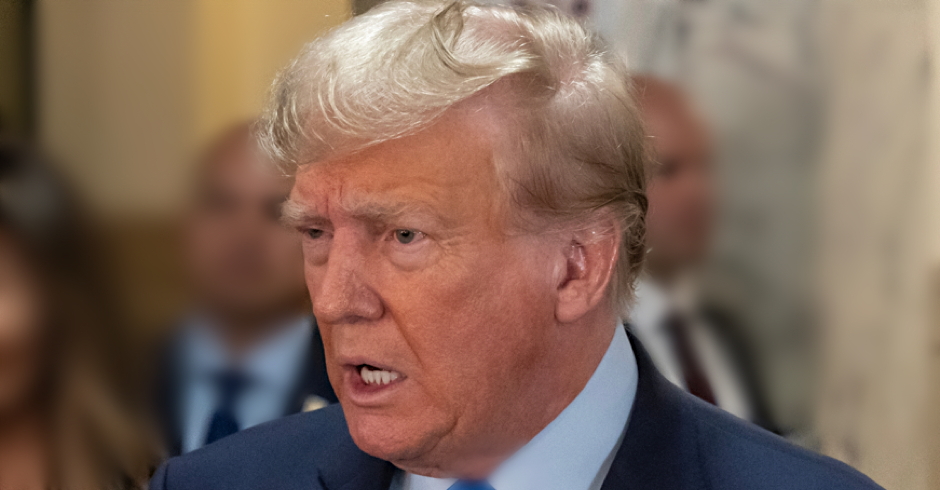
New York Supreme Court Judge Juan Merchan heard arguments in court Tuesday morning without the jury present after prosecutors in District Attorney Alvin Bragg’s office accused Donald Trump of violating his gag order ten times, via posts on his Truth Social account.
Judge Merchan did not rule from the bench, but is expected to announce his ruling possibly as early as later Tuesday. Prosecutors asked for Trump to be held in contempt, and outlined four possible responses. Merchan refused one response but agreed three were possible.
Among them, Merchan might fine Trump and issue a stern warning that could threaten jail time if he violates the gag order in the future.
From the bench, Merchan had directed attorneys to create a timeline of events to show if Trump was reacting to what the ex-president’s attorneys called “attacks.”
“We’re gonna take one at a time, otherwise it’s going to get really confusing,” Judge Merchan said to Trump lead attorney Todd Blanche, as Lawfare managing editor Tyler McBrien reports. McBrien noted the judge “wants to get the timeline of these posts, reposts, and replies clear.”
RELATED: Fox News Host Suggests Trump ‘Force’ Court to Throw Him in Jail – by Quoting Him
Trump’s attorneys appeared to suggest if his posts are “political” they should not be subjected to the gag order, which bars Trump from making “public statements about known or reasonably foreseeable witnesses concerning their potential participation in the investigation or in this criminal proceeding.”
“Blanche says that the witnesses are making money, documentaries, TV interviews about Trump, all while Trump is gagged and threatened with jail if he responds,” McBrien also reported. “Merchan wants to get into what was actually said rather than interpret and ‘read between the lines.'”
Blanche earlier had insisted Trump was aware of what the gag order requires.
“‘Just to set the record very straight and clear: President Trump does know what the gag order’ allows him to do and not do,” MSNBC contributor Adam Klasfeld reported.
One of the larger issues discussed appears to be Fox News segments made by host Jesse Watters. One aired hours before then-juror number two asked to be excused, saying they no longer felt they could be impartial.
MSNBC’s Katie Phang posted this exchange between the judge and Trump’s lead attorney:
“Now, Merchan asks Blanche about what Jesse Watters, in fact, said.
Blanche: No.
Merchan: “So your client manipulated what was said and put it in quotes?
Blanche: I wouldn’t say it was a manipulation.
Merchan: This isn’t a repost at all. Your client had to type it out. Use the shift-key and all.”
It did not go well for Trump and his legal team.
At one point Judge Merchan told Blanche, “You’re losing all credibility.” McBrien reports when Merchan said that, “there was an audible gasp from the press.”
Former U.S. Acting Solicitor General Neal Katyal weighed in:
Very very ominous for a judge to say Trump’s lawyer has lost all credibility with the court. https://t.co/yAKk5HzFby
— Neal Katyal (@neal_katyal) April 23, 2024
“This isn’t quite like watching a full blown car accident, but it’s certainly like watching a fender bender,” McBrien also noted.
“This is going very badly for Trump already,” reported Courthouse News’ Erik Uebelacker. “Judge Merchan is losing his patience with Blanche, who can’t seem to prove that any of Trump’s attacks are ‘responses.'”
Attorney George Conway went further: “Blanche is flailing. This is painful to watch. Merchan is cutting him to shreds.”
Continuing, Conway wrote (not in quotation marks) Merchan said: “I’ve asked you several times to show me the post that the defendant was responding to. You haven’t done so once.”
He called the judge’s remark “BRUTAL.”
READ MORE: ‘Rally Behind MAGA’: Trump Advocates Courthouse ‘Protests’ Nationwide
“Basically, Blanche is pretty much arguing there’s a ‘running for president’ exception to the gag order that has been specifically directed at the man running for defendant,” Conway adds. “Merchan now getting pissed at Blanche’s unresponsiveness and evasiveness.”
Klasfeld also characterized the exchanges as “brutal.”
“Merchan says he’s going to ‘reserve decision on this,’ after brutal arguments for the defense.”
Trump has been criminally indicted in four separate cases and is facing a total of 88 felony charges, including 34 in this New York criminal trial for alleged falsification of business records to hide payments of hush money to an adult film actress and one other woman, in an alleged effort to suppress their stories and protect his 2016 presidential campaign, which could be deemed election interference.
Image via Shutterstock
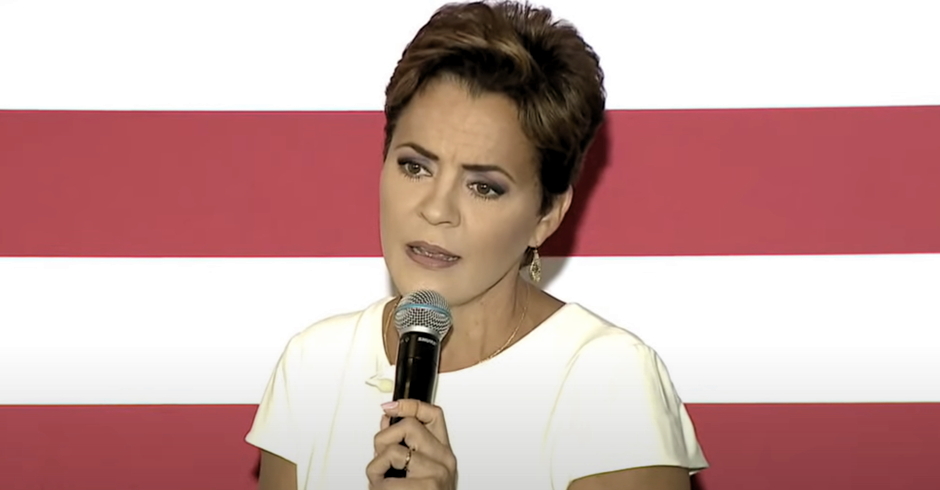
Republican U.S. Senate candidate Kari Lake is promoting a conspiracy theory suggesting Hillary Clinton wants to assassinate her. Her remarks came just one day before she lost her attempt to have the Supreme Court review what some have called her conspiracy-theory fueled lawsuit about electronic voting machines.
“Lake, who filed the lawsuit during her failed campaign for governor in 2022, challenged whether the state’s electronic voting machines assured ‘a fair and accurate vote.’ Two lower courts dismissed the suit, finding that Lake and former Republican state lawmaker Mark Finchem had not been harmed in a way that allowed them to sue,” CNN reported Monday.
Also on Monday Law&Crime reported that when she filed her lawsuit, a Dominion Voting Systems spokesperson “rejected Lake’s cybersecurity claim, telling Law&Crime it was ‘implausible and conspiratorial.'”
Democracy Docket, founded by top Democratic elections attorney Marc Elias, called it “the end of the road for a conspiratorial lawsuit,” and Lake and Fincham, “election deniers.”
READ MORE: ‘Old and Tired and Mad’: Trump’s Demeanor in Court Detailed by Rachel Maddow
Lake, a far-right conspiracy theorist who has yet to concede the 2022 election, which she lost to Democrat Katie Hobbs, has a history of pushing exaggerated and baseless claims.
On Sunday, as MeidasTouch Network reported, Lake promoted an old, anti-Clinton conspiracy theory but twisted it to try to make it appear she was in danger from former U.S. Secretary of State and former Democratic presidential nominee Hillary Clinton.
Lake on Newsmax listened to a clip of Secretary Clinton calling Trump’s fondness for Russian President Vladimir Putin a “bromance,” and saying the ex-president is “just gaga over Putin, because Putin does what he would like to do: kill his opposition, imprison his opposition, drive, you know, journalists and others into exile, rule without any check or balance.”
Then Lake promoted a thoroughly debunked conspiracy theory by responding, “Oh, boy. Oh, that’s really rich coming from a woman like Hillary Clinton, who’s, how many of her friends have just like, mysteriously died or committed suicide?”
“I mean, honestly, that’s rich of her. What President Trump wants is to root out the corruption and deliver our government back to We The People and she looks very nervous. She talked about her friend Mark Elias, Mark Elias has meddled in in his and his cohorts have meddled in the elections.”
She called Democratic policies, “destructive, deadly and frankly, in some ways, diabolical,”and added, “it’s almost comical that Hillary Clinton is talking about Trump wanting to kill his opponents.”
READ MORE: ‘Election Interference’ and ‘Corruption’: Experts Explain Trump Prosecution Opening Argument
“I just want to say as I’m as I’m speaking about this topic, I want everyone out there to know that my brakes on my car have recently been checked and they work. I’m not suicidal. And Hillary, I don’t mean any harm to you. Please don’t send your henchmen out to me. We understand what you’re about. ”
Watch below or at this link.
.@HillaryClinton is talking about Trump wanting to kill his opponents.
We call that projection.
While on the subject of Hillary, I want everyone out there to know that the brakes on my car work just fine. I’m not suicidal.
I’m very happy to be alive & working to save Arizona… pic.twitter.com/Mhj84g5bVu
— Kari Lake (@KariLake) April 22, 2024
READ MORE: ‘Rally Behind MAGA’: Trump Advocates Courthouse ‘Protests’ Nationwide

‘Old and Tired and Mad’: Trump’s Demeanor in Court Detailed by Rachel Maddow

‘I’m Not Suicidal’: Kari Lake Pushes Hillary Clinton Murder Conspiracy Theory

‘Cutting Him to Shreds’: ‘Pissed’ Judge Tells Trump’s Attorney ‘You’re Losing All Credibility’

Biden Campaign Hammers Trump Over Infamous COVID Comment
Biden Campaign Hammers Trump Over Infamous COVID Comment
‘Cutting Him to Shreds’: ‘Pissed’ Judge Tells Trump’s Attorney ‘You’re Losing All Credibility’
‘I’m Not Suicidal’: Kari Lake Pushes Hillary Clinton Murder Conspiracy Theory
‘Old and Tired and Mad’: Trump’s Demeanor in Court Detailed by Rachel Maddow

‘Election Interference’ and ‘Corruption’: Experts Explain Trump Prosecution Opening Argument

 News1 day ago
‘Rally Behind MAGA’: Trump Advocates Courthouse ‘Protests’ Nationwide
 News1 day ago
‘Election Interference’ and ‘Corruption’: Experts Explain Trump Prosecution Opening Argument
 News23 hours ago
‘Old and Tired and Mad’: Trump’s Demeanor in Court Detailed by Rachel Maddow
 News20 hours ago
‘I’m Not Suicidal’: Kari Lake Pushes Hillary Clinton Murder Conspiracy Theory
 News2 hours ago
‘Cutting Him to Shreds’: ‘Pissed’ Judge Tells Trump’s Attorney ‘You’re Losing All Credibility’
 News1 hour ago
Biden Campaign Hammers Trump Over Infamous COVID Comment