Today Is National Bill Of Rights Day. Now, More Than Ever, We Need To Remember.
“Congress shall make no law respecting an establishment of religion, or prohibiting the free exercise thereof; or abridging the freedom of speech, or of the press, or the right of the people peaceably to assemble, and to petition the Government for a redress of grievances.”
Â
In 1941, Democratic President Franklin D. Roosevelt declared December 15 to be Bill of Rights Day, commemorating the 150th anniversary of the ratification of the Bill of Rights. In the present climate of political repression in which we find ourselves, the importance of the first ten amendments to our constitution deserves to be recognized.
During the debates on the adoption of the Constitution, opponents repeatedly charged that as drafted the Constitution would open the way to tyranny by the central government.
Remembering the violation of civil rights before and during the Revolution, the Founding Fathers demanded a “bill of rights” that would spell out protections for individual citizens. Several state conventions in their ratification of the Constitution asked for such amendments; others ratified the Constitution with the understanding that the amendments would be offered.
James Madison originally introduced the amendments to the first United States Congress as a series of legislative articles. Prior to his proposing the amendments, Madison acknowledged there was discontent with the Constitution as written:
“I believe that the great mass of the people who opposed disliked it because it did not contain effectual provision against encroachments on particular rights, and those safeguards which they have been long accustomed to have interposed between them and the magistrate who exercised the sovereign power: nor ought we to consider them safe, while a great number of our fellow citizens think these securities necessary.â€
The Bill of Rights was adopted by the House of Representatives on August 21, 1789, formally proposed by joint resolution of Congress on September 25, 1789, and upon ratification by three quarters of the States, came into effect as Constitutional Amendments on December 15, 1791. While twelve
amendments were passed by Congress, only the ten we call The Bill of Rights, were originally passed by the states. Of the remaining two, one was adopted as the Twenty-seventh Amendment and the other still technically remains pending before the states.
The Bill of Rights originally only included legal protection for land-owning white men; it excluded African Americans and women. It took additional Amendments and decisions by the Supreme Court to extend the same rights to all U.S. citizens.

UC Davis police officer pepper spraying unarmed, non-violent students at campus Occupy Movement protest, November, 2011
The First Amendment is especially referenced these days; most often because of recent attempts to bring religion into the political discussion or to curb freedom of speech and the press and peaceable assembly. As we observe the sometimes successful attempts to insert religious belief into school curricula and the excesses of police brutality; pepper-spraying, tear-gassing and arrests of peaceful protestors and the prevention of the press from photographing the incidents, the importance of The First Amendment is especially apparent.
Â
Congress OF THE United States
begun and
held at the City of New York, on Wednesday
the Fourth of March, one thousand seven hundred and eighty nine.
THE Conventions of a number of
the States having at the time of their adopting the Constitution, expressed a
desire, in order to prevent misconstruction or abuse of its powers, that
further declaratory and restrictive clauses should be added: And as extending
the ground of public confidence in the Government, will best insure the
beneficent ends of its institution
RESOLVED by the Senate and House of
Representatives of the United States of America, in Congress assembled, two
thirds of both Houses concurring, that the following Articles be proposed to
the Legislatures of the several States, as Amendments to the Constitution of
the United States, all or any of which Articles, when ratified by three fourths
of the said Legislatures, to be valid to all intents and purposes, as part of
the said Constitution; viz.:
ARTICLES in addition to, and
Amendment of the Constitution of the United States of America, proposed by
Congress, and ratified by the Legislatures of the several States, pursuant to
the fifth Article of the original Constitution.
Article I
Congress
shall make no law respecting an establishment of religion, or prohibiting the
free exercise thereof; or abridging the freedom of speech, or of the press, or
the right of the people peaceably to assemble, and to petition the Government
for a redress of grievances.
Article
II
A well regulated
Militia, being necessary to the security of a free State, the right of the
people to keep and bear Arms, shall not be infringed.
Article III
No Soldier
shall, in time of peace be quartered in any house, without the consent of the
Owner, nor in time of war, but in a manner to be prescribed by law.
Article IV
The right of
the people to be secure in their persons, houses, papers, and effects, against unreasonable
searches and seizures, shall not be violated, and no Warrants shall issue, but
upon probable cause, supported by Oath or affirmation, and particularly
describing the place to be searched, and the persons or things to be seized.
Article V
No person
shall be held to answer for a capital, or otherwise infamous crime, unless on a
presentment or indictment of a Grand Jury, except in cases arising in the land
or naval forces, or in the Militia, when in actual service in time of War or
public danger; nor shall any person be subject for the same offence to be twice
put in jeopardy of life or limb, nor shall be compelled in any criminal case to
be a witness against himself, nor be deprived of life, liberty, or property,
without due process of law; nor shall private property be taken for public use,
without just compensation.
Article VI
In all
criminal prosecutions, the accused shall enjoy the right to a speedy and public
trial, by an impartial jury of the State and district wherein the crime shall
have been committed; which district shall have been previously ascertained by
law, and to be informed of the nature and cause of the accusation; to be
confronted with the witnesses against him; to have compulsory process for
obtaining witnesses in his favor, and to have the assistance of counsel for his
defense.
Article VII
In Suits at
common law, where the value in controversy shall exceed twenty dollars, the
right of trial by jury shall be preserved, and no fact tried by a jury shall be
otherwise re-examined in any Court of the United States, than according to the
rules of the common law.
Article VIII
Excessive
bail shall not be required, nor excessive fines imposed, nor cruel and unusual
punishments inflicted.
Article
IX
The
enumeration in the Constitution of certain rights shall not be construed to
deny or disparage others retained by the people.
Article X
The powers
not delegated to the United States by the Constitution, nor prohibited by it to
the States, are reserved to the States respectively, or to the people.
Upon ratification by three quarters of the States, these ten articles came into
effect as Constitutional Amendments on December 15, 1791 and are known as The Bill of Rights.
Â

Stuart Wilber. Photo by Mathew Ryan Williams
Â
Stuart Wilber believes that living life openly as a Gay, Lesbian, Bisexual, Transgender or
Allied person is the most powerful kind of activism. Shortly after meeting his partner in Chicago in 1977, he opened a gallery named In a Plain Brown Wrapper, where he exhibited cutting edge work by leading artists; art that dealt with sexuality and gender identification. In the late 1980’s when they moved to San Clemente, CA in Orange County, life as an openly gay couple became a political act. They moved to Seattle 16 years ago and married in Canada a few weeks after British Columbia legalized same-​sex marriage. Although legally married in some countries, they are only considered domestic partners in Washington State. Equality continues to elude him.

Enjoy this piece?
… then let us make a small request. The New Civil Rights Movement depends on readers like you to meet our ongoing expenses and continue producing quality progressive journalism. Three Silicon Valley giants consume 70 percent of all online advertising dollars, so we need your help to continue doing what we do.
NCRM is independent. You won’t find mainstream media bias here. From unflinching coverage of religious extremism, to spotlighting efforts to roll back our rights, NCRM continues to speak truth to power. America needs independent voices like NCRM to be sure no one is forgotten.
Every reader contribution, whatever the amount, makes a tremendous difference. Help ensure NCRM remains independent long into the future. Support progressive journalism with a one-time contribution to NCRM, or click here to become a subscriber. Thank you. Click here to donate by check.
 |

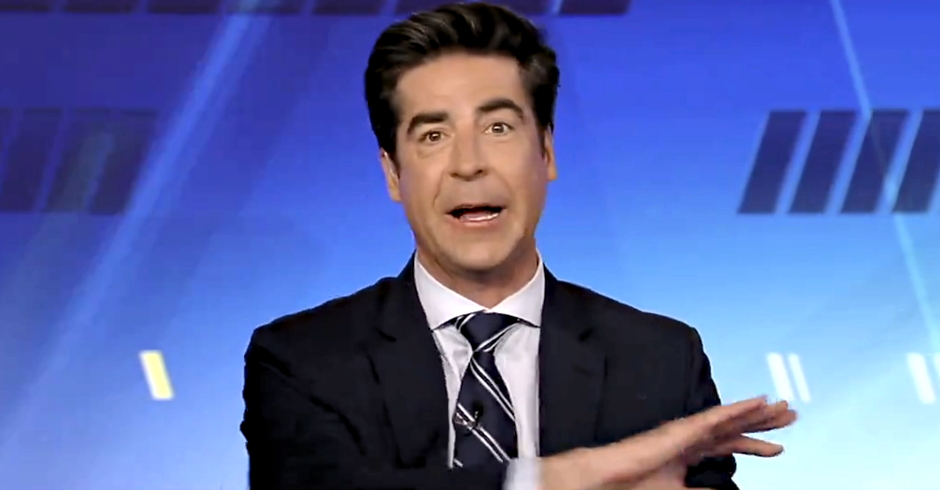
The Fox News host who targeted a juror serving on Donald Trump’s criminal New York trial is now suggesting the ex-president should violate his gag order and “force” the court to throw him in jail, by quoting the Fox News host.
Jesse Watters came under fire earlier this week for profiling juror number two, sharing possibly identifying information published by a myriad of reporters but then using that information to pass judgment on her ability to serve.
“I’m not so sure about juror number two,” Watters concluded on Fox News.
Jurors, at the judge’s direction, were to remain anonymous, for their protection and the protection of the trial.
The judge excused her, after she said she felt she was not able to be impartial because friends and family were calling her asking if she had been chosen to serve on the Trump trial, after the media blitz.
New York Supreme Court Judge Juan Merchan admonished the press for reporting the information, but some news outlets appeared to ignore his warning.
Watters on Wednesday “did a segment with a jury consultant, revealing details about people who had been seated on the jury and questioning whether some were ‘stealth liberals’ who would be out to convict Trump,” the Associated Press reported.
READ MORE: Gaetz: ‘Corrupt’ Republicans Could ‘Take a Bribe’ and Throw House to Dems, Blocking Trump Run
Trump later posted Watters’ quote on his Truth Social platform, leading some, including New York prosecutors, to ask the judge to cite him for allegedly breaking his gag order.
Judge Merchan ordered Trump to not mention witnesses, jurors, prosecutors, court staff, or the family members of prosecutors and court staff, CNN has reported.
New York prosecutors told Juge Merchan Trump has violated the gag order at least ten times.
“Prosecutor Christopher Conroy described the ‘most disturbing’ example as a social media message Trump posted on Wednesday evening quoting a Fox News host as saying, ‘They are catching undercover Liberal Activists lying to the Judge in order to get on the Trump Jury,'” Politico reports.
That host was Jesse Watters.
RELATED: ‘Afraid and Intimidated’: Trump Trial Juror Targeted by Fox News Dismissed
Friday afternoon, Watters appeared to egg Trump on, urging the ex-president to violate the gag order.
“I would make them put me in jail,” Watters said on Fox News. “I would have a tweet about something perhaps I said on ‘The Five’ or ‘Jesse Watters Primetime,’ and I would force them to throw me in jail.”
Watch Watters’ remark below or at this link.
Watters floating the suggestion that Trump should force the court to throw him in jail by posting statements made by Watters on Fox pic.twitter.com/9FYXtLr4uw
— Acyn (@Acyn) April 19, 2024

U.S. Rep. Matt Gaetz (R-FL) says some of his fellow House Republicans would “take a bribe” to throw the razor-thin GOP majority to the Democrats if a far-right faction calls up a motion to oust Speaker of the House Mike Johnson, allowing Democrats to hand the gavel to the Minority Leader, Hakeem Jeffries. he warned if that happens, Democrats would immediately declare Trump ineligible to be President, pack the U.S. Supreme Court, and pass numerous laws like the American Rescue Plan.
“I do believe in a one seat majority there could be one or two or three of my colleagues who would take a bribe in one form or another in order to deprive the Republicans of a majority at all,” Gaetz said Friday on his podcast (video below.)
He added, “the risk that one or two of my corrupt Republican colleagues might take a bribe, take a walk, feign an ailment and flip this thing to the Democrats is a risk that is too high for me at this time.”
Gaetz’s fellow far-right Florida Republican member of Congress, Anna Paulina Luna, told listeners, “I heard that when, if and when the motion vacate is introduced, that there will be immediate resignations of a couple of more moderate members of Congress. And in the event that that happens, that ultimately means it does go to a Democrat speaker.”
RELATED: Jeffries Vows Democrats Will Ensure Ukraine Aid Passes as Johnson Defectors Grow
U.S. Rep. Marjorie Taylor Greene (R-GA) last month filed a “motion to vacate,” which she can use at any time to force a vote to oust the GOP Speaker, Mike Johnson. U.S. Rep. Tim Massie (R-KY) and just today, U.S. Rep. Paul Gosar (R-AZ) has signed on as co-sponsors.
Congressman Gaetz told listeners if Democrats do take the House through a force vote to remove Johnson, Democrats would “be declaring Donald Trump an insurrectionist and setting up a barrier to him being able to become the president United States.”
“That’ll be their leadoff hitter, and then the chaser to that shot will be a massive spending package that looks a lot more like the American Rescue Plan. They will blow past every concept of every cap ever imagined. You’ll be looking at Universal Basic Income, you could be looking at packing the Supreme Court.”
Watch a short clip of Gaetz’s remarks below or at this link.
Gaetz says that he thinks that at least 1-3 of his “corrupt Republican colleagues” will take a bribe and vote for Hakeem Jeffries once a motion to vacate is successful. pic.twitter.com/cT7XlW7rkj
— Ron Filipkowski (@RonFilipkowski) April 19, 2024
READ MORE: ‘Stop Bringing Up Nazis and Hitler’: Marjorie Taylor Greene Smacked Down by Democrats
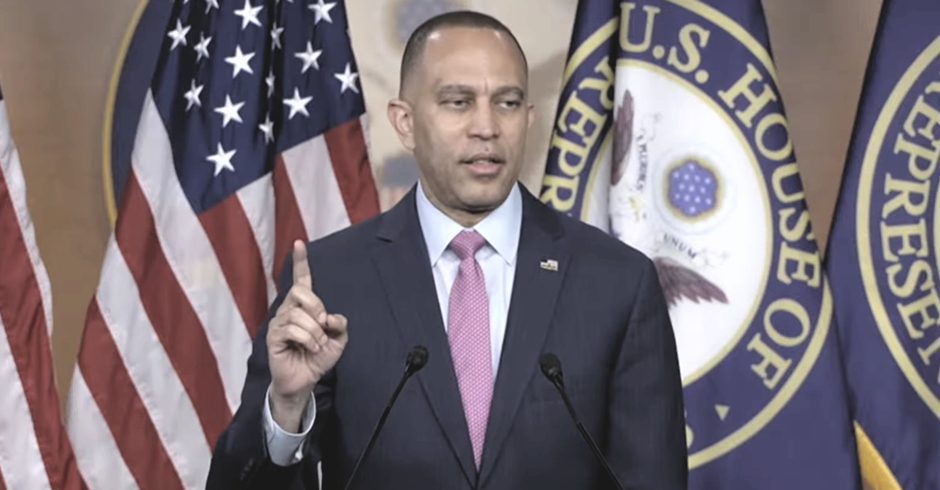
Democratic House Minority Leader Hakeem Jeffries vowed Friday the majority of Democrats will support Republicans’ Ukraine, Israel, Taiwan, and Gaza foreign aid legislation as Republican Speaker Mike Johnson lost support of another member of his conference to a faction determined to oust him.
“Democrats will provide a majority of our majority as it relates to funding Israel, humanitarian assistance, Ukraine, and our allies in the Indo Pacific,” Minority Leader Jeffries said. “It remains to be seen what Republicans will do in terms of meeting the national security needs of the American people, but it was important for House Democrats to ensure that the national security bills are going to be considered.”
“Democrats will provide a majority of our majority as it relates to funding Israel, humanitarian assistance, Ukraine, and our allies in the Indo Pacific.”
— House Minority Leader Hakeem Jeffries (D-NY), ahead of Saturday vote on foreign aid bills pic.twitter.com/aAfqOlEC5h
— The Recount (@therecount) April 19, 2024
Despite Republicans having a one-vote majority, more Democrats on Friday voted to move the critical and long-awaited foreign aid bills forward than did Republicans.
READ MORE: ‘Stop Bringing Up Nazis and Hitler’: Marjorie Taylor Greene Smacked Down by Democrats
The 316-94 vote included 165 Democrats and 151 Republicans voting yes, and 55 Republicans and 39 Democrats voting no.
Axios’ Juliegrace Brufke posted the list of Republicans voting against their party’s legislation.
Republicans who voted against the rule pic.twitter.com/M9MI8BZc5D
— Juliegrace Brufke (@juliegraceb) April 19, 2024
Calling it a “rare” moment in modern congressional history to have to rely on opposition party votes to pass legislation, BBC News reports Speaker Johnson’s “hold on power is tenuous, and the legislators who oppose him – and his bid to provide aid to Ukraine – occupy some key positions within the House’s power structure.”
Amid the procedural vote to move the foreign aid funding bills forward, U.S. Rep. Paul Gosar, a far-right Republican of Arizona, announced he is joining Congresswoman Marjorie Taylor Greene (R-GA), and Congressman Tim Massie (R-KY) in formally announcing their will vote to oust Speaker Johnson.
Gosar, like Greene, is reportedly a Christian nationalist. In 2022 CNN reported his “lengthy ties to White nationalists, [a] pro-Nazi blogger and far-right fringe received little pushback for years.”
RELATED: ‘Repercussions’: Democrats and Republicans Stand Against ‘Pro-Putin’ House GOP Faction
“We’ve been very honest in our assessment of the situation from the beginning,” Jeffries on Friday also declared. “At the appropriate time as House Democrats, we will have a conversation about how to deal with any hypothetical motion to vacate.”
“Moscow Marjorie Taylor Greene, Massie, and Gosar are quite a group. But central to our conversation is to make sure that the national security legislation in totality is passed by the House of Representatives.”
“At the appropriate time as House Democrats, we will have a conversation about how to deal with any hypothetical motion to vacate. … Moscow Marjorie Taylor Greene, [Thomas] Massie, and [Paul] Gosar are quite a group.”
— House Minority Leader Hakeem Jeffries (D-NY) pic.twitter.com/HbkhiNlQCZ
— The Recount (@therecount) April 19, 2024
Watch the videos above or at this link.

Jeffries Vows Democrats Will Ensure Ukraine Aid Passes as Johnson Defectors Grow

Gaetz: ‘Corrupt’ Republicans Could ‘Take a Bribe’ and Throw House to Dems, Blocking Trump Run

Biden Amps Up Field Offices, Trump to Mobilize Thousands of Lawyers to Monitor Vote Counts

Fox News Host Suggests Trump ‘Force’ Court to Throw Him in Jail – by Quoting Him
Fox News Host Suggests Trump ‘Force’ Court to Throw Him in Jail – by Quoting Him
Gaetz: ‘Corrupt’ Republicans Could ‘Take a Bribe’ and Throw House to Dems, Blocking Trump Run
Jeffries Vows Democrats Will Ensure Ukraine Aid Passes as Johnson Defectors Grow
Biden Amps Up Field Offices, Trump to Mobilize Thousands of Lawyers to Monitor Vote Counts

‘Repercussions’: Democrats and Republicans Stand Against ‘Pro-Putin’ House GOP Faction
 OPINION3 days ago
‘Stop Bringing Up Nazis and Hitler’: Marjorie Taylor Greene Smacked Down by Democrats
 OPINION3 days ago
‘Big Journalism Fail’: Mainstream Media Blasted Over Coverage of Historic Trump Trial
 News3 days ago
‘Used by the Russians’: Moskowitz Mocks Comer’s Biden Impeachment Failure
- News1 day ago
‘Repercussions’: Democrats and Republicans Stand Against ‘Pro-Putin’ House GOP Faction
- News2 days ago
‘Afraid and Intimidated’: Trump Trial Juror Targeted by Fox News Dismissed
 OPINION2 days ago
Marjorie Taylor Greene, ‘Putin’s Envoy’? Democrat’s Bills Mock Republican’s Actions

 News2 days ago
‘They Want Russia to Win So Badly’: GOP Congressman Blasts Far-Right House Republicans
 News17 hours ago
Jeffries Vows Democrats Will Ensure Ukraine Aid Passes as Johnson Defectors Grow