Romney’s Last Breath: Vote For Me Because GOP Will Forever Block Obama
Â
2009
As the world now knows, on January 20, 2009, the night Senator Barack Obama officially became President Barack Obama, Republican Rep. Paul Ryan and a dozen GOP Congressman — bolstered by Newt Gingrich and Fox News pollster Frank Luntz — got together for several hours in The Caucus Room, a high-end D.C. restaurant, and planned the demise of the nascent Obama presidency.
“The event — which provides a telling revelation for how quickly the post-election climate soured — serves as the prologue of Robert Draper’s much-discussed and heavily-reported new book, “Do Not Ask What Good We Do: Inside the U.S. House of Representatives,” Sam Stein at The Huffington Post reported, in an extensive and fascinatingly frightening examination of GOP practices, earlier this year:
According to Draper, the guest list that night (which was just over 15 people in total) included Republican Reps. Eric Cantor (Va.), Kevin McCarthy (Calif.), Paul Ryan (Wis.), Pete Sessions (Texas), Jeb Hensarling (Texas), Pete Hoekstra (Mich.) and Dan Lungren (Calif.), along with Republican Sens. Jim DeMint (S.C.), Jon Kyl (Ariz.), Tom Coburn (Okla.), John Ensign (Nev.) and Bob Corker (Tenn.). The non-lawmakers present included Newt Gingrich, several years removed from his presidential campaign, and Frank Luntz, the long-time Republican wordsmith. Notably absent were Senate Minority Leader Mitch McConnell (R-Ky.) and House Minority Leader John Boehner (R-Ohio) — who, Draper writes, had an acrimonious relationship with Luntz.
For several hours in the Caucus Room (a high-end D.C. establishment), the book says they plotted out ways to not just win back political power, but to also put the brakes on Obama’s legislative platform.
So, we’ve got 12 Republican Congressmen, plus Newt Gingrich and Frank Luntz, and one unnamed participant, all in a restaurant plotting not a takeover of the government, but a disloyal opposition coup d’état-like plan in an absolute act of, in my opinion, something approaching, something almost akin to, something that sowed the seeds for something that others might call treason; the willful disregard of their fiduciary responsibility to work for the American people, not for the Republican Party.
This wasn’t party politics, it was a brazen act of using their elected offices and taxpayer-supported budgets, with the American people as collateral damage, to extinguish a presidency.
“In other words, there was nothing President Obama could have done to build common ground with Republicans,” The American Prospect reported:
“From the beginning, the plan was to relentlessly obstruct Obama, regardless of whether that was good for the country The GOP’s high-minded rhetoric of compromise and bipartisanship was bunk; cover for a plan to keep Democrats from accomplishing anything. It’s truly remarkable, and in an ideal world, would color any attempts from the GOP to portray itself as the victim of Democratic partisanship.”
Jonathan Capehart at The Washington Post offered this extensive take:
Republicans are complicit in the failures they rail against.
At first, we thought organized Republican recalcitrance against the president started in October 2010 after Senate Minority Leader Mitch McConnell (R-Ky.) famously said, “The single most important thing we want to achieve is for President Obama to be a one-term president.†Then came Robert Draper’s book, “Do Not Ask What Good We Do: Inside the U.S. House of Representatives,â€Â this spring. As the Huffington Post’s Sam Stein reported in April, the book reports on a dinner of leading Republicans held the night of Obama’s inauguration.
…
The dinner lasted nearly four hours. They parted company almost giddily. The Republicans had agreed on a way forward:
Go after Geithner. (And indeed Kyl did, the next day: ‘Would you answer my question rather than dancing around it — please?’)
Show united and unyielding opposition to the president’s economic policies. (Eight days later, Minority Whip Cantor would hold the House Republicans to a unanimous No against Obama’s economic stimulus plan.)
Begin attacking vulnerable Democrats on the airwaves. (The first National Republican Congressional Committee attack ads would run in less than two months.)
Win the spear point of the House in 2010. Jab Obama relentlessly in 2011. Win the White House and the Senate in 2012.
Now Greg Sargent at The Plum Line is sounding the alarm over a revelation in “The New New Deal†by Grunwald. Vice President Joe Biden told the author that during the transition, “seven different Republican Senators†told him that “McConnell had demanded unified resistance.†This was after the 2008 election but before Obama and Biden took office.
“The way it was characterized to me was: `For the next two years, we can’t let you succeed in anything. That’s our ticket to coming back,’ †Biden says.
Nevermind the nation was falling off the fiscal cliff. Nevermind the global economic system was hanging in the balance. Nevermind we were on the verge of another Great Depression. When the nation needed single-minded focus, the Republican political establishment put power over the national interest.
So, the next time you hear Republicans and conservatives bloviating about the “failures†of the Obama presidency, remember the role they played in them. And remember how their resistance hurt the country they are elected to help govern.
“These Republican members of Congress were not simply airing their complaints regarding the other party’s political platform for four long hours,” Daily Kos wrote. “No, these Republican Congressional Policymakers, who were elected to do ‘the People’s work’ were literally plotting to sabotage, undermine and destroy the U.S. Economy. “
“And Republicans Engaged In Historic Levels Of Obstruction To Block Obama’s Initiatives,” Media Matters reports, adding, “Republicans Held Secret Meeting On How To Block Obama’s Agenda On The Very Day He Was Nominated.”
And Ed Kilgore at Washington Monthly adds:
When you are a hammer, everything looks like a nail. What is somewhat new, however, is a political atmosphere in which partisanship can be depicted as identical to civic virtue: that “saving†the country from its president is viewed by the rank-and-file of a major political party, and by its servants and masters in the chattering classes and activist circles, as a necessary and sufficient agenda. That, along with the ability to convince the news media that this attitude of 100% opposition was actually a frustrated effort to cooperate, was key to the GOP’s ability to maintain a united front against anything Obama proposed, even if it was the GOP’s talking points from the day before yesterday.
What’s more interesting to me than the evidence of a cabal to plot against the president (what does anyone suppose Republicans would be doing on the night of their opponent’s apotheosis, raising toasts to his success?) is how effectively dissenting voices were obscured or rubbed out. I mean, when, exactly, did Republicans as a group repudiate the Keynesian economics that had been the bipartisan background for how Washington dealt with rececssions going back to the 70s, reinforced by the supply-siders’ hatred for “root canal†austerity policies? How did they so quickly convince hundreds of people leaving jobs in the Bush administration to agree that their former boss and one-time maximum leader of the conservative forces was in fact an unprincipled Big Spender who had sold out The Cause? And at what point, exactly, did the Move Right To Win strategy that had always existed on the fringes of conservative political science circles become uniform orthodoxy, to the point that the 2012 GOP nomination contest because strictly a matter of identifying the maximum conservatism the political markets could bear?
Â
Fast forward to 2010.
Senate Minority Leader Mitch McConnell told the National Journal, “the single most important thing we want to achieve is for President Obama to be a one-term president,” then repeated that idea everywhere he could.
https://youtube.com/watch?v=W-A09a_gHJc%3Fversion%3D3%26hl%3Den_US
Fast forward to this week.
“I’ve spent the morning reading various endorsements of Mitt Romney for president, and they all say the same thing: Mitch McConnell and John Boehner’s strategy worked,” Ezra Klein wrote in The Washington Post on Tuesday:
In endorsement after endorsement, the basic argument is that President Obama hasn’t been able to persuade House or Senate Republicans to work with him. If Obama is reelected, it’s a safe bet that they’ll continue to refuse to work with him. So vote Romney!
That’s not even a slight exaggeration. Take the Des Moines Register, Iowa’s largest and most influential paper. They endorsed Bill Clinton in 1992 and 1996, Al Gore in 2000, John Kerry in 2004, and Barack Obama in 2008. But this year, they endorsed Romney.
Why? In the end, they said, it came down to a simple test. “Which candidate could forge the compromises in Congress to achieve these goals? When the question is framed in those terms, Mitt Romney emerges the stronger candidate.â€
The paper goes on to note that “early in his administration, President Obama reached out to Republicans but was rebuffed.†The problem, they say, is that “since then, he has abandoned the effort, and the partisan divide has hardened.†I’m not sure that’s an accurate read of the situation — Obama spent most of 2011 negotiating with John Boehner — but that’s neither here nor there. The point is that’s how the Register sees it, and it stands in contrast with Romney, who “succeeded as governor in Massachusetts where he faced Democratic majorities in the legislature.â€
Of course, while Klein won’t say this, the Romney “succeeded as governor in Massachusetts where he faced Democratic majorities in the legislature,” idea is pure bullshit, as the New York Times last month reported:
“[Romney] vetoed scores of legislative initiatives and excised budget line items a remarkable 844 times, according to the nonpartisan research group Factcheck.org. Lawmakers reciprocated by quickly overriding the vast bulk of them.”
Fast forward to yesterday.
“In what his campaign billed as his ‘closing argument,’ Mitt Romney warned Americans that a second term for President Obama would have apocalyptic consequences for the economy in part because his own party would force a debt ceiling disaster,” Talking Points Memo’s Benjy Sarlin reported:
Romney said that Obama “promised to be a post-partisan president, but he became the most partisan†and that his bitter relations with the House GOP could threaten the economy. As his chief example, he pointed to a crisis created entirely by his own party’s choice — Republican lawmakers’ ongoing threat to reject a debt ceiling increase. Economists warn that a failure to pass such a measure would have immediate and catastrophic consequences for the recovery.
“You know that if the President is re-elected, he will still be unable to work with the people in Congress,†Romney said. “He has ignored them, attacked them, blamed them. The debt ceiling will come up again, and shutdown and default will be threatened, chilling the economy.â€
https://youtube.com/watch?v=ItGodTIiukc%3Fversion%3D3%26hl%3Den_US
So, bottom line, this is the treason-ish compact forged by the GOP: Under cover of darkness, expensive single malt scotch, cigars, and center cut filet mignon, forge a plan to overthrow — if not the President’s first term, certainly — his chances for a second by defaulting (call it, “placing on hold,”) on your sworn oath to the American people that you will preserve and protect the Constitution — rationalizing that since, in your twelfth-century, science is bad, Obama isn’t a Christian, all’s fair in a religious war mentality — by making President Obama a “one term president” at any and all costs, including at the cost of helping millions of unemployed Americans become employed, downgrading the U.S.A.’s credit rating, and ruining the environment around the world.
Get it?
Â

Enjoy this piece?
… then let us make a small request. The New Civil Rights Movement depends on readers like you to meet our ongoing expenses and continue producing quality progressive journalism. Three Silicon Valley giants consume 70 percent of all online advertising dollars, so we need your help to continue doing what we do.
NCRM is independent. You won’t find mainstream media bias here. From unflinching coverage of religious extremism, to spotlighting efforts to roll back our rights, NCRM continues to speak truth to power. America needs independent voices like NCRM to be sure no one is forgotten.
Every reader contribution, whatever the amount, makes a tremendous difference. Help ensure NCRM remains independent long into the future. Support progressive journalism with a one-time contribution to NCRM, or click here to become a subscriber. Thank you. Click here to donate by check.
 |

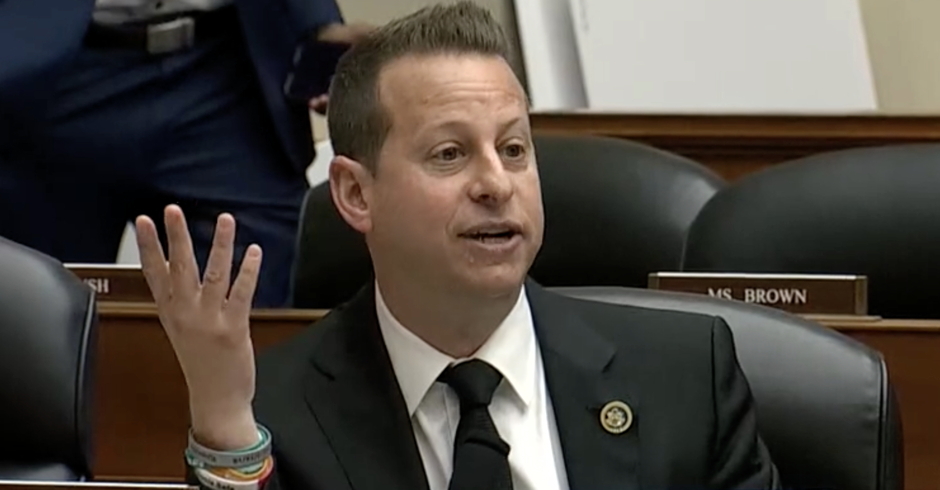
U.S. Rep. Jared Moskowitz (D-FL) is mocking House Oversight Committee Chairman Jim Comer over a CNN report revealing the embattled Kentucky Republican who has been alleging without proof President Joe Biden is the head of a vast multi-million dollar criminal bribery and influence-peddling conspiracy, has given up trying to impeach the leader of the free world.
CNN on Wednesday had reported, “after 15 months of coming up short in proving some of his biggest claims against the president, Comer recently approached one of his Republican colleagues and made a blunt admission: He was ready to be ‘done with’ the impeachment inquiry into Biden.” The news network described Chairman Comer as “frustrated” and his investigation as “at a dead end.”
One GOP lawmaker told CNN, “Comer is hoping Jesus comes so he can get out.”
“He is fed up,” the Republican added.
Despite the Chairman’s alleged remarks, “a House Oversight Committee spokesperson maintains that ‘the impeachment inquiry is ongoing and impeachment is 100% still on the table.'”
RELATED: ‘Used by the Russians’: Moskowitz Mocks Comer’s Biden Impeachment Failure
Last week, Oversight Committee Ranking Member Jamie Raskin (D-MD) got into a shouting match with Chairman Comer, with the Maryland Democrat saying, “You have not identified a single crime – what is the crime that you want to impeach Joe Biden for and keep this nonsense going?” and Comer replying, “You’re about to find out.”
Before those heated remarks, Congressman Raskin chided Comer, humorously threatening to invite Rep. Moskowitz to return to the hearing.
Congressman Moskowitz appears to be the only member of the House Oversight Committee who has ever made a motion to call for a vote on impeaching President Biden, which he did last month, although he did it to ridicule Chairman Comer.
Moskowitz: Make the motion to impeach President Biden. Go ahead…. No. Nothing. They’re never going to impeach him. It’s all fake. They’re lying to their base on Newsmax and Fox leading these people to believe that they’re going to impeach pic.twitter.com/WH375tkXtL
— Acyn (@Acyn) March 20, 2024
It appears the Moskowitz-Comer “bromance” may be over.
Wednesday afternoon Congressman Moskowitz, whose sarcasm is becoming well-known, used it to ridicule Chairman Comer.
“I was hoping our breakup would never become public,” he declared. “We had such a great thing while it lasted James. I will miss the time we spent together. I will miss our conversations. I will miss the pet names you gave me. I only wish you the best and hope you find happiness.”
Watch the video above or at this link.
READ MORE: ‘Doesn’t Care if Pregnant Women Live or Die’: Alito Slammed Over Emergency Abortion Remarks

The U.S. Supreme Court heard oral arguments in a case centered on the question, can the federal government require states with strict abortion bans to allow physicians to perform abortions in emergency situations, specifically when the woman’s health, but not her life, is in danger?
The 1986 federal Emergency Medical Treatment and Active Labor Act (EMTALA), signed into law by Republican President Ronald Reagan, says it can. The State of Idaho on Wednesday argued it cannot.
U.S. Solicitor General Elizabeth Prelogar, The Washington Post’s Kim Bellware reported, “made a clear delineation between Idaho law and what EMTALA provides.”
“In Idaho, doctors have to shut their eyes to everything except death,” Prelogar said, according to Bellware. “Whereas under EMTALA, you’re supposed to be thinking about things like, ‘Is she about to lose her fertility? Is her uterus going to become incredibly scarred because of the bleeding? Is she about to undergo the possibility of kidney failure?’ ”
READ MORE: Gag Order Breach? Trump Targeted Cohen in Taped Interview Hours Before Contempt Hearing
Attorney Imani Gandy, an award-winning journalist and Editor-at-Large for Rewire News Group, highlighted an issue central to the case.
“The issue of medical judgment vs. good faith judgment is a huge one because different states have different standards of judgment,” she writes. “If a doctor exercises their judgment, another doctor expert witness at trial could question that. That’s a BIG problem here. That’s why doctors are afraid to provide abortions. They may have an overzealous prosecutor come behind them and disagree.”
Right-wing Justice Samuel Alito appeared to draw the most fire from legal experts, as his questioning suggested “fetal personhood” should be the law, which it is not.
“Justice Alito is trying to import fetal personhood into federal statutory law by suggesting federal law might well prohibit hospitals from providing abortions as emergency stabilizing care,” observed Constitutional law professor Anthony Michael Kreis.
Paraphrasing Justice Alito, Kreis writes: “Alito: How can the federal government restrict what Idaho criminalizes simply because hospitals in Idaho have accepted federal funds?”
Appearing to answer that question, Georgia State University College of Law professor of law and Constitutional scholar Eric Segall wrote: “Our Constitution unequivocally allows the federal gov’t to offer the states money with conditions attached no matter how invasive b/c states can always say no. The conservative justices’ hostility to the spending power is based only on politics and values not text or history.”
Professor Segall also served up some of the strongest criticism of the right-wing justice.
READ MORE: ‘They Will Have Thugs?’: Lara Trump’s Claim RNC Will ‘Physically Handle the Ballots’ Stuns
He wrote that Justice Alito “is basically making it clear he doesn’t care if pregnant women live or die as long as the fetus lives.”
Earlier Wednesday morning Segall had issued a warning: “Trigger alert: In about 20 minutes several of the conservative justices are going to show very clearly that that they care much more about fetuses than women suffering major pregnancy complications which is their way of owning the libs which is grotesque.”
Later, predicting “Alito is going to dissent,” Segall wrote: “Alito is dripping arrogance and condescension…in a case involving life, death, and medical emergencies. He has no bottom.”
Taking a broader view of the case, NYU professor of law Melissa Murray issued a strong warning: “The EMTALA case, Moyle v. US, hasn’t received as much attention as the mifepristone case, but it is huge. Not only implicates access to emergency medical procedures (like abortion in cases of miscarriage), but the broader question of federal law supremacy.”
READ MORE: ‘Blood on Your Hands’: Tennessee Republicans OK Arming Teachers After Deadly School Shooting

Hours before his attorneys would mount a defense on Tuesday claiming he had not violated his gag order Donald Trump might have done just that in a 12-minute taped interview that morning, which did not air until later that day. It will be up to Judge Juan Merchan to make that decision, if prosecutors add it to their contempt request.
Prosecutors in Manhattan District Attorney Alvin Bragg’s office told Judge Juan Merchan that the ex-president violated the gag order ten times, via posts on his Truth Social platform, and are asking he be held in contempt. While the judge has yet to rule, he did not appear moved by their arguments. At one point, Judge Merchan told Trump’s lead lawyer Todd Blanche he was “losing all credibility” with the court.
And while Judge Merchan directed defense attorneys to provide a detailed timeline surrounding Trump’s Truth Social posts to prove he had not violated the gag order, Trump in an interview with a local television station appeared to have done so.
READ MORE: ‘They Will Have Thugs?’: Lara Trump’s Claim RNC Will ‘Physically Handle the Ballots’ Stuns
The gag order bars Trump from “commenting or causing others to comment on potential witnesses in the case, prospective jurors, court staff, lawyers in the district attorney’s office and the relatives of any counsel or court staffer, as CBS News reported.
“The threat is very real,” Judge Merchan wrote when he expanded the gag order. “Admonitions are not enough, nor is reliance on self-restraint. The average observer, must now, after hearing Defendant’s recent attacks, draw the conclusion that if they become involved in these proceedings, even tangentially, they should worry not only for themselves, but for their loved ones as well. Such concerns will undoubtedly interfere with the fair administration of justice and constitutes a direct attack on the Rule of Law itself.”
Tuesday morning, Trump told ABC Philadelphia’s Action News reporter Walter Perez, “Michael Cohen is a convicted liar. He’s got no credibility whatsoever.”
He repeated that Cohen is a “convicted liar,” and insisted he “was a lawyer for many people, not just me.”
READ MORE: ‘Old and Tired and Mad’: Trump’s Demeanor in Court Detailed by Rachel Maddow
Since Cohen is a witness in Trump’s New York criminal case, Judge Merchan might decide Trump’s remarks during that interview violated the gag order, if prosecutors bring the video to his attention.
Enter attorney George Conway, who has been attending Trump’s New York trial.
Conway reposted a clip of the video, tagged Manhattan District Attorney Bragg, writing: “cc: @ManhattanDA, for your proposed order to show cause why the defendant in 𝘗𝘦𝘰𝘱𝘭𝘦 𝘷. 𝘛𝘳𝘶𝘮𝘱 should not spend some quiet time in lockup.”
Trump has been criminally indicted in four separate cases and is facing a total of 88 felony charges, including 34 in this New York criminal trial for alleged falsification of business records to hide payments of “hush money” to an adult film actress and one other woman, in an alleged effort to suppress their stories and protect his 2016 presidential campaign, which experts say is election interference.
Watch the video below or at this link.
NEW: Trump’s Team let him do a lengthy interview with PA’s biggest TV station @6abc today.
It did not go well. In addition to some horrible abortion mansplaining, Trump:
– called the NY judge corrupt
– attacked witnesses personally
– committed to taking the stand at his trial pic.twitter.com/ePKckyQi76— J.J. Abbott 🦅 (@jjabbott) April 23, 2024
READ MORE: ‘Blood on Your Hands’: Tennessee Republicans OK Arming Teachers After Deadly School Shooting

‘They Will Have Thugs?’: Lara Trump’s Claim RNC Will ‘Physically Handle the Ballots’ Stuns

Gag Order Breach? Trump Targeted Cohen in Taped Interview Hours Before Contempt Hearing

‘Doesn’t Care if Pregnant Women Live or Die’: Alito Slammed Over Emergency Abortion Remarks

‘I Hope You Find Happiness’: Moskowitz Trolls Comer Over Impeachment Fail
‘I Hope You Find Happiness’: Moskowitz Trolls Comer Over Impeachment Fail
‘Doesn’t Care if Pregnant Women Live or Die’: Alito Slammed Over Emergency Abortion Remarks
Gag Order Breach? Trump Targeted Cohen in Taped Interview Hours Before Contempt Hearing
‘They Will Have Thugs?’: Lara Trump’s Claim RNC Will ‘Physically Handle the Ballots’ Stuns

‘Blood on Your Hands’: Tennessee Republicans OK Arming Teachers After Deadly School Shooting

 News3 days ago
‘Rally Behind MAGA’: Trump Advocates Courthouse ‘Protests’ Nationwide

 News2 days ago
‘I’m Not Suicidal’: Kari Lake Pushes Hillary Clinton Murder Conspiracy Theory
 News3 days ago
‘Old and Tired and Mad’: Trump’s Demeanor in Court Detailed by Rachel Maddow
 News3 days ago
‘Election Interference’ and ‘Corruption’: Experts Explain Trump Prosecution Opening Argument
 News2 days ago
‘Cutting Him to Shreds’: ‘Pissed’ Judge Tells Trump’s Attorney ‘You’re Losing All Credibility’
 News2 days ago
Biden Campaign Hammers Trump Over Infamous COVID Comment
 News1 day ago
‘Blood on Your Hands’: Tennessee Republicans OK Arming Teachers After Deadly School Shooting
 OPINION2 days ago
Trump Complains He’s ‘Not Allowed to Talk’ as He Gripes Live on Camera