Kobe Bryant: The Real Outrage Isn’t That He Said “Fag”
The real outrage is that at a time when anti-gay name-calling and bullying are leading causes of LGBTQ teen suicide, saying “fag” enables and encourages millions to continue harassing our youth.
Kobe Bryant, the Lakers’ superstar basketball player, Tuesday night looked straight into a TNT TV camera and called the referee a “fucking fag.” Bryant’s defense? “Frustration.” It took Bryant three attempts and twenty-four hours to reconcile the situation with the gay, lesbian, bisexual, and transgender community and their allies, but if his attempts — at least at first — felt half-hearted, perhaps it’s because they were. While Internet platforms like Twitter and Facebook voraciously took to the controversy, it was plain Bryant’s fans and defenders out-numbered his LGBT-supporting opponents — if not in number, at least in volume.
Ironically, Bryant’s words could not have been more relevant. Just hours earlier the NBA, the Ad Council, and GLSEN had been taping a public service announcement against anti-gay language as part of GLSEN’s “Think Before You Speak” campaign, to be aired during the NBA finals, in an effort to show the league as more “gay-friendly.” And this week marks the fifteenth anniversary of GLSEN’s “Day of Silence,” an effort during which “hundreds of thousands of students nationwide take a vow of silence to bring attention to anti-LGBT name-calling, bullying and harassment in their schools,” according to GLSEN.
“The words expressed do NOT reflect my feelings towards the gay and lesbian communities and were NOT meant to offend anyone,†was Kobe Bryant’s initial defense — short and none-too-sweet. And perhaps taking his cue from Senator John Kyl’s lie last week, (Kyl told Congress and America, “If you want an abortion, you go to Planned Parenthood, and that’s well over 90 percent of what Planned Parenthood does,” only to be forced to retract it later by saying it was “not intended to be a factual statement,â€) Bryant offered, “What I said last night should not be taken literally.†Bryant never explained how one could take the term, “fucking fag,” literally, but added, “My actions were out of frustration during the heat of the game, period.”
Â
What I said last night should not be taken literally,†Bryant offered — never explaining how one could take the term, “fucking fag,†literally — adding, “My actions were out of frustration during the heat of the game, period.â€
Â
U.K. rugby star and straight-ally Ben Cohen had a few words for Kobe Bryant about frustration. The 32-year old gay-friendly icon called Bryant’s outburst “disappointing,” and added, “As a professional athlete and rugby World Cup champion, I understand the heat and passion of competition at the highest levels. But we must all remember that strong bodies must be balanced with strong characters, and work toward that end. Our positions as role models demand it.â€
Cohen may have put his finger on one of the key aspects in this now national debate. Some, generally the more conservative of Americans, feel sports figures don’t bear responsibility for their roles as role models. But as President Franklin Delano Roosevelt said, “power must be linked with responsibility, and obliged to defend and justify itself within the framework of the general good.” In other words, “with great power comes great responsibility.”
Watch: “Kobe Bryant Calls Ref A “Fucking Fag†On Camera (Video)“
Kobe Bryant abdicated that responsibility when he was accused of adulterous rape in 2003, (reportedly, the charges were dropped when the victim refused to testify in public,) and did so again Tuesday night. Bryant had said his words “were not meant to offend anyone.” How could they have been meant to do anything but offend? (No one says, “fucking fag,” without looking to get a strong reaction.)
And they did offend. And worse than offend, they sent a strong message from a strong, national role model, that it’s OK to use anti-gay epithets when the chips are down.
What Bryant may have failed to understand the very moment he opened his mouth, is that like it or not, he is a role model to millions, especially millions of children. And in a split-second, caught on camera, he told those millions — adults and children alike — that it’s OK to denigrate, hate, and verbally abuse, gay men and lesbians, and bisexual and transgender folks.
The story itself took a life of its own, and The New Civil Rights Movement published a total of ten (this will be eleven) play-by-play articles, which drew a great many comments from all sides. But one reader may have said it best. “Kobe Bryant’s behaviour is more damaging to children than Janet Jackson’s boob. People need to realize that Bryant is the kind of role model that bullies look up to.”
Read: “USA Today Asks “Did Kobe’s Punishment Fit The Crime?†America Disappoints“
Before Bryant’s “heartfelt,” actual apology, GLAAD President Jarrett Barrios put his concern in more professional terms, properly stating, “Professional sports players need to set a better example for young people who use words like this on the playground and in our schools, creating a climate of intolerance and hostility. The LA Lakers have a responsibility to educate their fans about why this word is unacceptable.â€
(To date, the L.A. Lakers organization has not commented, although NBA Commissioner David Stern did fine Bryant $100,000 — a powerful statement of condemnation, given the comparatively steep fine.)
But GLAAD’s and HRC’s messages — if they were even heard by more than a few — were lost on the madding crowd Wednesday. Many Internet comments supported Bryant. Of those, many were of the “gays are too sensitive” variety. Or, “gays need to calm down.” Or, “That term is used very loosely around the country everyday.” Or, “get over it.” Others blatantly supported the “fucking fag” term.
Â
“If a young student was called the N-word every day for weeks or months on end, and after repeated cries for help finally took his own life, how quickly do you think citizens of all races would take to the streets to protest?”
Â
Bryant, a 32-year old shooting guard, ultimately managed to call the president of the nation’s largest LGBT organization, the Human Rights Campaign, to offer what President Joe Solmonese described as a “heartfelt” apology. Solmonese, who in immediate response to Bryant’s Tuesday night slur had called it “a disgrace,” added two important caveats to his homage of Bryant’s apology.
“He told me that it’s never ok to degrade or tease, and that he understands how his words could unfortunately give the wrong impression that this is appropriate conduct,†and, “At the end of a difficult day, I applaud Kobe for coming forward and taking responsibility for his actions.â€
These were important because Solmonese rightly knows he has a responsibility to help shape public opinion. And the public needed to know that Kobe Bryant thought he was wrong to call the referee a “fucking fag,” that Kobe Bryant was sorry, remorseful, regretful, and that Kobe Bryant wanted America to know “that it’s never ok to degrade or tease.”
Sadly, the message, trumpeted by HRC, was not equally amplified by Bryant, the Lakers, or the NBA. And sadly, nowhere do we have a direct quote that says, “I’m sorry and I was wrong. Don’t repeat my mistake, folks.”
Solmonese, while awaiting an apology prior to the Wednesday evening telephone conversation, had warned Bryant and the Lakers organization that “America is watching.â€
And they were watching– but not so much for an apology as for how far the LGBT community would take this. After all, it was just a word and gays should get over it, right?
Wrong.
Words have power and, in the wake of the anti-gay bullying teen suicides America saw last fall, America needs to remember that. We know that words from role models on the basketball court, and from bullies on the street corner, have power, meaning, and in many cases, can kill.
There are an estimated 5,000 suicides by Americans aged 15-24 every year, and studies show LGBTQ teens are three times as likely to die by suicide than their heterosexual peers. Simple math tells us then that over 100 LGBTQ 15-24 year olds die by suicide every month.
Yet America was shocked in September 2010 when the media reported five teens died by suicide due to anti-gay bullying. At The New Civil Rights Movement we were able to uncover at least ten, knowing that was only ten percent of the story.
Read: “September’s Anti-Gay Bullying Suicides – There Were A Lot More Than 5“
“If a young student was called the N-word every day for weeks or months on end, and after repeated cries for help finally took his own life, how quickly do you think citizens of all races would take to the streets to protest?,” asked Keli Goff, an African-American author, in October 2010, just after the rash of September anti-gay bullying suicides. Goff continued, asking, “Or better yet, how quickly would Al Sharpton and Co. demand accountability from the school and elected officials under the threat of casting the kind of media spotlight that people like Don Imus have nightmares about?”
“Which makes me think that the kids doing the bullying are not really the ones at fault,” she writes. “They are simply taking their cues from adults. And the message they are receiving is that today in 2010 it may not be okay to call someone the N-word on the playground, but it is okay to call someone the F-word.”
So what if Kobe Bryant’s “penalty” was not a $100,000 fine, but 100 hours spent counseling at-risk LGBTQ teens? Talk about a win-win-win. A win for LGBTQ teens, a win for Bryant, and a win for America, whose out-of-control media superstars would think twice before using anti-gay slurs publicly.
But America, by and large, has a very short-term memory and is not thinking about teen suicides. America is thinking that the LGBT community is too sensitive. America is thinking that, regardless of age, we should just roll with the punches. America is thinking Bryant’s “punishment,” a fine that amounts to about zero-point-zero-zero-two percent of his annual income, was too harsh.
Â
“The problem we have now is because of the way we don’t address homophobia, the ultimate insult to a man is to tell them either they’re like a woman or worse, that they’re gay,” says John Amaechi, the first gay NBA star to come out.
Â
How do we know? Ask your neighbors. Or, look at this USA Today online poll that as of this writing says that 53% of Americans think “a heartfelt apology should have been enough.” In other words, Kobe got the shaft. (Note the author’s phrase, “should have been enough,” as in, “How much more do you people want?”)
So, what explains this? Why does America think it’s OK to use hate speech and anti-gay slurs? In a word, prejudice. Dumb, unfounded, un-scientific, baseless prejudice. And it’s prejudice promulgated by some religious institutions, and by some “non-profit” anti-gay groups and anti-gay hate groups, like the National Organization for Marriage, the American Family Association, and Americans for Truth About Homosexuality.
America, despite our slow but forward-moving embrace of same-sex marriage, despite our overwhelming support of the repeal of Don’t Ask, Don’t Tell, still hasn’t had enough direct, personal experience with LGBT people.
I reached out to Clinton W. Anderson, PhD, the Director of the Lesbian, Gay, Bisexual, and Transgender Concerns Office, at the American Psychological Association. “Although many people have negative feelings and hostile attitudes toward homosexuality, no scientific research has ever found differences between lesbian, gay, or bisexual people and straight people that justify such prejudices,” Dr. Anderson told me, via email. He adds, “In fact, as straight people come to know gay people better, their prejudices decrease, which is exactly opposite of what would happen if the prejudices had some factual basis.”
Anderson says, “Similarly to members of other minority groups who are the targets of prejudice, many lesbian, gay, and bisexual people experience prejudicial acts, such as the use of epithets. Having to cope with such acts is a real psychological burden.” Quoting a CDC study, Anderson says this affects adversely LGBT students as well, noting, “lesbian, gay, and bisexual students in schools reported missing school due to fear, being threatened by other students, and having their property damaged at school more than heterosexual students did.”
Dr. Anderson says over time, “as straight people come to know gay people better, their prejudices decrease.” A great example of this is the defection last week of the National Organization for Marriage’s online and grassroots strategist, Louis Marinelli, who said he sees himself now as “a supporter of civil marriage equality,†after five years of working against the LGBT community, and says, “I agree that what the gay community are fighting for are their civil rights.â€
Kobe Bryant merely said what was at the forefront of his mind when it searched for the meanest slur it could find in a moment of anger and “frustration.” And Kobe Bryant merely said what many Americans say every day, whether or not the subject of their frustration is a gay man, a lesbian, or a bisexual or transgender person — or not. “Fag,” or “faggot” is one of those words some people use to make themselves feel better, because portraying someone else as a second-class citizen, as “less-than,” makes some people feel better, and feel better about themselves.
The problem with what Kobe Bryant said is not so much that he said it, it’s that so many Americans say it every day, do not understand the damage words like that can cause, and do not see anything wrong with it.
“The problem we have now is because of the way we don’t address homophobia, the ultimate insult to a man is to tell them either they’re like a woman or worse, that they’re gay,” says John Amaechi, the first gay NBA star to come out, in an interview with USA Today Thursday.
Amaechi, an African-American, is now a psychologist who works with Fortune 250 companies. He adds, “We have to take it as unacceptable as a white person screaming the N-word at a black person. … I can tell you that I’ve been called a f——- fairly routinely, and yet people seem to hold off on calling me the N-word. We’ve got to mirror that progress.”

Enjoy this piece?
… then let us make a small request. The New Civil Rights Movement depends on readers like you to meet our ongoing expenses and continue producing quality progressive journalism. Three Silicon Valley giants consume 70 percent of all online advertising dollars, so we need your help to continue doing what we do.
NCRM is independent. You won’t find mainstream media bias here. From unflinching coverage of religious extremism, to spotlighting efforts to roll back our rights, NCRM continues to speak truth to power. America needs independent voices like NCRM to be sure no one is forgotten.
Every reader contribution, whatever the amount, makes a tremendous difference. Help ensure NCRM remains independent long into the future. Support progressive journalism with a one-time contribution to NCRM, or click here to become a subscriber. Thank you. Click here to donate by check.
 |

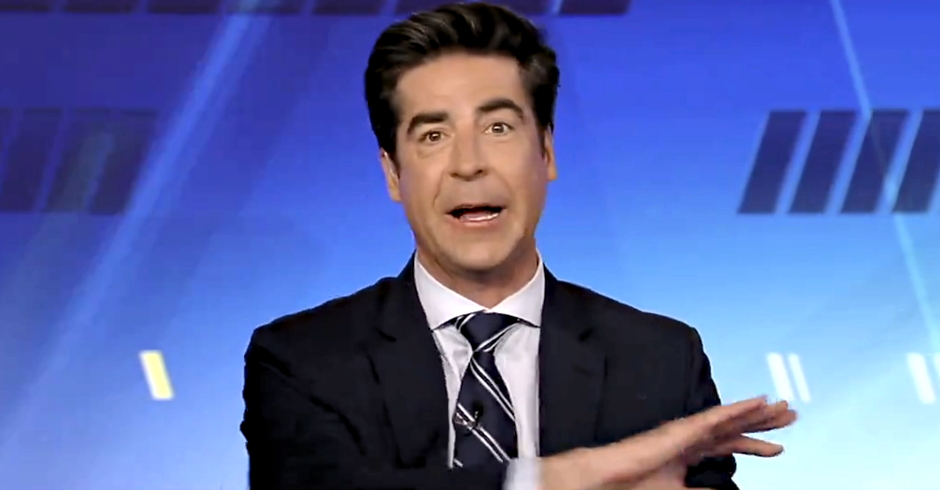
The Fox News host who targeted a juror serving on Donald Trump’s criminal New York trial is now suggesting the ex-president should violate his gag order and “force” the court to throw him in jail, by quoting the Fox News host.
Jesse Watters came under fire earlier this week for profiling juror number two, sharing possibly identifying information published by a myriad of reporters but then using that information to pass judgment on her ability to serve.
“I’m not so sure about juror number two,” Watters concluded on Fox News.
Jurors, at the judge’s direction, were to remain anonymous, for their protection and the protection of the trial.
The judge excused her, after she said she felt she was not able to be impartial because friends and family were calling her asking if she had been chosen to serve on the Trump trial, after the media blitz.
New York Supreme Court Judge Juan Merchan admonished the press for reporting the information, but some news outlets appeared to ignore his warning.
Watters on Wednesday “did a segment with a jury consultant, revealing details about people who had been seated on the jury and questioning whether some were ‘stealth liberals’ who would be out to convict Trump,” the Associated Press reported.
READ MORE: Gaetz: ‘Corrupt’ Republicans Could ‘Take a Bribe’ and Throw House to Dems, Blocking Trump Run
Trump later posted Watters’ quote on his Truth Social platform, leading some, including New York prosecutors, to ask the judge to cite him for allegedly breaking his gag order.
Judge Merchan ordered Trump to not mention witnesses, jurors, prosecutors, court staff, or the family members of prosecutors and court staff, CNN has reported.
New York prosecutors told Juge Merchan Trump has violated the gag order at least ten times.
“Prosecutor Christopher Conroy described the ‘most disturbing’ example as a social media message Trump posted on Wednesday evening quoting a Fox News host as saying, ‘They are catching undercover Liberal Activists lying to the Judge in order to get on the Trump Jury,'” Politico reports.
That host was Jesse Watters.
RELATED: ‘Afraid and Intimidated’: Trump Trial Juror Targeted by Fox News Dismissed
Friday afternoon, Watters appeared to egg Trump on, urging the ex-president to violate the gag order.
“I would make them put me in jail,” Watters said on Fox News. “I would have a tweet about something perhaps I said on ‘The Five’ or ‘Jesse Watters Primetime,’ and I would force them to throw me in jail.”
Watch Watters’ remark below or at this link.
Watters floating the suggestion that Trump should force the court to throw him in jail by posting statements made by Watters on Fox pic.twitter.com/9FYXtLr4uw
— Acyn (@Acyn) April 19, 2024
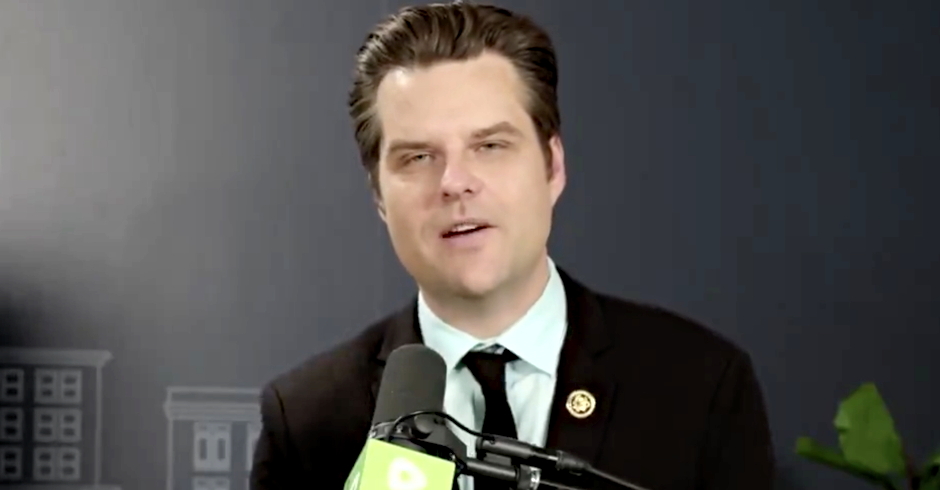
U.S. Rep. Matt Gaetz (R-FL) says some of his fellow House Republicans would “take a bribe” to throw the razor-thin GOP majority to the Democrats if a far-right faction calls up a motion to oust Speaker of the House Mike Johnson, allowing Democrats to hand the gavel to the Minority Leader, Hakeem Jeffries. he warned if that happens, Democrats would immediately declare Trump ineligible to be President, pack the U.S. Supreme Court, and pass numerous laws like the American Rescue Plan.
“I do believe in a one seat majority there could be one or two or three of my colleagues who would take a bribe in one form or another in order to deprive the Republicans of a majority at all,” Gaetz said Friday on his podcast (video below.)
He added, “the risk that one or two of my corrupt Republican colleagues might take a bribe, take a walk, feign an ailment and flip this thing to the Democrats is a risk that is too high for me at this time.”
Gaetz’s fellow far-right Florida Republican member of Congress, Anna Paulina Luna, told listeners, “I heard that when, if and when the motion vacate is introduced, that there will be immediate resignations of a couple of more moderate members of Congress. And in the event that that happens, that ultimately means it does go to a Democrat speaker.”
RELATED: Jeffries Vows Democrats Will Ensure Ukraine Aid Passes as Johnson Defectors Grow
U.S. Rep. Marjorie Taylor Greene (R-GA) last month filed a “motion to vacate,” which she can use at any time to force a vote to oust the GOP Speaker, Mike Johnson. U.S. Rep. Tim Massie (R-KY) and just today, U.S. Rep. Paul Gosar (R-AZ) has signed on as co-sponsors.
Congressman Gaetz told listeners if Democrats do take the House through a force vote to remove Johnson, Democrats would “be declaring Donald Trump an insurrectionist and setting up a barrier to him being able to become the president United States.”
“That’ll be their leadoff hitter, and then the chaser to that shot will be a massive spending package that looks a lot more like the American Rescue Plan. They will blow past every concept of every cap ever imagined. You’ll be looking at Universal Basic Income, you could be looking at packing the Supreme Court.”
Watch a short clip of Gaetz’s remarks below or at this link.
Gaetz says that he thinks that at least 1-3 of his “corrupt Republican colleagues” will take a bribe and vote for Hakeem Jeffries once a motion to vacate is successful. pic.twitter.com/cT7XlW7rkj
— Ron Filipkowski (@RonFilipkowski) April 19, 2024
READ MORE: ‘Stop Bringing Up Nazis and Hitler’: Marjorie Taylor Greene Smacked Down by Democrats
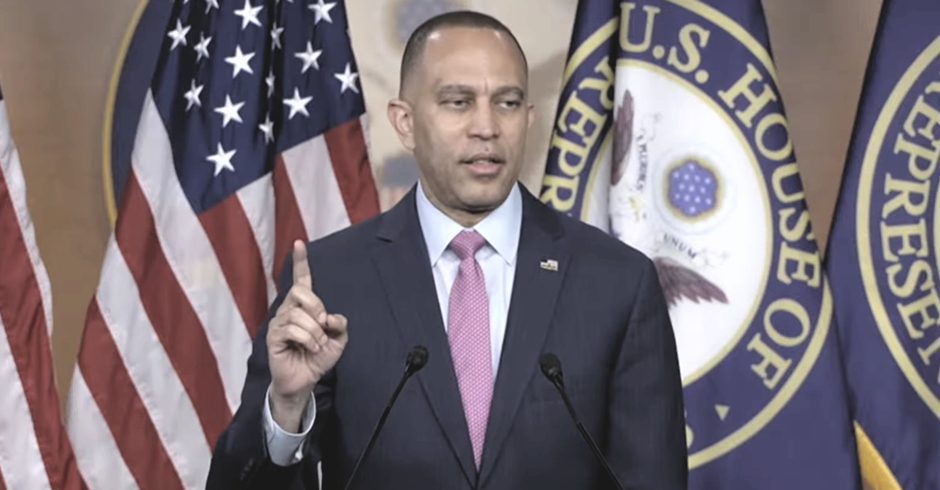
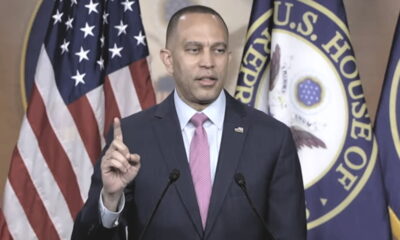
Democratic House Minority Leader Hakeem Jeffries vowed Friday the majority of Democrats will support Republicans’ Ukraine, Israel, Taiwan, and Gaza foreign aid legislation as Republican Speaker Mike Johnson lost support of another member of his conference to a faction determined to oust him.
“Democrats will provide a majority of our majority as it relates to funding Israel, humanitarian assistance, Ukraine, and our allies in the Indo Pacific,” Minority Leader Jeffries said. “It remains to be seen what Republicans will do in terms of meeting the national security needs of the American people, but it was important for House Democrats to ensure that the national security bills are going to be considered.”
“Democrats will provide a majority of our majority as it relates to funding Israel, humanitarian assistance, Ukraine, and our allies in the Indo Pacific.”
— House Minority Leader Hakeem Jeffries (D-NY), ahead of Saturday vote on foreign aid bills pic.twitter.com/aAfqOlEC5h
— The Recount (@therecount) April 19, 2024
Despite Republicans having a one-vote majority, more Democrats on Friday voted to move the critical and long-awaited foreign aid bills forward than did Republicans.
READ MORE: ‘Stop Bringing Up Nazis and Hitler’: Marjorie Taylor Greene Smacked Down by Democrats
The 316-94 vote included 165 Democrats and 151 Republicans voting yes, and 55 Republicans and 39 Democrats voting no.
Axios’ Juliegrace Brufke posted the list of Republicans voting against their party’s legislation.
Republicans who voted against the rule pic.twitter.com/M9MI8BZc5D
— Juliegrace Brufke (@juliegraceb) April 19, 2024
Calling it a “rare” moment in modern congressional history to have to rely on opposition party votes to pass legislation, BBC News reports Speaker Johnson’s “hold on power is tenuous, and the legislators who oppose him – and his bid to provide aid to Ukraine – occupy some key positions within the House’s power structure.”
Amid the procedural vote to move the foreign aid funding bills forward, U.S. Rep. Paul Gosar, a far-right Republican of Arizona, announced he is joining Congresswoman Marjorie Taylor Greene (R-GA), and Congressman Tim Massie (R-KY) in formally announcing their will vote to oust Speaker Johnson.
Gosar, like Greene, is reportedly a Christian nationalist. In 2022 CNN reported his “lengthy ties to White nationalists, [a] pro-Nazi blogger and far-right fringe received little pushback for years.”
RELATED: ‘Repercussions’: Democrats and Republicans Stand Against ‘Pro-Putin’ House GOP Faction
“We’ve been very honest in our assessment of the situation from the beginning,” Jeffries on Friday also declared. “At the appropriate time as House Democrats, we will have a conversation about how to deal with any hypothetical motion to vacate.”
“Moscow Marjorie Taylor Greene, Massie, and Gosar are quite a group. But central to our conversation is to make sure that the national security legislation in totality is passed by the House of Representatives.”
“At the appropriate time as House Democrats, we will have a conversation about how to deal with any hypothetical motion to vacate. … Moscow Marjorie Taylor Greene, [Thomas] Massie, and [Paul] Gosar are quite a group.”
— House Minority Leader Hakeem Jeffries (D-NY) pic.twitter.com/HbkhiNlQCZ
— The Recount (@therecount) April 19, 2024
Watch the videos above or at this link.

Jeffries Vows Democrats Will Ensure Ukraine Aid Passes as Johnson Defectors Grow

Biden Amps Up Field Offices, Trump to Mobilize Thousands of Lawyers to Monitor Vote Counts

Gaetz: ‘Corrupt’ Republicans Could ‘Take a Bribe’ and Throw House to Dems, Blocking Trump Run

Fox News Host Suggests Trump ‘Force’ Court to Throw Him in Jail – by Quoting Him
Fox News Host Suggests Trump ‘Force’ Court to Throw Him in Jail – by Quoting Him
Gaetz: ‘Corrupt’ Republicans Could ‘Take a Bribe’ and Throw House to Dems, Blocking Trump Run
Jeffries Vows Democrats Will Ensure Ukraine Aid Passes as Johnson Defectors Grow
Biden Amps Up Field Offices, Trump to Mobilize Thousands of Lawyers to Monitor Vote Counts

‘Repercussions’: Democrats and Republicans Stand Against ‘Pro-Putin’ House GOP Faction
 OPINION2 days ago
‘Stop Bringing Up Nazis and Hitler’: Marjorie Taylor Greene Smacked Down by Democrats
 OPINION2 days ago
‘Big Journalism Fail’: Mainstream Media Blasted Over Coverage of Historic Trump Trial
 News2 days ago
‘Used by the Russians’: Moskowitz Mocks Comer’s Biden Impeachment Failure
- News1 day ago
‘Repercussions’: Democrats and Republicans Stand Against ‘Pro-Putin’ House GOP Faction
- News1 day ago
‘Afraid and Intimidated’: Trump Trial Juror Targeted by Fox News Dismissed
 OPINION1 day ago
Marjorie Taylor Greene, ‘Putin’s Envoy’? Democrat’s Bills Mock Republican’s Actions
 News1 day ago
‘They Want Russia to Win So Badly’: GOP Congressman Blasts Far-Right House Republicans
 News9 hours ago
Jeffries Vows Democrats Will Ensure Ukraine Aid Passes as Johnson Defectors Grow