Fighting DOMA, Edie Windsor Now Takes Her Case To The Supreme Court
Edie Windsor, fresh off the heels of a federal district court win, is now petitioning the U.S. Supreme Court to rule on her case that has already found DOMA to be unconstitutional. Windsor, now 83, is working with the American Civil Liberties Union (ACLU).
READ: DOMA Ruled ‘Unconstitutional’ In Lesbian Estate Tax Case
In 2007, New York resident Edie Windsor married her partner of more than 40 years, Thea Spyer, in Canada, and when Spyer died, was forced by the U.S. Government to pay over $353,053 tax in federal estate taxes, merely because the U.S. Government — because of DOMA — in not allowed to recognize her marriage.
Windsor, in Windsor v. United States, won her case and the government was directed to refund her $363,000.
The Huffington Post reports that today, “lawyers filed a petition on behalf of Edith ‘Edie’ Windsor, an 83-year-old lesbian from New York, asking the Supreme Court to review her case, thus bypassing a second round in the 2nd Circuit Court of Appeals, where the case is scheduled to appear next.
Earlier this month, the Obama administration asked the high court to review two other cases challenging DOMA’s constitutionality. With Windsor’s petition, there are now three cases, from three of the most significant gay marriage states, that could challenge DOMA at the Supreme Court as early as next spring, if the court consents to hear them.
…
On the phone Monday, Windsor told The Huffington Post that she never dreamed her lawsuit would get this far. At family breakfasts, Windsor said, two 10-year-old cousins have started asking her every morning, “Is it in the Supreme Court?”
“I tell them, ‘We don’t know yet. Not today. But we hope we will be there, and I’ll let you know when,'” Windsor said.
When U.S. District Court Judge Barbara Jones ruled in Windsor’s favor last month, Windsor said she walked around, looking at all the photographs of Spyer displayed on the walls of her New York home.
Windsor said she was thrilled about how wide-reaching the implications of her case could be for other same-sex couples. But her first reaction was, “I need to tell Thea immediately,” she recalled. “So I walked around, looking at the pictures and I said, ‘Oh honey, look what’s happening.'”
Noting that the ACLU “has struck out in a different direction from the Obama Administration on a key question of legal strategy,” Chris Geidner, writing at Buzzfeed, today in a lengthy examination, adds:
In today’s filing, the ACLU argues that the case presents “a question of exceptional national importance,†stating, “DOMA has been held unconstitutional by federal courts in three circuits. The Government has declined to defend its constitutionality, but continues to enforce the statute pending resolution by this Court. Thus, individuals like [Windsor] continue to suffer serious consequences from the Government’s failure to recognize their lawfully solemnized marriages.â€
…
The House Republican leadership-controlled Bipartisan Legal Advisory Group and the Department of Justice already have weighed in asking the court to take two other cases challenging the constitutionality of DOMA. The House GOP leadership has been defending DOMA’s constitutionality since the Obama Administration stopped defending the law’s federal marriage definition in February of 2011.
Today, Windsor’s lawyers are telling the Supreme Court that her case is the one the court should take. As the Obama Administration did earlier this month in another DOMA challenge, the ACLU is asking the Supreme Court to take the unusual step of hearing the case before a federal appeals court rules on it.
…
Joined by a high-powered law firm – the lead lawyer for the ACLU’s case is Roberta Kaplan, a partner at Paul, Weiss, Rifkind, Wharton & Garrison – and one of the leading liberal law professors in the country, Stanford Law School’s Pam Karlan, the ACLU is pressing the argument that Windsor’s challenge “presents an excellent vehicle†for deciding DOMA’s constitutionality.
The main reason for this, the ACLU’s legal team argues, is that the GOP leaders “acknowledged that [Windsor] ‘has submitted documents that, if accurate, establish … the estate would not have been liable for federal estate tax, if Spyer had been married to a surviving male U.S. citizen at the time of her death.’†In other words, the Republican filing acknowledged that, without DOMA, Windsor wouldn’t have owed taxes and there would have been no case.
…
A week before the ruling in Windsor’s case, the First Circuit Court of Appeals in Boston held that DOMA was unconstitutional in another pair of challenges to the law, brought by Gay & Lesbian Advocates & Defenders and Massachusetts Attorney General Martha Coakley (D), and involving several couples challenging the law. And a California judge struck down the law earlier this year in a case brought by an employee of the federal courts, Karen Golinski, who was denied spousal health insurance benefits for her wife. Golinski’s case, brought by Lambda Legal, is now on appeal before the Ninth Circuit Court of Appeals.
Â
Video of Edie Windsor discussing her court win in June:
https://youtube.com/watch?v=ashwGjJQASA%3Fversion%3D3%26hl%3Den_US

Enjoy this piece?
… then let us make a small request. The New Civil Rights Movement depends on readers like you to meet our ongoing expenses and continue producing quality progressive journalism. Three Silicon Valley giants consume 70 percent of all online advertising dollars, so we need your help to continue doing what we do.
NCRM is independent. You won’t find mainstream media bias here. From unflinching coverage of religious extremism, to spotlighting efforts to roll back our rights, NCRM continues to speak truth to power. America needs independent voices like NCRM to be sure no one is forgotten.
Every reader contribution, whatever the amount, makes a tremendous difference. Help ensure NCRM remains independent long into the future. Support progressive journalism with a one-time contribution to NCRM, or click here to become a subscriber. Thank you. Click here to donate by check.
 |

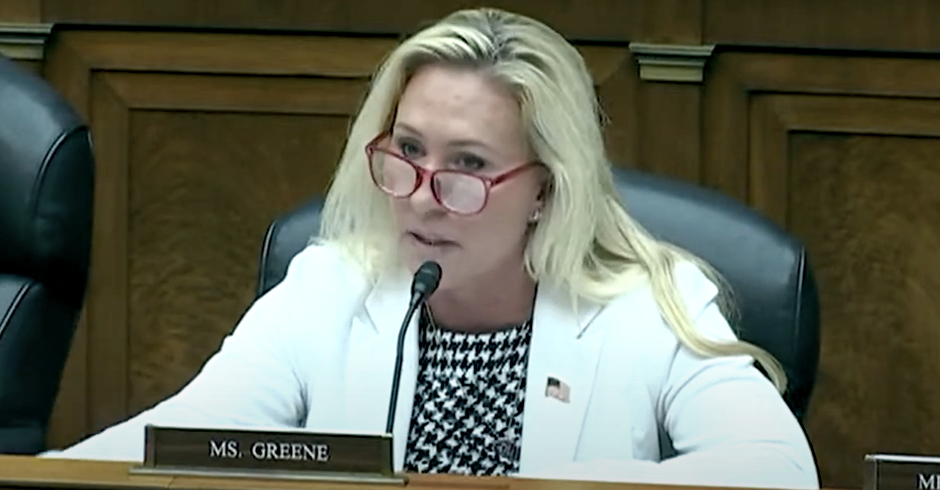
Some House Democrats and House Republicans are coming together toward a common opponent: far-right “pro-Putin” hardliners in the House Republican conference, who appear to be led by U.S. Rep. Marjorie Taylor Greene (R-GA).
Congresswoman Greene has been threatening to oust the Republican Speaker of the House, Mike Johnson. Last month she filed a “motion to vacate the chair.” If she chooses to call it up she could force a vote on the House floor to try to remove Speaker Johnson.
House Democrats say they are willing to vote against ousting Johnson, as long as the Speaker puts on the floor desperately needed and long-awaited legislation to fund aid to Ukraine and Israel. Johnson has refused to put the Ukraine aid bill on the floor for months, but after Iran attacked Israel Johnson switched gears. Almost all Democrats and a seemingly large number of Republicans want to pass the Ukraine and Israel aid packages.
RELATED: Marjorie Taylor Greene, ‘Putin’s Envoy’? Democrat’s Bills Mock Republican’s Actions
Forgoing the possibility of installing Democratic House Minority Leader Hakeem Jeffries as Speaker, which is conceivable given Johnson’s now one-vote majority, Democrats say if Johnson does the right thing, they will throw him their support.
“I think he’ll be in good shape,” to get Democrats to support him, if he puts the Ukraine aid bill on the floor, U.S. Rep. Raja Krishnamoorthi (D-IL) told CNN Thursday. “I would say that there’s a lot of support for the underlying bills. I think those are vital.”
“If these bills were delivered favorably, and the aid was favorably voted upon, and Marjorie Taylor Greene went up there with a motion to remove him, for instance, I think there’s gonna be a lot of Democrats that move to kill that motion,” Congressman Krishnamoorthi said. “They don’t want to see him getting punished for doing the right thing.”
“If these bills were delivered favorably and the aid was favorably vote upon and Marjorie Taylor Greene went up there with a motion to remove [Johnson]…I think there’s gonna be a lot of Democrats that move to kill that motion…”
Rep. Raja Krishnamoorthi joins @Boris_Sanchez. pic.twitter.com/WAAEZ07gUC
— CNN News Central (@NewsCentralCNN) April 18, 2024
“I think it is a very bad policy of the House to allow one individual such as Marjorie Taylor Greene, who is an arsonist to this House of Representatives,” U.S. Rep. Dan Goldman (D-NY) told CBS News’ Scott MacFarlane, when asked about intervening to save Johnson. He added he doesn’t want her “to have so much influence.”
U.S. Rep. Anthony D’Esposito, one of several Republicans who won their New York districts in 2022, districts that were previously held by Democrats, opposes Greene’s motion to vacate – although he praised the Georgia GOP congresswoman.
Rep. D’Esposito who represents a district that Biden won: Marjorie Taylor Greene, I respect her, she works hard for her district pic.twitter.com/TrfIcAQ8J5
— Acyn (@Acyn) April 18, 2024
CNN’s Manu Raju reports Republicans “say it’s time to marginalize hardliners blocking [their] agenda.”
D’Esposito, speaking to Raju, called for “repercussions for those who completely alienate the will of the conference. The people gave us the majority because they wanted Republicans to govern.”
U.S. Rep. Mike Lawler, like D’Esposito is another New York Republican who won a previously Democratic seat in 2022. Lawler spoke out against the co-sponsor of Greene’s motion to vacate, U.S. Rep. Tim Massie (R-KY), along with two other House Republicans who are working to block the Ukraine aid bill via their powerful seats on the Rules Committee.
Rs say it’s time to marginalize hardliners blocking agenda
GOP Rep. Mike Lawler says three Rs on Rules — Roy, Norman and Massie — should be “removed” if they don’t advance conference’s position.
D’Esposito calls for “repercussions”
Bacon backs changing motion-to-vacate rule pic.twitter.com/KS8cnuIY5I— Manu Raju (@mkraju) April 18, 2024
U.S. Rep. Mikie Sherrill (D-NJ), a former Navy pilot, blasted Congresswoman Greene.
RELATED: ‘They Want Russia to Win So Badly’: GOP Congressman Blasts Far-Right House Republicans
“Time is of the essence” for Ukraine, Rep. Sherrill told CNN Wednesday night. “The least we can do is support our Democratic allies, especially given what we know Putin to do. To watch a report and to think there are people like Marjorie Taylor Greene on the right that are pro-Putin? That are pro-Russia? It is really shocking.”
Ukraine needs our support to fight back against Putin.
They’re about to be at a 10-1 artillery disadvantage.
Marjorie Taylor Greene and her pro-Putin colleagues are sabotaging our national security and democracy worldwide. pic.twitter.com/EPBSk0Z8YV
— Rep. Mikie Sherrill (@RepSherrill) April 18, 2024
U.S. Rep. Dan Crenshaw (R-TX), as NCRM reported Thursday, had denounced Greene.
“I guess their reasoning is they want Russia to win so badly that they want to oust the Speaker over it,” he said, referring to the Ukraine aid bill Greene and her cohorts want to tank. “I mean that’s a strange position to take.”
The far-right hardliners are also causing chaos in the House.
“Things just got very heated on the House floor,” NBC News’ Julie Tsirkin reported earlier Thursday. “Group of hardliners were trying to pressure Johnson to only put Israel aid on the floor and hold Ukraine aid until the Senate passed HR2.”
HR2 is the House Republicans’ extremist anti-immigrant legislation that has n o chance of passage in the Senate nor would it be signed into law by President Biden.
“Johnson said he couldn’t do it, and [U.S. Rep. Derrick] Van Orden,” a far-right Republican from Wisconsin “called him ‘tubby’ and vowed to bring on the MTV [Motion to Vacate.]”
“No one in the group (Gaetz, Boebert, Burchett, Higgins, Donalds et al.) were threatening Johnson with an MTV,” Tsirkin added. “Van Orden seemed to escalate things dramatically…”
Despite Greene’s pro-Putin and anti-Ukraine positions, her falsehoods about “Ukrainian Nazis,” and Russians not slaughtering Ukrainian clergy, reporters continue to “swarm”:
A photo by CBS News’ @MacFarlaneNews captures the swarm of press around Rep. Marjorie Taylor Greene (R-GA) as she spoke on the steps of the U.S. Capitol Thursday morning.
Greene’s threat to oust House Speaker Mike Johnson gained momentum this week as another Republican, Rep.… pic.twitter.com/nDjKTGR0ZN
— CBS News (@CBSNews) April 18, 2024
Watch the videos above or at this link.
READ MORE: ‘Afraid and Intimidated’: Trump Trial Juror Targeted by Fox News Dismissed

A sitting Republican Congressman is harshly criticizing far-right House Republicans over their apparent support of Russia.
“I guess their reasoning is they want Russia to win so badly that they want to oust the Speaker over it. I mean that’s a strange position to take,” U.S. Rep. Dan Crenshaw, a three-term Texas Republican rated a hard-core conservative told CNN’s Manu Raju, in video posted Thursday. “I think they want to be in the minority too. I think that’s an obvious reality.”
Congressman Crenshaw was referring to the movement led by U.S. Rep. Marjorie Taylor Greene (R-GA), now joined by U.S. Rep. Thomas Massie (R-KY), over the Republican Speaker of the House Mike Johnson’s decision to finally put legislation on the floor to provide funding to Ukraine to support that sovereign nation in its fight against Russia.
“I’m still trying to process all the b*llsh*t,” Crenshaw added.
Crenshaw on Thursday also commented on Speaker Johnson’s remarks, stating he will hold the Ukraine funding vote regardless of attempts to oust him over it.
“To be clear, he’s being threatened for even allowing a vote to come to the floor. For allowing the constitutional process to play out as intended by our Founders. That’s a wild thing to consider, especially when his enemies consider themselves ‘conservative.’ Not conserving the painstaking constitutional process our Founders created, that’s for sure. Conserving Putin’s gains on the battlefield, more like it.”
Journalist Brian Beutler, a former editor-in-chief at Crooked Media, called it, “darkly funny to me that a pincer movement of MAGAns and leftists mock liberals for claiming the GOP works hand in glove with Russia, and then multiple conservative Republican dissenters are like ‘no it’s true, we’re lousy with Russian influence.'”
Watch Crenshaw’s remarks below or at this link.
GOP Rep. Dan Crenshaw on threats to oust Johnson: “I guess their reasoning is they want Russia to win so badly that they want to oust the speaker over it. I mean that’s a strange position to take… I think they want to be in the minority too. I think that’s an obvious reality.” pic.twitter.com/aPDGrgAGPm
— Manu Raju (@mkraju) April 18, 2024
READ MORE: Marjorie Taylor Greene, ‘Putin’s Envoy’? Democrat’s Bills Mock Republican’s Actions
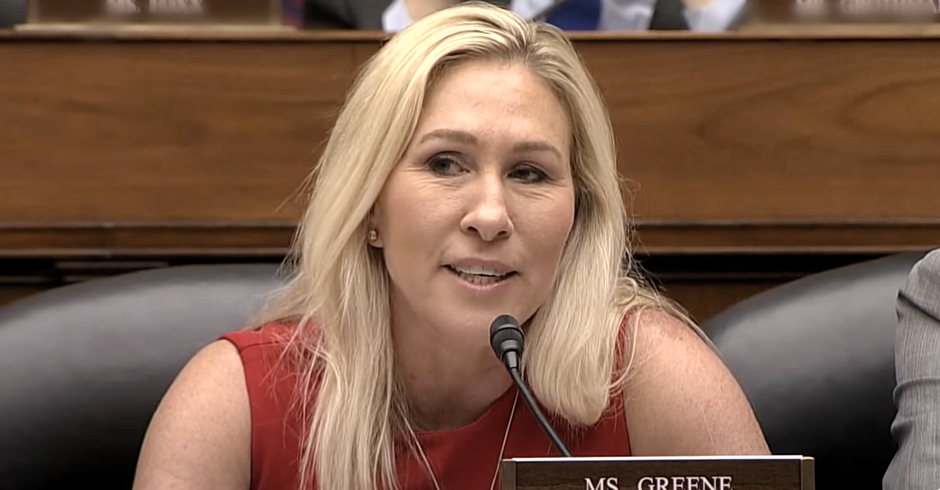
For years U.S. Rep. Marjorie Taylor Greene (R-GA) has been called “Pro-Putin.” As far back as 2021, her first year as a member of Congress, the question had been raised on social media: “Is Marjorie Taylor Greene a Russian asset?”
In 2022 The Annenberg Public Policy Center’s FactCheck.org reported: “Marjorie Taylor Greene Parrots Russian Talking Point on Ukraine.”
Back then, as the article highlighted, Greene had said, “there is no doubt that [Russian President Vladimir] Putin’s actions in Ukraine are despicable and evil.”
Now, she promotes a far more favorable view of President Vladimir Putin and his illegal war against Ukraine, a sovereign nation which the Russian autocrat wants to incorporate – at least partly – into Russia.
Just last week Greene spread demonstrably false pro-Russia talking points about a “war on Christianity” while defending and promoting President Vladimir Putin.
READ MORE: ‘Afraid and Intimidated’: Trump Trial Juror Targeted by Fox News Dismissed
“This is a war on Christianity,” Greene told far-right propagandist Steve Bannon. “The Ukrainian government is attacking Christians, the Ukrainian government is executing priests. Russia is not doing that.”
That’s just plain false, as NCRM reported.
Largely in response to her strong opposition to the U.S. supporting Ukraine, and her spreading Russian disinformation and flat-out pro-Putin falsehoods, Greene’s fondness for Putin and Russia has been making headlines.
“Republicans Who Like Putin,” was the headline last month at The New York Times, which observed: “A few Republicans have gone so far as [to] speak about Ukraine and its president, Volodymyr Zelensky, in ways that mimic Russian propaganda. Representative Marjorie Taylor Greene has accused Ukraine of having ‘a Nazi army,’ echoing language Putin used to justify the invasion.”
“The Putin Republicans Have the Upper Hand” warned Washington Monthly‘s David Atkins on Wednesday, reporting on “conservative extremists led by Representative Marjorie Taylor Greene.”
“They admire the strongman as a Christian nationalist leader, and won’t support Ukraine. The global consequences of their besotted love affair with the Russian strongman could be cataclysmic.”
“Russia Is Buying Politicians in Europe. Is It Happening Here Too?” The New Republic‘s Alex Finley wrote last week. The photo at the top of the page? Marjorie Taylor Greene.
READ MORE: ‘Used by the Russians’: Moskowitz Mocks Comer’s Biden Impeachment Failure
Finley pointed to Greene’s interview with Bannon, “about Ukraine’s persecution of Christians, which is a Kremlin talking point aimed at boosting the pro-Moscow wing of Ukraine’s Orthodox Church. The U.S. should be spending money on the border with Mexico, not on Ukraine aid? That’s a Kremlin talking point. Russia invaded Ukraine to defend itself against an expanding NATO? That’s a Kremlin talking point. Call for a cease-fire, and give Russia Crimea and eastern Ukraine? That’s a Kremlin talking point.”
Rupert Murdoch’s New York Post last week ran this headline: “Rep. Marjorie Taylor Greene says she ‘seriously hates’ people who support sending more aid to Ukraine: ‘Most repulsive, disgusting thing happening’.”
Then there is Greene’s obsession with Nazis. Specifically, equating Ukrainians with Nazis, which she did several times over the past week, including on Wednesday. That earned her the condemnation and wrath of U.S. Rep. Jared Moskowitz (D-FL), who demanded: “Stop bringing up Nazis and Hitler.”
Wednesday night, Congressman Moskowitz, known for his use of humor and sarcasm to make his points, declared: “Just submitted an amendment to Bill drafting appointing MTG [Marjorie Taylor Greene] as Putin’s Special Envoy to the United States Congress.”
Moskowitz’s amendment was in response to Congresswoman Greene’s amendments requiring members to “conscript in the Ukrainian military” if they vote for the Ukraine military funding bill, as Juliegrace Brufke reported.
READ MORE: ‘Big Journalism Fail’: Mainstream Media Blasted Over Coverage of Historic Trump Trial
The Florida Democrat wasn’t joking, as Axios’ Andrew Solender pointed out Thursday morning.
He actually did it https://t.co/i5C28l9Kb9 pic.twitter.com/LotBrLNzZI
— Andrew Solender (@AndrewSolender) April 18, 2024
Moskowitz did not stop there.
He drafted legislation on Thursday to name the Capitol Hill offices occupied by Congresswoman Greene after the British Prime Minister Neville Chamberlain, infamous for promoting appeasement in dealing with Adolf Hitler.
Chamberlain also signed the Munich Agreement, which allowed Hitler to annex part of Czechoslovakia.
Big day for British history references on Capitol Hill as @JaredEMoskowitz has proposed renaming Marjorie Taylor Greene’s office after Neville Chamberlain pic.twitter.com/VVfZySblHz
— Ben Jacobs (@Bencjacobs) April 18, 2024
See the social media posts above or at this link.

‘Afraid and Intimidated’: Trump Trial Juror Targeted by Fox News Dismissed

Marjorie Taylor Greene, ‘Putin’s Envoy’? Democrat’s Bills Mock Republican’s Actions

‘They Want Russia to Win So Badly’: GOP Congressman Blasts Far-Right House Republicans

‘Repercussions’: Democrats and Republicans Stand Against ‘Pro-Putin’ House GOP Faction
‘Repercussions’: Democrats and Republicans Stand Against ‘Pro-Putin’ House GOP Faction
‘They Want Russia to Win So Badly’: GOP Congressman Blasts Far-Right House Republicans
Marjorie Taylor Greene, ‘Putin’s Envoy’? Democrat’s Bills Mock Republican’s Actions
‘Afraid and Intimidated’: Trump Trial Juror Targeted by Fox News Dismissed
‘Stop Bringing Up Nazis and Hitler’: Marjorie Taylor Greene Smacked Down by Democrats

 News2 days ago
‘Something’s Fishy Here’: Trump’s Latest $175 Million Bond Filings Questioned by Experts

 News2 days ago
‘I Have a Bucket of Water’: Dems to Save Johnson’s Job Over GOPer Who Wants ‘World to Burn’

 OPINION2 days ago
SCOTUS Justices Appear to Want to Toss Obstruction Charges Against Some J6 Defendants: Experts
 OPINION1 day ago
‘Big Journalism Fail’: Mainstream Media Blasted Over Coverage of Historic Trump Trial

 News1 day ago
‘Used by the Russians’: Moskowitz Mocks Comer’s Biden Impeachment Failure
 OPINION1 day ago
‘Stop Bringing Up Nazis and Hitler’: Marjorie Taylor Greene Smacked Down by Democrats
- News9 hours ago
‘Afraid and Intimidated’: Trump Trial Juror Targeted by Fox News Dismissed
 OPINION7 hours ago
Marjorie Taylor Greene, ‘Putin’s Envoy’? Democrat’s Bills Mock Republican’s Actions