Croatia President, Prime Minister Condemn Violence At Gay Pride Parade
Croatia’s President and Prime Minister condemned violence at a gay pride parade on Saturday, while a party leader pointed fingers at Roman Catholic priests’ messaging during the Pope’s recent visit as a catalyst for the violence against gays and lesbians and their allies.
Â
Just one day after the European Commission green lighted Croatia for European Union admission in 2013, violence marred Split, Croatia’s first LGBT Pride March, instigated by at least 4,000 to include as many as 10,000 violent protesters, who pounced upon 200 LGBT marchers by throwing fists, firecrackers, bottles and rocks, some wielded cigarette lighters, threw tomatoes and tear gas by a virulently anti-gay opposition, who came prepared to disrupt the first gay event in the notorious nationalist right-wing stronghold of 1,700-year old Split, Croatia.
Croatia’s President Ivo Josipovic condemned the violence and was joined by Prime Minister Jadranka Kosor, reports Radio Free Europe/Radio Liberty this morning, Josipovic, the first Croatian president to formally endorse nationanl gay pride and LGBT rights last year, said that Split protesters have “shown that there are some non-European parts of our society and that the violence in Split was “not Croatia’s real face.”
Prime Minister Jadranka Kosor warned that violence and hatred were “something that cannot be tolerated in Croatia.”
Last year, Josipovic became the first president in Croatian history to endorse and express his support for the national LGBT Pride celebration.
The Split-Dalmacia police department announced in a press conference following the Pride event that 137 persons were arrested, including 25 minors, and eight people required medical attention for injuries sustained, mostly members of the working, press, including a RTL cameraman, who suffered a concussion when hit with a brick and called a “Jew”.
[youtube http://www.youtube.com/watch?v=_IyxbrPqqmg&version=3&hl=en_US]
News organizations are also reporting this morning in Croatia Green Party leader AljoÅ¡a Babic is calling for the resignation of Tomislav Karamarko, the Minister of Internal Affairs, “because of the shameful conduct of police and security during Split Gay Pride.”
Babic added, “The Croatian tax payers do not pay the police to witness the scenes we’ve seen today in Split. [These] events are the result of recent homophobic statements which were communicated by priests during the recent visit of the Pope.”
UK Gay News reports several “Croatian bishops have condemned what they call “unnatural families,†their term for same-sex headed households.
Babic also criticized President Ivo Josipović and Prime Minister Jadranka Kosor for not condemning the Vatican’s homophobic messages which were reported by the media, according to Babic.
Croatia, a deeply devout Roman Catholic country has historically had a nearly symbiotic relationship with with the Church that dates back to its darkest chapter during World War II while under occupation by the German Third Reich. Cardinal Aloysius Stepinac, a known collaborator and supporter of the  “Ustashe,” a Croatian nationalist movement that served as brutal proxies for the Nazis. Despite his conviction for war crimes in 1946,  Stepanac was beatified by Pope John Paul II, putting him on th p ath to “sainthood” (more on the Ustashe later).
Aloysius Stepanac was convicted of war crimes in 1946 and served 16 years in prison at hard labor.
Also condeming the violence was Amnesty International, who was the first international human rights organization,who said the violence was unacceptable. “The Croatian authorities need to act to stop this happening in future,” said Nicola Duckworth, the human right group’s director for Europe and Central Asia, urging an immediate investigation and punishment for the attackers.
According to Pride organizers, the parade participants totalled 200 people, mostly from Split, who were supported by 30 marchers from Belgrade, Serbia; Ljubljana, Slovenia; the Netherlands, among other European cities.
With extensive police barricades in place along the parade route, police reportedly deployed 400 uniformed officers and unknown numbers of officers in plain clothes, although Croatian LGBT activists criticized the government agencies who were responsible for maintaining public safety.
Police in full-riot gear, were outmatched by thousands of full-throated opposition, many of whom screamed “kill the gays,” “kill the Serbs,” and “kill the gypsies,” repeatedly. Signs carried by LGBT activists said “Lesbians are okay,” Lesbians Against Fascism,” and “My Partner, My Lover,” among others were defiantly displayed by the small minority.
In a report by Croatian Nacional newspaper, Sanja Juras, of the Croatian Lesbian group, Kontra, addressed the audience from the rally stage near the Split waterfront and accused police of not adequately protecting the protesters, consequently people were injured.
“State institutions have not done their job properly, and today’s rally in Split reflects that LGBT rights are not  guaranteed legal rights in Croatia,” Juras said.
Also speaking at the rally were European Parliament member Marije Coruielssen of the Netherlands, a member of the Committee on Women’s Rights and Gender Equality, Linda Frieman, co-chair of the European division of the International Lesbian and Gay Association, LGBT activists from Slovenia, the first and only Former Yugoslav republic to have joined the EU and, activists from Serbia, another Balkan country which has experienced at least a decade of violence against LGBT human rights activists who have yet to march, without significant violence occurring in Belgrade.
READ: Belgrade Gay Pride Marchers Attacked By Violent Anti-Gay Demonstrators In Historic Parade
The violence against LGBT people in Split, Zagreb, Belgrade and Sarajevo did not manifest from a vacuum. Wars were fought three times during the 20th century in the Balkans which have planted seeds of deep emnity, transmitted intergenerationally by members of ethnic groups and religious faiths–leaving scars all around that remain tangible in the body politic and cultural memory.
Croatia fought two wars in the 1990s, led by extreme nationalist Franjo Tudjman, who merged his rule with an insurgent and nationalistic Roman Catholic Church, against former Yugoslavia, eventually securing independence from Belgrade, long imagined and sought for throughout the 20th century. Croatia fought a bloody war against Serbia, eventually repelling Serb forces who invaded Croatia in 1991.
Croatia later joined forces with the Bosnian Muslim-Croat Federation. who had declared independence from Belgrade in March 1992. Croatia and Bosnia jointly fought the Serbs who were pushed to stop the war by American diplomat Richard Holbrooke. The parties signed a peace agreement in Dayton, Ohio in 1995 . Many horrible war crimes, including genocide and crimes against humanity, rape, torture and enslavement, occurred during the course of these wars, committed disproportionately by Serbian, Bosnian Serb and Croatian military and paramilitary members, many of whom have been prosecuted by the International Criminal Tribunal of the Former Yugoslavia (ICTY).
READ: Bosnian Serb General to Stand Trial for Crimes Against Humanity
But the recent wars are emotionally layered and political charged by unresolved events that occurred during World War II. Croat nationalists established the Croat Revolutionary Movement, also known as the “Ustashe” who committed some of the worst excesses of World War II in its heinous and banal collaboration with Nazi Germany’s Third Reich. These sordid events transpired during the Axis Powers occupation and annexation of Croatia (including the Split area) and of Bosnia and Herzegovina as far east as Banja Luka, the present capital the Bosnian Serb entity.
According to many historical accounts, Archbishop Stepanac was a partner and collaborator with  the Ustashe government. He supported the Ustashi Government from the beginning until the end. Indeed, even after Ustashi Croatia collapsed following the disintegration of Nazi Germany. Stepinac was not only the Head of the Council of Croatian Bishops and of the committee which carried out a policy of forcible conversions, he was none other than the Supreme Military Apostolic Vicar of the Ustashi Army, which is a major symbol of the Roman Catholic Church.
When Ustashi Croatia fell in 1945 as a result of the defeat of Nazi Germany and Ante Pavelic, the leader of the government ran for his life, Archbishop Stepinac, in a futile effort to save the regime, succeeded him as leader of the Ustashi Croatia. Stepinac ordered special ceremonies in all the Catholic churches on Pavelic’s birthday, and he frequently invoked prayers for the Ustashi.
Marshall Tito, who led the Partisan communisist in a civil war against the Croats and the Serb Chetniks, of the Serbian Renewal Movement, eventually defeating both parties and supported efforts by Allied Forces who invaded Italy and drove the Nazis from the Balkans. Tito formed the Federal Socialist Republic of Yugoslavia that he governed until his death in 1980.
[youtube http://www.youtube.com/watch?v=yydmw-V3OxI&version=3&hl=en_US]
Since 1995, Croatia has been working its way toward achieving peace, interrupted at times on its path to Europe, which took a considerable leap when Tudjman died in 1999.  Through a series of good fortune and electing less nationalistic governments (although corruption remains an endemic problem for Croatia and throughout the region) that rid itself of the hardline political party Croatian Democratic Union and has worked assiduously during the past six years toward achieving required legal and financial reforms necessary for European Union accession.
EU accession requires the decriminalization of existing sodomy laws and adoption of anti-discrimination laws, including employment anti-discrimination protection. This leverage over the accession process has advanced LGBT organizing throughout hte Balkans to mitigated success.
But it has always been two steps forward, one step back for Croatia, whose efforts to arrest war criminals has been resisted by many in the populace, who view some of these generals as “heroes”. In April two former Croatian generals Ante Gotovina and Mladen Markac were sentenced for war crimes committed in 1995. Gotovina had been a fugitive for many years when he was arrested in Spain in 2006, although thousands turned out in Split in protest over his extradition to ICTY.
Thus last Friday, the European Commission President Jose Manuel Barroso announced that “today is a special day for Croatia and for the European Union.“ Barroso also said: “At this significant moment, I would like to applaud the Croatian authorities for their hard work over the last years. Even more importantly, I would like to congratulate the people of Croatia. Joining the EU family of nations is first and foremost your success!”
 Tanya L. Domi is an Adjunct Assistant Professor of International and Public Affairs at Columbia University, who teaches about human rights in Eurasia and is a Harriman Institute affiliated faculty member. Prior to teaching at Columbia, Domi worked internationally for more than a decade on issues related to democratic transitional development, including political and media development, human rights, gender issues, sex trafficking, and media freedom.

Enjoy this piece?
… then let us make a small request. The New Civil Rights Movement depends on readers like you to meet our ongoing expenses and continue producing quality progressive journalism. Three Silicon Valley giants consume 70 percent of all online advertising dollars, so we need your help to continue doing what we do.
NCRM is independent. You won’t find mainstream media bias here. From unflinching coverage of religious extremism, to spotlighting efforts to roll back our rights, NCRM continues to speak truth to power. America needs independent voices like NCRM to be sure no one is forgotten.
Every reader contribution, whatever the amount, makes a tremendous difference. Help ensure NCRM remains independent long into the future. Support progressive journalism with a one-time contribution to NCRM, or click here to become a subscriber. Thank you. Click here to donate by check.
 |

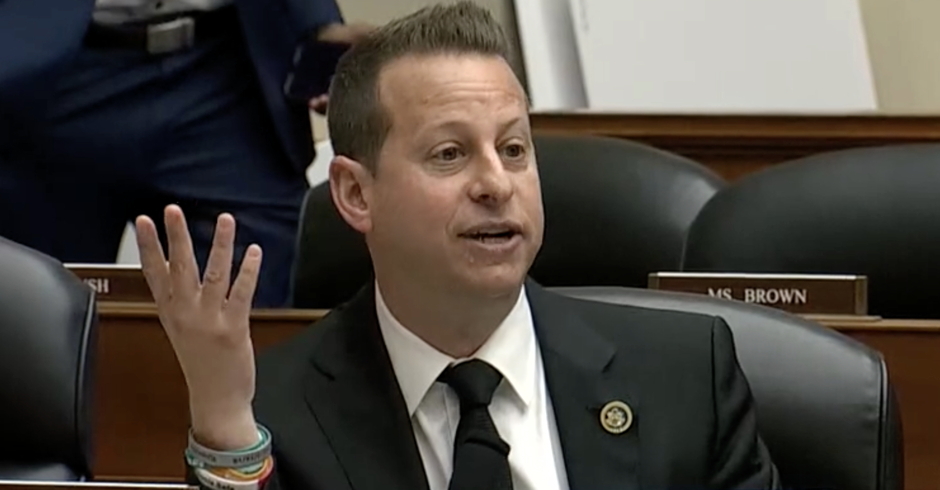
U.S. Rep. Jared Moskowitz (D-FL) is mocking House Oversight Committee Chairman Jim Comer over a CNN report revealing the embattled Kentucky Republican who has been alleging without proof President Joe Biden is the head of a vast multi-million dollar criminal bribery and influence-peddling conspiracy, has given up trying to impeach the leader of the free world.
CNN on Wednesday had reported, “after 15 months of coming up short in proving some of his biggest claims against the president, Comer recently approached one of his Republican colleagues and made a blunt admission: He was ready to be ‘done with’ the impeachment inquiry into Biden.” The news network described Chairman Comer as “frustrated” and his investigation as “at a dead end.”
One GOP lawmaker told CNN, “Comer is hoping Jesus comes so he can get out.”
“He is fed up,” the Republican added.
Despite the Chairman’s alleged remarks, “a House Oversight Committee spokesperson maintains that ‘the impeachment inquiry is ongoing and impeachment is 100% still on the table.'”
RELATED: ‘Used by the Russians’: Moskowitz Mocks Comer’s Biden Impeachment Failure
Last week, Oversight Committee Ranking Member Jamie Raskin (D-MD) got into a shouting match with Chairman Comer, with the Maryland Democrat saying, “You have not identified a single crime – what is the crime that you want to impeach Joe Biden for and keep this nonsense going?” and Comer replying, “You’re about to find out.”
Before those heated remarks, Congressman Raskin chided Comer, humorously threatening to invite Rep. Moskowitz to return to the hearing.
Congressman Moskowitz appears to be the only member of the House Oversight Committee who has ever made a motion to call for a vote on impeaching President Biden, which he did last month, although he did it to ridicule Chairman Comer.
Moskowitz: Make the motion to impeach President Biden. Go ahead…. No. Nothing. They’re never going to impeach him. It’s all fake. They’re lying to their base on Newsmax and Fox leading these people to believe that they’re going to impeach pic.twitter.com/WH375tkXtL
— Acyn (@Acyn) March 20, 2024
It appears the Moskowitz-Comer “bromance” may be over.
Wednesday afternoon Congressman Moskowitz, whose sarcasm is becoming well-known, used it to ridicule Chairman Comer.
“I was hoping our breakup would never become public,” he declared. “We had such a great thing while it lasted James. I will miss the time we spent together. I will miss our conversations. I will miss the pet names you gave me. I only wish you the best and hope you find happiness.”
Watch the video above or at this link.
READ MORE: ‘Doesn’t Care if Pregnant Women Live or Die’: Alito Slammed Over Emergency Abortion Remarks

The U.S. Supreme Court heard oral arguments in a case centered on the question, can the federal government require states with strict abortion bans to allow physicians to perform abortions in emergency situations, specifically when the woman’s health, but not her life, is in danger?
The 1986 federal Emergency Medical Treatment and Active Labor Act (EMTALA), signed into law by Republican President Ronald Reagan, says it can. The State of Idaho on Wednesday argued it cannot.
U.S. Solicitor General Elizabeth Prelogar, The Washington Post’s Kim Bellware reported, “made a clear delineation between Idaho law and what EMTALA provides.”
“In Idaho, doctors have to shut their eyes to everything except death,” Prelogar said, according to Bellware. “Whereas under EMTALA, you’re supposed to be thinking about things like, ‘Is she about to lose her fertility? Is her uterus going to become incredibly scarred because of the bleeding? Is she about to undergo the possibility of kidney failure?’ ”
READ MORE: Gag Order Breach? Trump Targeted Cohen in Taped Interview Hours Before Contempt Hearing
Attorney Imani Gandy, an award-winning journalist and Editor-at-Large for Rewire News Group, highlighted an issue central to the case.
“The issue of medical judgment vs. good faith judgment is a huge one because different states have different standards of judgment,” she writes. “If a doctor exercises their judgment, another doctor expert witness at trial could question that. That’s a BIG problem here. That’s why doctors are afraid to provide abortions. They may have an overzealous prosecutor come behind them and disagree.”
Right-wing Justice Samuel Alito appeared to draw the most fire from legal experts, as his questioning suggested “fetal personhood” should be the law, which it is not.
“Justice Alito is trying to import fetal personhood into federal statutory law by suggesting federal law might well prohibit hospitals from providing abortions as emergency stabilizing care,” observed Constitutional law professor Anthony Michael Kreis.
Paraphrasing Justice Alito, Kreis writes: “Alito: How can the federal government restrict what Idaho criminalizes simply because hospitals in Idaho have accepted federal funds?”
Appearing to answer that question, Georgia State University College of Law professor of law and Constitutional scholar Eric Segall wrote: “Our Constitution unequivocally allows the federal gov’t to offer the states money with conditions attached no matter how invasive b/c states can always say no. The conservative justices’ hostility to the spending power is based only on politics and values not text or history.”
Professor Segall also served up some of the strongest criticism of the right-wing justice.
READ MORE: ‘They Will Have Thugs?’: Lara Trump’s Claim RNC Will ‘Physically Handle the Ballots’ Stuns
He wrote that Justice Alito “is basically making it clear he doesn’t care if pregnant women live or die as long as the fetus lives.”
Earlier Wednesday morning Segall had issued a warning: “Trigger alert: In about 20 minutes several of the conservative justices are going to show very clearly that that they care much more about fetuses than women suffering major pregnancy complications which is their way of owning the libs which is grotesque.”
Later, predicting “Alito is going to dissent,” Segall wrote: “Alito is dripping arrogance and condescension…in a case involving life, death, and medical emergencies. He has no bottom.”
Taking a broader view of the case, NYU professor of law Melissa Murray issued a strong warning: “The EMTALA case, Moyle v. US, hasn’t received as much attention as the mifepristone case, but it is huge. Not only implicates access to emergency medical procedures (like abortion in cases of miscarriage), but the broader question of federal law supremacy.”
READ MORE: ‘Blood on Your Hands’: Tennessee Republicans OK Arming Teachers After Deadly School Shooting

Hours before his attorneys would mount a defense on Tuesday claiming he had not violated his gag order Donald Trump might have done just that in a 12-minute taped interview that morning, which did not air until later that day. It will be up to Judge Juan Merchan to make that decision, if prosecutors add it to their contempt request.
Prosecutors in Manhattan District Attorney Alvin Bragg’s office told Judge Juan Merchan that the ex-president violated the gag order ten times, via posts on his Truth Social platform, and are asking he be held in contempt. While the judge has yet to rule, he did not appear moved by their arguments. At one point, Judge Merchan told Trump’s lead lawyer Todd Blanche he was “losing all credibility” with the court.
And while Judge Merchan directed defense attorneys to provide a detailed timeline surrounding Trump’s Truth Social posts to prove he had not violated the gag order, Trump in an interview with a local television station appeared to have done so.
READ MORE: ‘They Will Have Thugs?’: Lara Trump’s Claim RNC Will ‘Physically Handle the Ballots’ Stuns
The gag order bars Trump from “commenting or causing others to comment on potential witnesses in the case, prospective jurors, court staff, lawyers in the district attorney’s office and the relatives of any counsel or court staffer, as CBS News reported.
“The threat is very real,” Judge Merchan wrote when he expanded the gag order. “Admonitions are not enough, nor is reliance on self-restraint. The average observer, must now, after hearing Defendant’s recent attacks, draw the conclusion that if they become involved in these proceedings, even tangentially, they should worry not only for themselves, but for their loved ones as well. Such concerns will undoubtedly interfere with the fair administration of justice and constitutes a direct attack on the Rule of Law itself.”
Tuesday morning, Trump told ABC Philadelphia’s Action News reporter Walter Perez, “Michael Cohen is a convicted liar. He’s got no credibility whatsoever.”
He repeated that Cohen is a “convicted liar,” and insisted he “was a lawyer for many people, not just me.”
READ MORE: ‘Old and Tired and Mad’: Trump’s Demeanor in Court Detailed by Rachel Maddow
Since Cohen is a witness in Trump’s New York criminal case, Judge Merchan might decide Trump’s remarks during that interview violated the gag order, if prosecutors bring the video to his attention.
Enter attorney George Conway, who has been attending Trump’s New York trial.
Conway reposted a clip of the video, tagged Manhattan District Attorney Bragg, writing: “cc: @ManhattanDA, for your proposed order to show cause why the defendant in 𝘗𝘦𝘰𝘱𝘭𝘦 𝘷. 𝘛𝘳𝘶𝘮𝘱 should not spend some quiet time in lockup.”
Trump has been criminally indicted in four separate cases and is facing a total of 88 felony charges, including 34 in this New York criminal trial for alleged falsification of business records to hide payments of “hush money” to an adult film actress and one other woman, in an alleged effort to suppress their stories and protect his 2016 presidential campaign, which experts say is election interference.
Watch the video below or at this link.
NEW: Trump’s Team let him do a lengthy interview with PA’s biggest TV station @6abc today.
It did not go well. In addition to some horrible abortion mansplaining, Trump:
– called the NY judge corrupt
– attacked witnesses personally
– committed to taking the stand at his trial pic.twitter.com/ePKckyQi76— J.J. Abbott 🦅 (@jjabbott) April 23, 2024
READ MORE: ‘Blood on Your Hands’: Tennessee Republicans OK Arming Teachers After Deadly School Shooting

‘They Will Have Thugs?’: Lara Trump’s Claim RNC Will ‘Physically Handle the Ballots’ Stuns

Gag Order Breach? Trump Targeted Cohen in Taped Interview Hours Before Contempt Hearing

‘Doesn’t Care if Pregnant Women Live or Die’: Alito Slammed Over Emergency Abortion Remarks

‘I Hope You Find Happiness’: Moskowitz Trolls Comer Over Impeachment Fail
‘I Hope You Find Happiness’: Moskowitz Trolls Comer Over Impeachment Fail
‘Doesn’t Care if Pregnant Women Live or Die’: Alito Slammed Over Emergency Abortion Remarks
Gag Order Breach? Trump Targeted Cohen in Taped Interview Hours Before Contempt Hearing
‘They Will Have Thugs?’: Lara Trump’s Claim RNC Will ‘Physically Handle the Ballots’ Stuns

‘Blood on Your Hands’: Tennessee Republicans OK Arming Teachers After Deadly School Shooting

 News3 days ago
‘Rally Behind MAGA’: Trump Advocates Courthouse ‘Protests’ Nationwide

 News2 days ago
‘I’m Not Suicidal’: Kari Lake Pushes Hillary Clinton Murder Conspiracy Theory

 News3 days ago
‘Old and Tired and Mad’: Trump’s Demeanor in Court Detailed by Rachel Maddow

 News3 days ago
‘Election Interference’ and ‘Corruption’: Experts Explain Trump Prosecution Opening Argument

 News2 days ago
‘Cutting Him to Shreds’: ‘Pissed’ Judge Tells Trump’s Attorney ‘You’re Losing All Credibility’
 News2 days ago
‘Blood on Your Hands’: Tennessee Republicans OK Arming Teachers After Deadly School Shooting
 News2 days ago
Biden Campaign Hammers Trump Over Infamous COVID Comment

 OPINION2 days ago
Trump Complains He’s ‘Not Allowed to Talk’ as He Gripes Live on Camera